
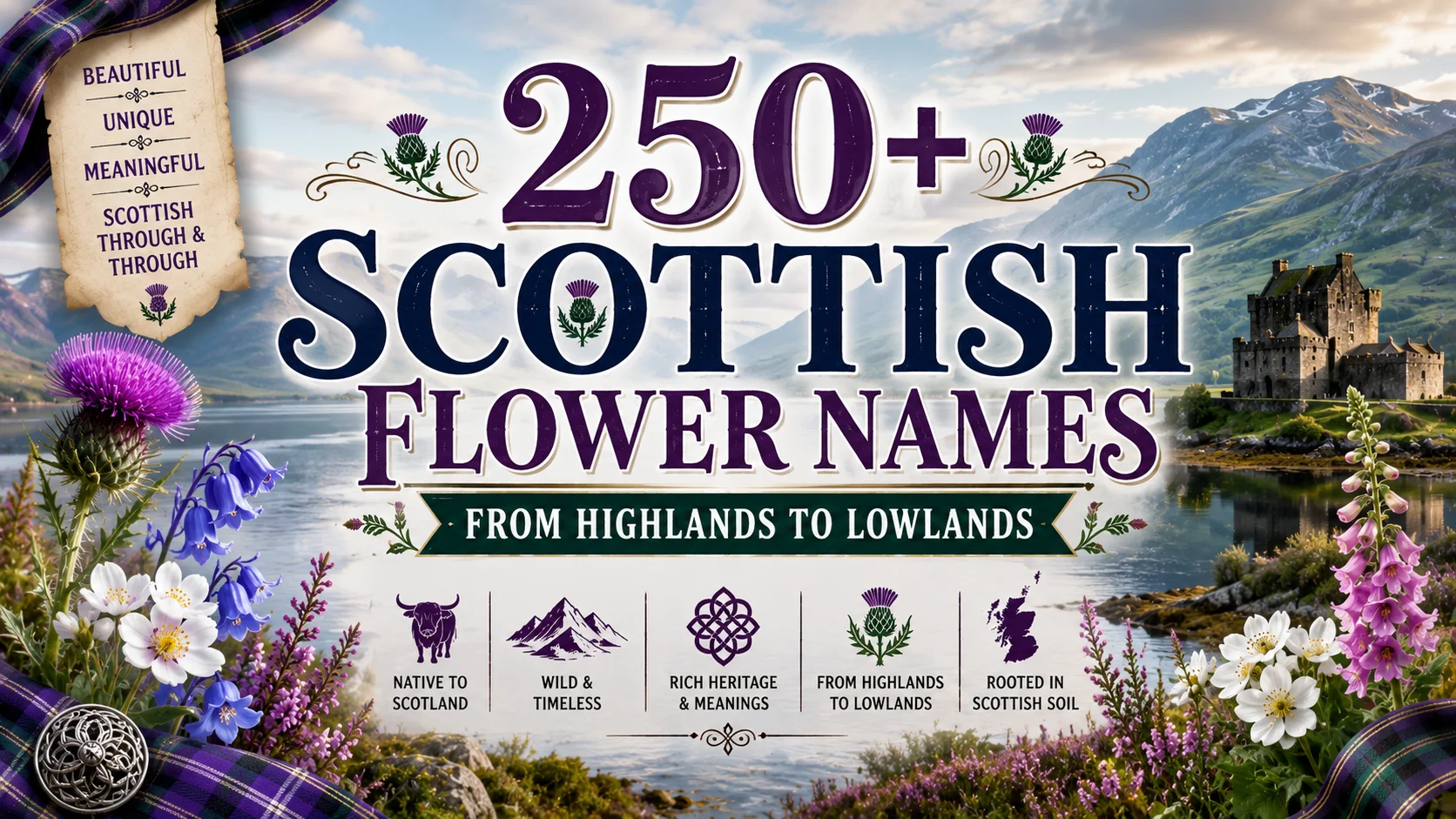
Scottish flower names carry the spirit of the rugged Highlands and misty glens. The country’s national emblem, the thistle, has been a symbol of Scotland for over 800 years. Some flowers are found nowhere else on Earth, such as the Scottish primrose. Others have fascinating Gaelic names passed down through generations. This article delivers over 250 Scottish flower names, from iconic blooms to rare mountain treasures. Skip the ordinary. Discover the flowers of Scotland.
The National Flower: Thistle
The thistle is Scotland’s national flower and one of its most recognisable symbols. Since King Alexander III, it has been Scotland’s national emblem. A legendary story attributes the thistle being chosen as the emblem to the Battle of Largs in the 13th century. A Norse army crept barefoot through the night to ambush sleeping Scottish clansmen. One stepped on a prickly thistle, cried out in pain, and roused the Scots to victory. The thistle symbolizes resilience and strength. The Order of the Thistle, founded in 1687, is the highest honour Scotland can bestow, with the motto “Nemo me impune lacessit” (No one provokes me with impunity). Silver coins issued by King James III in 1474 featured the thistle.
- Thistle
- Spear Thistle
- Cotton Thistle
- Musk Thistle
- Melancholy Thistle
- Our Lady’s Thistle
- Creeping Thistle
- Marsh Thistle
- Scotch Thistle
- Cirsium Vulgare
- Onopordum Acanthium
- Purple Thistle
- Pink Thistle
- Prickly Thistle
- Scottish National Emblem
- Highland Thistle
- Lowland Thistle
- Island Thistle
- Roadside Thistle
- Ditch Thistle
- Meadow Thistle
- Dry Field Thistle
- Coastal Thistle
- Wild Thistle
- Order Of The Thistle
Heather: The Iconic Highland Bloom
Heather is perhaps the most iconic Scottish flower, commonly found on moorlands, mountainsides, and in heathland areas. It blooms in shades of purple, pink, and occasionally white and is associated with good luck and protection. Heather covers most of Scotland’s dry open moorland in the west and north, as well as wetlands and forests. It blooms from July to September. White heather is considered “lucky Heather”. Three main types are found: Common Heather (Ling), Bell Heather, and Cross-leaved Bell Heath. These plants have fed, warmed, and sheltered the Scottish moors’ wildlife and people from time immemorial, contributing twigs for thatch, fuel for fire, and flavoring for ale.
- Common Heather
- Ling
- Bell Heather
- Cross Leaved Bell Heath
- Erica Cinerea
- Erica Tetralix
- Calluna Vulgaris
- Pink Heather
- Purple Heather
- White Heather
- Lucky Heather
- Moorland Heather
- Highland Heather
- Lowland Heather
- Island Heather
- Dwarf Heather
- Fine Leaved Bell Heath
- Scotch Heather
- Mountain Heather
- Dry Heath Heather
- Wet Heath Heather
- Woodland Heather
- Coastal Heather
- Summer Heather
- Late Summer Heather
Scottish Primrose: Scotland’s Unique Treasure
The Scottish primrose is found only in Scotland. Its Latin name is Primula scotia. These beautiful wildflowers are about the size of a thumbnail. They grow wild only in Caithness, Sutherland, and Orkney. They bloom from May to June. This plant is a “nationally scarce” find due to its very particular nature – it enjoys moist but well-draining soil, often sprouting in grasslands grazed just enough. Primroses in general thrive in Scotland, with a primula garden featuring many drumstick and candelabra primulas at Ardtornish Gardens in the West Highlands.
- Scottish Primrose
- Primula Scotia
- Caithness Primrose
- Sutherland Primrose
- Orkney Primrose
- Thumbnail Primrose
- Nationally Scarce Primrose
- May Bloom
- June Bloom
- Moist Soil Primrose
- Well Draining Primrose
- Grassland Primrose
- Highland Primrose
- Lowland Primrose
- Island Primrose
- Drumstick Primula
- Candelabra Primula
- Ardtornish Primrose
- West Highland Primrose
- Native Scottish Primrose
- Rare Primrose
- Wild Primrose
- Spring Primrose
- Early Summer Primrose
- Primula Scotica
Bluebells: The Fairy Flowers
Bluebells, known in folklore as fairy flowers, blossom in a violet-blue mist across the woodland floor. The clusters of bell-shaped flowers create beautiful carpets of colour found all over Scotland. The UK is home to up to half of the global population of bluebells. Native woodland bluebells have a droop at the stem and deep violet colour. In Scotland, they are often known as wild hyacinths. Rare white bluebells are said to indicate where a fairy has been. The Gaelic name for bluebell is Fuath-mhuc, meaning “hated by pigs,” as the plant contains toxic glycosides. Another Gaelic name is Bròg na Cubhaig, meaning Cuckoo’s shoe, as it blooms when cuckoos are calling.
- Bluebell
- Wild Hyacinth
- Fairy Flower
- Violet Bluebell
- Deep Violet Bluebell
- White Bluebell
- Pink Bluebell
- Lavender Bluebell
- Woodland Bluebell
- Native Bluebell
- Spring Bluebell
- Drooping Bluebell
- Bell Shaped Bluebell
- Shady Woods Bluebell
- Stream Bank Bluebell
- Sea Cliff Bluebell
- Clump Forming Bluebell
- Fuath Mhuc
- Bròg Na Cubhaig
- Cuckoo Shoe
- Meadow Bluebell
- Highland Bluebell
- Lowland Bluebell
- Island Bluebell
- Garden Bluebell
Harebell: The Scottish Bluebell
Harebells are frequently referred to as bluebells in Scotland. They are a different species from woodland bluebells and flower from July to September. These delicate plants have nodding pastel blue flowers adorning hill pastures and glens. Harebells thrive best on dry, sunny soils, especially in upland and coastal areas. They are associated with magic and witchcraft in Scottish folklore, carrying names such as “witches’ thimbles” and “fairy bells”. They were also sometimes known as “aul man’s bells,” where the aul man is a euphemism for the Devil. Harebells are also known as the “Bluebell of Scotland”.
- Harebell
- Bluebell Of Scotland
- Campanula Rotundifolia
- Witches Thimbles
- Fairy Bells
- Aul Mans Bells
- Dry Soil Harebell
- Sunny Harebell
- Upland Harebell
- Coastal Harebell
- Late Summer Harebell
- July Harebell
- August Harebell
- September Harebell
- Nodding Harebell
- Pastel Blue Harebell
- Pale Violet Harebell
- Hill Pasture Harebell
- Glens Harebell
- Rocky Harebell
- Meadow Harebell
- Grassland Harebell
- Scottish Harebell
- Wild Harebell
- Slender Stem Harebell
Meadowsweet: The Medieval Flower
Meadowsweet’s original name was Mead Sweet because it was used to flavour the alcoholic drink Mead. It was also a very useful pest control for fleas and a natural air freshener due to its strong sweet scent. Meadowsweet loves marshland, riversides, and boggy meadows throughout Scotland, making it a very common sighting. It blooms from May to September. It has been used medicinally to treat colds, bronchitis, heartburn, stomach problems, bladder infections, and joint disorders. In Scots, it is also known as Queen of the Meadows, Meadow Queen, Blacking Grass, and molarie-tea.
- Meadowsweet
- Queen Of The Meadows
- Meadow Queen
- Blacking Grass
- Molarie Tea
- Spirea Ulmaria
- Filipendula Ulmaria
- Mead Sweet
- Meadow Sweet
- Sweet Scented Meadowsweet
- Medieval Meadowsweet
- Marshland Meadowsweet
- Riverside Meadowsweet
- Boggy Meadow Meadowsweet
- May Meadowsweet
- September Meadowsweet
- Aromatic Meadowsweet
- Medicinal Meadowsweet
- White Meadowsweet
- Creamy Meadowsweet
- Fluffy Meadowsweet
- Highland Meadowsweet
- Lowland Meadowsweet
- Common Meadowsweet
- Wild Meadowsweet
Gorse: The Year-Round Yellow
Gorse produces vibrant yellow flowers almost year-round and has a strong coconut-like scent. It is a common sight in the Scottish countryside, especially in moorland areas. The plant is often associated with Scottish folklore and rural tradition.
- Gorse
- Yellow Gorse
- Furze
- Whin
- Common Gorse
- Western Gorse
- Ulex Europaeus
- Coconut Scent Gorse
- Year Round Bloom
- Moorland Gorse
- Highland Gorse
- Lowland Gorse
- Coastal Gorse
- Spiky Gorse
- Evergreen Gorse
- Bright Yellow Gorse
- Fragrant Gorse
- Scottish Gorse
- Wild Gorse
- Roadside Gorse
- Hedgerow Gorse
- Island Gorse
- Spring Gorse
- Summer Gorse
- Winter Gorse
Rowan: The Protector Tree
The Rowan tree is often associated with folklore and is said to protect against witches. It blooms with clusters of small, white flowers, followed by bright red berries in the autumn. It is also known as the Mountain Ash. The rowan has deep roots in Scottish Highland tradition and was often planted near homes for protection.
- Rowan
- Mountain Ash
- Sorbus Aucuparia
- White Rowan Blossom
- Red Rowan Berries
- Autumn Rowan
- Witch Protector Rowan
- Folklore Rowan
- Scottish Rowan
- Highland Rowan
- Lowland Rowan
- Mountain Rowan
- Wild Rowan
- Native Rowan
- Deciduous Rowan
- Flowering Rowan
- Berry Producing Rowan
- Leafy Rowan
- Rugged Rowan
- Upland Rowan
- Ancient Rowan
- Ornamental Rowan
- Garden Rowan
- Woodland Rowan
- Hedgerow Rowan
Bog Myrtle: The Aromatic Moorland Plant
Bog Myrtle is often found in wet, boggy areas. It has small yellowish flowers and is known for its aromatic leaves, which have been used traditionally for medicinal purposes and as a natural insect repellent. It thrives in the damp, acidic conditions typical of Scottish bogs and moorlands.
- Bog Myrtle
- Myrica Gale
- Wetland Bog Myrtle
- Aromatic Bog Myrtle
- Yellowish Flower
- Insect Repellent
- Medicinal Bog Myrtle
- Moorland Bog Myrtle
- Highland Bog Plant
- Lowland Bog Plant
- Scented Leaves
- Wild Bog Myrtle
- Native Bog Myrtle
- Common Bog Myrtle
- Damp Soil Bog Myrtle
- Acidic Soil Bog Myrtle
- Creeping Bog Myrtle
- Deciduous Bog Myrtle
- Scottish Bog Plant
- Island Bog Myrtle
- Caledonian Bog Myrtle
- Ancient Bog Plant
- Wet Heath Plant
- Marsh Bog Myrtle
- Wild Myrtle
Scots Lovage: The Coastal Plant
Scots Lovage is a coastal plant found primarily along Scotland’s rugged shoreline. It has small, white or pinkish flowers and aromatic leaves. It thrives in the salty, windy conditions of Scottish coastal areas.
- Scots Lovage
- Ligusticum Scoticum
- Coastal Scots Lovage
- White Scots Lovage
- Pinkish Scots Lovage
- Aromatic Lovage
- Scottish Lovage
- Highland Coastal Plant
- Island Coastal Plant
- Seaside Lovage
- Cliff Lovage
- Shoreline Lovage
- Wild Lovage
- Native Lovage
- Salt Tolerant Lovage
- Wind Tolerant Lovage
- Scottish Shore Plant
- Rugged Coastal Plant
- Perennial Lovage
- Umbellifer Lovage
- Herbaceous Lovage
- Flowering Lovage
- Green Lovage
- Sea Lovage
- Coastal Herb
Scots Words For Flowers
Scotland has a rich tradition of unique and poetic names for flowers. These Scots names often describe the flower’s appearance, uses, or folklore associations.
- Fuff-daisy
- Gowkinspintl
- Gowk’s Hose
- Gowk’s Meat
- Hairy Davie
- Hard-heid
- Horse’s Knot
- Hert o’ the yearth
- Puir Man’s Clover
- Hielanman’s Garters
- Hillberry
- Honey Blobs
- Horse-gladdening
- Jacob’s Sword
- How-doup
- Hundred-fald
- King’s Hood
- King’s Head
- Kirrie Dumplins
- Lad’s Love
- Ploughman’s Love
- Lady Nit
- Lamb’s Lugs
- Lammie Sourocks
- Lazier
More Scots Flower Names
- Links o’ Love
- Maid-in-the-Mist
- Love Links
- Queen’s Cushion
- Luck Lilac
- Mad Dog’s Berries
- Mammy-floocers
- Moorfowl Berry
- Moss-brummle
- Ox-toung
- Paddy’s Rhubarb
- Puddock’s Spindle
- Puddock-pipes
- Rabbit’s Thistle
- Rosidandrum
- Rhodies
- Siller Shakers
- Sit-siccar
- Slattyvarrie
- Sleepin Maggie
- Sleepy Dose
- Stinkin Davie
- Stinkin Willie
- Smear Docken
- Sodger
More Scots Flower Names Continued
- Sodger’s Bluid
- Rantie-tantie
- Rabbit’s Sugar
- Sodger’s Buttons
- Sodger’s Feather
- Son-afore-the-faither
- Souky Mammy
- Souky Soo
- Sheepie Mac
- Sticky Willie
- Robbie-rin-the-hedge
- Stinkin Billy
- Stinkin Nettle
- Stinkin Tam
- Sweet Willie
- Wild Jessamine
- William and Mary
- Jock and Jennie
- Dell’s Ain
- Thunner-an-lichtenin
- Witch’s Thorn
- Cat-haws
- Haw-haws
- Lady’s Meat
- Cheese-an-breid
- Withershins
Gaelic Flower Names
Scotland’s Gaelic language has given many beautiful and descriptive names to flowers. These names often describe the flower’s appearance, habitat, or folklore associations.
- Fuath-mhuc
- Bròg Na Cubhaig
- Biolair Ghriagain
- Seachdamh Aran
- Slatvarrie
- Feilear
- Bòidhchead
- Crios Buidhe
- Gorm
- Geal
- Dearg
- Purpaidh
- Uaine
- Mòintich
- Cladach
- Coille
- Beinn
- Srath
- Gleann
- Eilean
- Tobar
- Allt
- Loch
- Meall
- Sgùrr
Mountain Flowers Of The Highlands
Scotland’s mountains host rare and beautiful alpine flowers. These plants are often found only at high elevations on mountains like Ben Lawers, Ben Lomond, and in the Cairngorms. Many are rare and some are found nowhere else in the UK.
- Alpine Forget-me-not
- Mountain Avens
- Purple Mountain Saxifrage
- Alpine Lady’s Mantle
- Dwarf Cornel
- Alpine Fleabane
- Dwarf Cudweed
- Norwegian Cudweed
- Blue-flowered Sow-thistle
- Alpine Pearlwort
- Alpine Milk Vetch
- Pale Yellow Oxytropis
- Mountain Wood-rush
- Drooping Alpine Saxifrage
- Alpine Brook Saxifrage
- Alpine Clustered Saxifrage
- Alpine Speedwell
- Trailing Azalea
- Least Willow
- Woolly Willow
- Dwarf Birch
- Sibbaldia
- Alpine Sow-thistle
- Rock Whitebeam
- Yellow Saxifrage
Meadow And Grassland Flowers
Scotland’s meadows are a treasure trove of wildflowers, showcasing a vibrant tapestry of color and biodiversity. These flowers provide essential habitats for wildlife.
- Meadow Buttercup
- Red Clover
- Oxeye Daisy
- Common Knapweed
- Yellow Rattle
- Devil’s-bit Scabious
- Meadow Vetchling
- Ragged Robin
- Wild Thyme
- Lady’s Bedstraw
- Field Scabious
- Bird’s-foot Trefoil
- Eyebright
- Purple Milk-vetch
- Common Sorrel
- Sheep’s Sorrel
- Wood Anemone
- Groundsel
- Buckbean
- Ribbon Grass
- Quaking Grass
- Good King Henry
- Water Avens
- Burnet-leaved Rose
- Burr Burdock
Wetland And Bog Flowers
Scotland’s wetlands and bogs are home to a unique set of moisture-loving flowers. These plants thrive in the damp, acidic conditions of marshes, riverbanks, and boggy meadows.
- Yellow Flag
- Cuckoo Flower
- Lady’s Smock
- Ragged Robin
- Bog Cotton
- Sphagnum Moss
- Cranberry
- Crowberry
- Buckbean
- Marsh Thistle
- Water Avens
- Meadowsweet
- Bog Myrtle
- Marsh Violet
- Bog Pimpernel
- Marsh Marigold
- Water Plantain
- Bur-reeds
- Reedmace
- Bulrush
- Common Spike-rush
- Bogbean
- Cotton Grass
- Deergrass
- Heath Spotted Orchid
Coastal And Dune Flowers
Scotland’s coastline supports plants adapted to salty, windy conditions. These flowers grow on sea cliffs, dunes, and sandy shores.
- Sea Plantain
- Sea Milkwort
- Sea Pink
- Sea Campion
- Sea Rocket
- Sea Sandwort
- Sea Pimpernel
- Rock Samphire
- Glasswort
- Sea Aster
- Saltmarsh Rush
- Sea Club-rush
- Marram Grass
- Lyme Grass
- Sea Bindweed
- Sea Pea
- Sea Spurge
- Beach Rose
- Sea Holly
- Thrift
- Sand Sedge
- Dune Fescue
- Sea Fern
- Rock Sea-lavender
- Common Scurvygrass
Woodland Flowers
Scotland’s ancient woodlands are home to a range of spring and summer flowers. These plants thrive in the shady, sheltered conditions of the forest floor.
- Bluebell
- Wood Anemone
- Wild Hyacinth
- Wood Sorrel
- Wood Cranesbill
- Woodruff
- Dog Violet
- Sweet Violet
- Primrose
- Lesser Celandine
- Ferns
- Foxglove
- Honesty
- Lungwort
- Spotted Orchid
- Herb Robert
- Red Campion
- Daisy
- Dandelion
- Coltsfoot
- Butterbur
- Cudweed
- Wild Strawberry
- Navelwort
- Yellow Stonecrop
Garden And Cultivated Flowers
While not native, many flowers have been introduced and are now popular in Scottish gardens. These include plants that tolerate the cool, damp Scottish climate.
- Cherry Blossom
- Witch Hazel
- Begonia
- Rhododendron
- Azalea
- Hydrangea
- Rose
- Lavender
- Honeysuckle
- Clematis
- Delphinium
- Lupin
- Peony
- Iris
- Lily
- Daffodil
- Tulip
- Crocus
- Snowdrop
- Aconite
- Heather
- Primula
- Polyanthus
- Auricular
- Carnation
Rare And Endangered Scottish Flowers
Scotland is home to many rare and endangered plant species. These flowers are often found only in specific locations and are protected by conservation efforts.
- Scottish Primrose
- Alpine Forget-me-not
- Dwarf Cudweed
- Norwegian Cudweed
- Trailing Azalea
- Alpine Pearlwort
- Drooping Alpine Saxifrage
- Pale Yellow Oxytropis
- Sibbaldia
- Cuckoo Flower
- Twinflower
- Alpine Milk Vetch
- Blue-flowered Sow-thistle
- Mountain Avens
- Purple Mountain Saxifrage
- Alpine Brook Saxifrage
- Alpine Clustered Saxifrage
- Mountain Wood-rush
- Alpine Speedwell
- Least Willow
- Woolly Willow
- Dwarf Birch
- Alpine Lady’s Mantle
- Dwarf Cornel
- Alpine Fleabane
Picking The Right Scottish Flower Name
Match the name to your purpose and setting. A garden inspired by the Highlands welcomes heather and thistle. A wildflower meadow suits bluebells and harebells. A woodland project benefits from primrose and wood anemone. Consider the cultural significance of each name. The thistle represents resilience and strength. Heather symbolizes good luck and protection. Choose names that carry meaning for your project.
Why Scottish Flower Names Matter More Than You Think
Scottish flower names preserve the country’s natural and cultural heritage. The thistle has been the national emblem for over 800 years. Many flowers are found nowhere else on Earth, such as the Scottish primrose. The Gaelic and Scots names for flowers have been passed down through generations. These names connect people to Scotland’s landscape and history.
What Makes A Scottish Flower Name Special
Scottish flower names often come with fascinating stories. The thistle’s legend involves a sleeping army saved by a prickly plant. Bluebells are associated with fairies in Scottish folklore. Harebells were used in witchcraft and magic. These names carry centuries of tradition. They are not just names, they are part of Scotland’s cultural identity.
Common Mistakes People Make With Scottish Flowers
Confusing bluebells and harebells is a common mistake. Woodland bluebells flower in spring, while harebells (also called Scottish bluebells) flower from July to September. Another mistake is assuming heather is one plant, whereas there are actually several varieties of heath and heather. Also, not all thistles are native, the Scotch thistle (cotton thistle) was likely introduced from Europe.
The Real Impact Of Scottish Flowers
Scottish flowers support vital ecosystems. Heather is an important food source for red grouse, sheep, and deer, as well as a variety of butterflies. Meadowsweet has medicinal uses dating back to medieval times. The thistle and heather are central to Scotland’s tourism and cultural identity. They appear on coins, flags, and the logos of Scottish Rugby and the national football team. These flowers are woven into the fabric of Scottish life.
Can Scottish Flowers Grow In Your Garden
Many Scottish flowers grow well in gardens. Heathers are popular for their four-season interest and winter hardiness, surviving down to -30°F. Primroses thrive in cool, damp conditions. Bluebells rapidly colonize and create broad swaths of color. However, some are challenging, such as the rare Scottish primrose which has very specific needs.
Simple Tips To Grow Scottish Flowers
Provide well-drained soil for most species. Heathers prefer acidic soil and full sun. Bluebells tolerate sun and partial shade and withstand winter temperatures down to -40°F. Water regularly until established. Many Scottish flowers are cold hardy, choose appropriate species for your climate.
you can also explore Irish flowers for Celtic inspiration
you might like wildflower names for more natural options
Frequently Asked Questions
What is the national flower of Scotland?
The thistle is the national flower of Scotland. It has been the Scottish national emblem for nearly 800 years. The legendary story attributes the thistle being chosen as the emblem to the Battle of Largs in the 13th century, where a Norse soldier stepped on a thistle and cried out, alerting the Scottish army to the ambush.
What is the most iconic Scottish flower?
Heather is perhaps the most iconic Scottish flower. It is commonly found on moorlands, mountainsides, and in heathland areas across Scotland. Heather is associated with good luck and protection.
What is the rarest Scottish flower?
The Scottish primrose (Primula scotia) is a rare flower found only in Scotland, specifically in Caithness, Sutherland, and Orkney. It is considered a “nationally scarce” find. The Alpine Forget-me-not and Trailing Azalea are also very rare mountain plants found only in specific Scottish locations.
What do bluebells mean in Scottish folklore?
In Scottish folklore, bluebells are known as fairy flowers. Rare white bluebells are said to indicate where a fairy has been. The Gaelic name for bluebell is Fuath-mhuc, which means “hated by pigs,” because the plant is toxic to livestock.
What are some Scottish wildflowers?
Common Scottish wildflowers include harebell, meadow buttercup, red clover, oxeye daisy, common knapweed, yellow rattle, devil’s-bit scabious, and ragged robin. Woodland bluebells and primroses are also widespread.
What are some Scottish mountain flowers?
Scottish mountain flowers include alpine forget-me-not, mountain avens, purple mountain saxifrage, alpine lady’s mantle, dwarf cornel, alpine fleabane, and dwarf cudweed. Many of these are rare and found only at high elevations.
What is the Gaelic name for bluebell?
The Gaelic name for bluebell is Fuath-mhuc, meaning “hated by pigs,” as the plant contains toxic glycosides. Another Gaelic name is Bròg na Cubhaig, meaning Cuckoo’s shoe, because it blooms when cuckoos are calling.
Conclusion
Scottish flower names open a world of Highland beauty and cultural heritage. You now have over 250 options. Thistle and heather lead the list. Bluebells and harebells bring color. Primroses and mountain flowers reveal Scotland’s treasures. Use these names for garden inspiration. Use them for travel planning. Also Use them for cultural appreciation. Scottish flowers are resilient and beautiful. They represent the spirit of Scotland.

Ethan Carter is a nature enthusiast and content writer with a passion for flowers and botanical knowledge. He is the author behind FlowerNamez, where he shares simple and informative content about flower names, types, and meanings.
With a focus on clarity and accuracy, Ethan aims to help readers explore the beauty of flowers and understand their significance in everyday life.