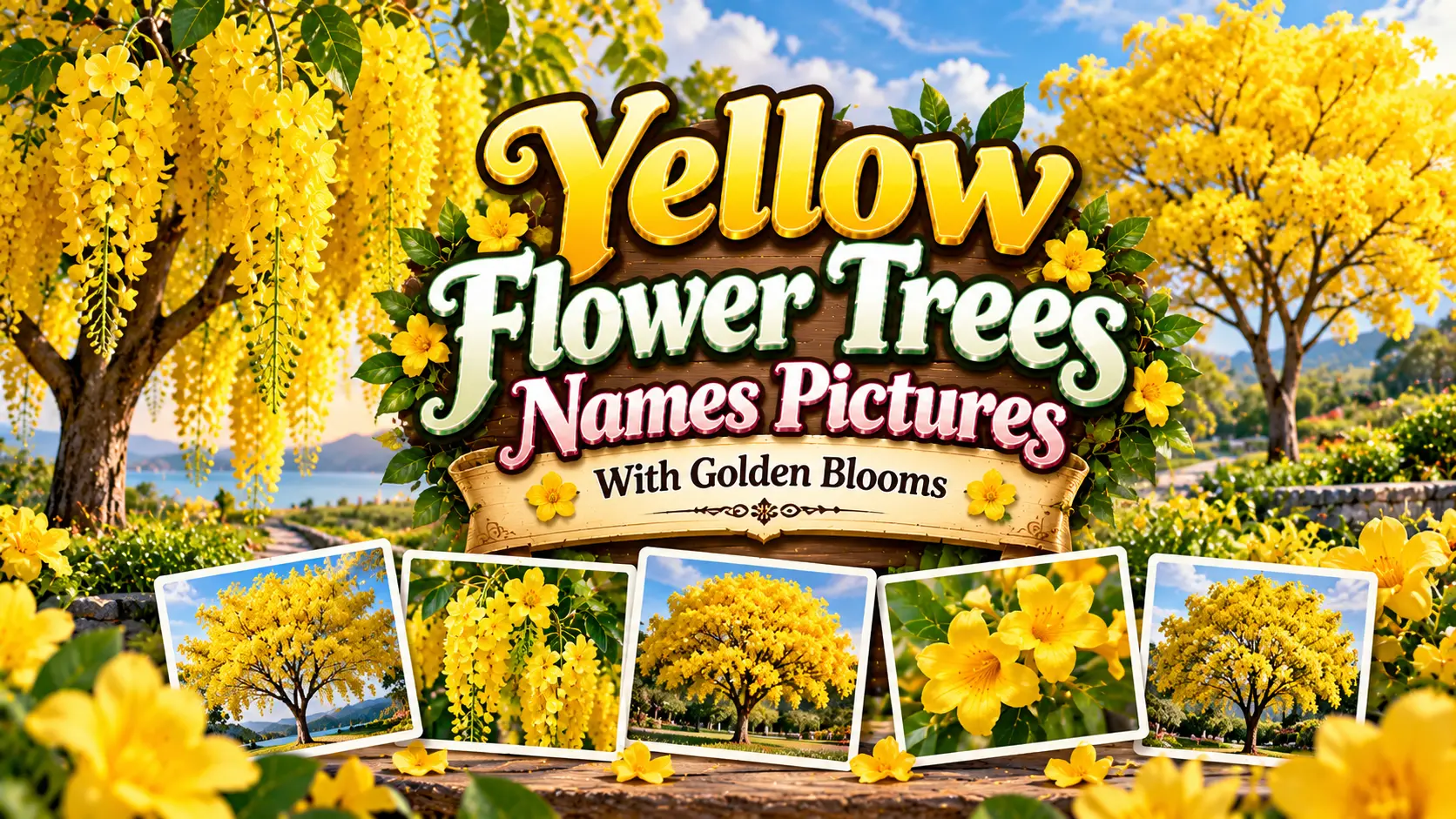
Yellow flowering trees can turn an ordinary landscape into a bright, cheerful display of golden color. From trees covered in long hanging flower clusters to varieties with trumpet-shaped blossoms, there are many beautiful species worth discovering.
If you are searching for yellow flower trees names pictures, this guide will help you identify some of the most popular trees with yellow flowers. You will find their common names, botanical names, flower characteristics, growing habits, and useful identification tips.
Some yellow-flowering trees are famous tropical beauties, while others are better suited to temperate gardens. Golden Shower Tree, Yellow Flame Tree, Golden Chain Tree, Yellow Trumpet Tree, Golden Raintree, and Yellow Bells are among the most eye-catching choices.
Whether you are identifying a tree from a photograph, planning a garden, choosing a landscape tree, or simply exploring beautiful flowering trees, these golden-blooming varieties offer plenty of inspiration.
🌳 Golden Shower Tree — Cassia fistula
The Golden Shower Tree, also called Amaltas or Indian Laburnum, is famous for its spectacular yellow flowers. Its long, hanging clusters create a waterfall-like appearance when the tree is in full bloom, making it one of the most recognizable yellow flowering trees.
- Botanical name: Cassia fistula
- Common name: Golden Shower Tree
- Other name: Amaltas
- Flower color: Bright yellow
- Flowers: Long hanging clusters
- Growth: Medium to large tree
- Foliage: Compound green leaves
- Climate: Tropical and subtropical
- Best feature: Cascading golden flowers
- Landscape use: Parks, roadsides, gardens, and lawns
- Flower style: Pendulous racemes
- Overall appearance: Bright and dramatic
- Garden appeal: Excellent ornamental tree
- Sun preference: Full sun
- Popular region: South Asia
- Common identification clue: Long golden flower chains
- Seasonal interest: Especially attractive during flowering
- Color effect: Creates a golden canopy
- Picture tip: Photograph the entire hanging flower clusters
🌼 Yellow Trumpet Tree — Handroanthus
Yellow Trumpet Trees are known for their large, trumpet-shaped flowers that can cover the branches with brilliant yellow color. Several related species may be called Yellow Trumpet Tree, so the botanical name is useful when making an exact identification.
- Flower color: Yellow
- Flower shape: Trumpet-shaped
- Common name: Yellow Trumpet Tree
- Related group: Handroanthus
- Growth: Small to medium tree
- Foliage: Species-dependent
- Bloom: Often seasonal
- Best feature: Large golden trumpets
- Landscape use: Streets and gardens
- Climate: Tropical and subtropical
- Sun: Full sun
- Canopy: Rounded or spreading
- Flower clusters: Often dense
- Visual effect: Bright yellow crown
- Identification clue: Trumpet-like petals
- Popular use: Ornamental landscaping
- Garden style: Tropical and modern
- Picture tip: Capture flowers and leaves together
- Special appeal: Dramatic flowering display
🔥 Yellow Flame Tree — Peltophorum pterocarpum
The Yellow Flame Tree is a large tropical tree admired for its golden-yellow flower clusters and delicate, fern-like foliage. Its broad canopy can create a spectacular display in warm climates.
- Botanical name: Peltophorum pterocarpum
- Common name: Yellow Flame Tree
- Other names: Copperpod, Yellow Flamboyant
- Flower color: Golden yellow
- Flower arrangement: Branched clusters
- Leaves: Fine and feathery
- Growth: Large tree
- Climate: Tropical
- Canopy: Broad and spreading
- Best feature: Golden flowers with delicate foliage
- Landscape use: Streets and parks
- Sun: Full sun
- Flower display: Abundant
- Trunk: Strong woody trunk
- Garden effect: Shade and color
- Style: Tropical
- Identification clue: Fern-like leaves
- Flower clusters: Upright and branched
- Picture tip: Show the flowers against the foliage
💛 Golden Chain Tree — Laburnum
The Golden Chain Tree is famous for its long strings of yellow flowers that hang gracefully from the branches. The blooms resemble golden curtains, giving this tree a particularly elegant appearance.
- Botanical name: Laburnum
- Common species: Laburnum anagyroides
- Common name: Golden Chain Tree
- Flower color: Bright yellow
- Flower shape: Pea-like
- Flower arrangement: Long hanging clusters
- Growth: Small tree
- Blooming season: Spring
- Leaves: Three-part leaflets
- Best feature: Golden flower chains
- Landscape use: Ornamental gardens
- Canopy: Graceful and spreading
- Sun: Full sun
- Style: Cottage garden
- Identification clue: Long pendulous racemes
- Visual effect: Golden curtain
- Garden appeal: Elegant
- Picture tip: Photograph flowers hanging beneath branches
🌿 Golden Raintree — Koelreuteria paniculata
The Golden Raintree produces airy clusters of yellow flowers followed by distinctive papery seed capsules. It is a popular ornamental tree because it provides seasonal interest beyond its flowering period.
- Botanical name: Koelreuteria paniculata
- Common name: Golden Raintree
- Flower color: Yellow
- Flower arrangement: Branched panicles
- Leaves: Compound
- Growth: Small to medium tree
- Fruit: Papery capsules
- Flowering: Summer
- Best feature: Flowers and decorative seed pods
- Landscape use: Gardens and streets
- Canopy: Rounded
- Sun: Full sun
- Climate: Temperate to warm
- Identification clue: Yellow flower panicles
- Seasonal interest: Flowers and seed capsules
- Garden style: Ornamental
- Picture tip: Include both flowers and seed pods if possible
- Special appeal: Long-lasting landscape interest
🌻 Gold Medallion Tree — Cassia leptophylla
The Gold Medallion Tree produces rounded clusters of brilliant yellow flowers. Its lush green foliage provides a strong contrast with the bright blossoms, making it an attractive ornamental tree for warm climates.
- Botanical name: Cassia leptophylla
- Common name: Gold Medallion Tree
- Flower color: Bright yellow
- Flowers: Clustered
- Origin: Brazil
- Growth: Medium-sized tree
- Climate: Subtropical
- Leaves: Compound
- Canopy: Rounded
- Best feature: Golden flower clusters
- Landscape use: Parks and gardens
- Sun: Full sun
- Flowering: Warm-season display
- Visual effect: Bright golden accents
- Garden use: Specimen planting
- Identification clue: Dense yellow clusters
- Foliage contrast: Green against gold
- Picture tip: Photograph flowers from beneath the canopy
🌞 Yellow Bells — Tecoma stans
Tecoma stans, commonly known as Yellow Bells or Yellow Elder, can grow as a shrub or small tree. Its bright yellow, trumpet-shaped flowers make it a popular choice for warm-climate landscapes.
- Botanical name: Tecoma stans
- Common name: Yellow Bells
- Other name: Yellow Elder
- Flower color: Bright yellow
- Flower shape: Bell or trumpet
- Growth: Shrub or small tree
- Leaves: Compound
- Climate: Warm regions
- Best feature: Repeated yellow flowering
- Landscape use: Gardens and hedges
- Sun: Full sun
- Canopy: Bushy
- Flowers: Tubular
- Identification clue: Serrated leaflets and yellow trumpets
- Garden effect: Cheerful
- Flower clusters: Often abundant
- Maintenance: Can be pruned
- Picture tip: Capture the flowers close up
🌼 Yellow Magnolia Trees
Several magnolia cultivars produce yellow flowers, offering an unusual alternative to the more familiar white and pink magnolia blooms. Their large flowers make them excellent focal points in ornamental gardens.
- Common name: Yellow Magnolia
- Flower color: Yellow
- Flower size: Large
- Flower shape: Cup-like
- Growth: Small to medium tree
- Leaves: Broad and green
- Bloom: Often spring
- Best feature: Large yellow flowers
- Landscape use: Specimen tree
- Garden style: Elegant
- Sun: Full sun to partial shade, depending on cultivar
- Canopy: Rounded
- Flower texture: Waxy and substantial
- Visual effect: Soft golden display
- Popular cultivar: ‘Butterflies’
- Identification clue: Large magnolia-shaped blooms
- Picture tip: Show the flower beside the large leaves
- Seasonal appeal: Strong spring interest
🌿 Cootamundra Wattle — Acacia baileyana
The Cootamundra Wattle is an Australian tree or large shrub recognized for its fluffy yellow flower clusters and attractive silvery foliage. The contrast between the foliage and flowers gives it a distinctive appearance.
- Botanical name: Acacia baileyana
- Common name: Cootamundra Wattle
- Flower color: Yellow
- Flower shape: Round and fluffy
- Leaves: Silvery-green
- Origin: Australia
- Growth: Small to medium tree
- Bloom: Seasonal
- Best feature: Yellow flowers against silver foliage
- Climate: Mild to warm
- Landscape use: Ornamental planting
- Canopy: Spreading
- Sun: Full sun
- Flower texture: Soft-looking
- Identification clue: Silvery foliage
- Garden effect: Airy and bright
- Flower clusters: Rounded
- Picture tip: Include foliage in the photograph
🌳 Yellow Buckeye — Aesculus flava
The Yellow Buckeye is a large North American tree with spring flower clusters that can show yellow or yellow-green tones. Its palmate leaves also make it relatively distinctive.
- Botanical name: Aesculus flava
- Common name: Yellow Buckeye
- Flower color: Yellow to yellow-green
- Flowers: Upright clusters
- Leaves: Palmate
- Growth: Large tree
- Origin: Eastern North America
- Bloom: Spring
- Canopy: Broad
- Best feature: Flower clusters and large leaves
- Landscape use: Large gardens
- Sun: Sun to partial shade
- Identification clue: Five-part palmate leaves
- Tree form: Upright
- Seasonal appeal: Spring flowers
- Fruit: Buckeye nuts
- Picture tip: Photograph flowers and leaves together
🌸 Forsythia — Golden Bells
Forsythia is better known as a flowering shrub than a tree, but mature specimens can develop a tree-like appearance. Its bright yellow flowers cover the bare branches in early spring.
- Common name: Forsythia
- Nickname: Golden Bells
- Flower color: Bright yellow
- Flower shape: Four-lobed
- Growth: Usually shrub
- Possible form: Tree-like
- Bloom: Early spring
- Branches: Arching
- Leaves: Green after flowering
- Best feature: Flowers on bare branches
- Landscape use: Hedges and borders
- Sun: Full sun
- Flower display: Dense
- Identification clue: Yellow blooms before leaves
- Garden effect: Bright spring color
- Picture tip: Photograph the flowering branches
- Style: Informal and natural
🌼 Yellow Flower Trees and Their Botanical Names
Knowing the botanical name can make plant identification much easier because common names can overlap between different species.
| Common Name | Botanical Name |
|---|---|
| Golden Shower Tree | Cassia fistula |
| Yellow Flame Tree | Peltophorum pterocarpum |
| Golden Chain Tree | Laburnum |
| Golden Raintree | Koelreuteria paniculata |
| Gold Medallion Tree | Cassia leptophylla |
| Cootamundra Wattle | Acacia baileyana |
| Yellow Bells | Tecoma stans |
| Yellow Buckeye | Aesculus flava |
| Yellow Magnolia | Magnolia cultivars |
| Yellow Trumpet Tree | Handroanthus species |
| Yellow Tabebuia | Handroanthus/Tabebuia species |
| Golden Poinciana | Various species/common-name usage |
💛 Yellow Flower Trees by Flower Shape
Flower shape is one of the most useful characteristics when comparing yellow flowering trees. Looking closely at the petals and how the flowers are arranged can quickly narrow down possible species.
| Flower Shape | Example |
|---|---|
| Trumpet | Yellow Trumpet Tree |
| Bell | Yellow Bells |
| Hanging chain | Golden Chain Tree |
| Long raceme | Golden Shower Tree |
| Branched cluster | Golden Raintree |
| Fluffy ball | Cootamundra Wattle |
| Large cup | Yellow Magnolia |
| Upright cluster | Yellow Buckeye |
| Rounded cluster | Gold Medallion Tree |
| Dense golden cluster | Yellow Flame Tree |
🌳 Yellow Flower Trees for Warm Climates
Many spectacular yellow-flowering trees thrive in tropical or subtropical environments. Their ability to produce abundant flowers in warm conditions makes them popular in parks, streets, gardens, and large landscapes.
- Golden Shower Tree
- Yellow Flame Tree
- Gold Medallion Tree
- Yellow Trumpet Tree
- Yellow Bells
- Yellow Tabebuia
- Golden Raintree
- Cootamundra Wattle
- Golden Poinciana
- Yellow Cassia
- Tropical Acacia
- Golden Trumpet Tree
- Yellow Poinciana
- Amaltas
- Golden Bloom Tree
- Yellow Flame
- Tropical Yellow Trumpet
- Golden Cascade Tree
- Sunshine Tree
- Golden Canopy Tree
🌼 Yellow Flower Trees for Gardens
The right tree for a garden depends on climate, available space, mature size, soil, and maintenance needs. Smaller ornamental varieties can work in residential landscapes, while large tropical trees may need considerably more room.
- Yellow Magnolia
- Golden Raintree
- Golden Chain Tree
- Yellow Bells
- Cootamundra Wattle
- Gold Medallion Tree
- Yellow Buckeye
- Golden Shower Tree
- Yellow Trumpet Tree
- Yellow Flame Tree
- Forsythia
- Yellow Tabebuia
- Golden Poinciana
- Yellow Acacia
- Golden Bloom Tree
- Sunshine Tree
- Golden Canopy
- Yellow Garden Tree
- Golden Cascade
- Golden Blossom Tree
📸 How to Identify Yellow Flower Trees From Pictures
A photograph can provide useful clues, but identifying a tree accurately usually requires more than looking at flower color. Examine the flowers, leaves, bark, branches, fruit, and overall growth pattern together.
- Look at the flower shape.
- Count visible petals when possible.
- Check whether flowers hang downward.
- Look for trumpet-shaped flowers.
- Examine the leaves.
- Determine whether the leaves are simple or compound.
- Check whether flowers appear before leaves.
- Look at the bark.
- Examine the branches.
- Check the canopy shape.
- Look for seed pods.
- Observe the flower clusters.
- Note the size of individual flowers.
- Check the tree’s overall height.
- Consider the climate where it grows.
- Compare several pictures.
- Use the botanical name when available.
- Photograph both flowers and foliage.
- Check the underside of leaves if necessary.
- Avoid identifying the tree from color alone.
🌱 Yellow Flower Trees vs. Yellow Flowering Shrubs
Not every plant commonly described as a yellow flower tree is actually a tree. Some popular yellow-flowering plants grow primarily as shrubs or can become tree-like only under certain conditions.
| Plant | Typical Growth Form |
|---|---|
| Golden Shower Tree | Tree |
| Yellow Flame Tree | Tree |
| Golden Chain Tree | Small tree |
| Golden Raintree | Tree |
| Gold Medallion Tree | Tree |
| Yellow Trumpet Tree | Tree |
| Yellow Bells | Shrub or small tree |
| Forsythia | Shrub |
| Yellow Magnolia | Tree |
| Cootamundra Wattle | Tree or large shrub |
This distinction matters when you are selecting a plant for landscaping because a shrub and a large mature tree can require very different amounts of space.
☀️ What Makes Yellow Flowering Trees So Attractive?
Yellow is one of the most noticeable colors in a landscape, especially when it contrasts with green foliage. A tree covered in golden blossoms can become a natural focal point in a garden or public space.
- Bright golden color
- Strong contrast with green leaves
- Excellent visibility from a distance
- Cheerful appearance
- Attractive spring or summer displays
- Good focal-point potential
- Suitable for many landscape styles
- Can provide seasonal interest
- Some offer shade
- Many attract pollinators
- Useful for streetscapes
- Beautiful against blue skies
- Excellent for garden photography
- Works well with green lawns
- Creates a warm visual atmosphere
- Can complement colorful gardens
- Provides dramatic flowering displays
- Offers ornamental value
- Adds seasonal character
- Creates memorable landscapes
🌿 Tips for Choosing a Yellow Flowering Tree
Before planting a yellow-flowering tree, consider its mature size, climate requirements, root space, flowering season, and maintenance needs. A beautiful tree still needs to be suitable for its location.
- Check the mature height.
- Check the mature canopy width.
- Match the tree to your climate.
- Consider the available sunlight.
- Check soil requirements.
- Consider drainage.
- Research watering needs.
- Look at the flowering season.
- Check root-space requirements.
- Consider nearby buildings.
- Keep power lines in mind.
- Choose a suitable planting distance.
- Consider maintenance needs.
- Check whether branches spread widely.
- Think about fallen flowers and pods.
- Research local growing conditions.
- Choose a reputable nursery.
- Confirm the botanical name.
- Look at mature specimens.
- Consider the overall garden design.
🌞 Yellow Flower Tree Names for Landscaping
If you need attractive names for a landscaping article, garden plan, plant collection, or project, these descriptive names capture the golden appearance of flowering trees.
- Golden Canopy
- Sunshine Tree
- Golden Cascade
- Yellow Blossom Tree
- Golden Trumpet
- Golden Chain
- Yellow Flame
- Golden Shower
- Golden Rain
- Sunshine Bloom
- Golden Garden Tree
- Yellow Paradise
- Golden Petal Tree
- Amber Blossom
- Honey Bloom Tree
- Golden Crown
- Sunburst Tree
- Golden Meadow Tree
- Yellow Garden Star
- Golden Flower Canopy
🌼 Final Thoughts
There are many beautiful yellow flower trees, and each has a distinctive way of displaying its golden blooms. The Golden Shower Tree is famous for its long hanging flower clusters, while the Yellow Flame Tree creates large golden displays above fine foliage. Golden Chain Tree produces elegant cascading flowers, and Yellow Trumpet Trees are known for their trumpet-shaped blossoms.
Other interesting choices include Golden Raintree, Gold Medallion Tree, Cootamundra Wattle, Yellow Bells, Yellow Buckeye, and yellow-flowering magnolias. Some commonly included plants, such as Forsythia, are technically shrubs rather than true trees, so checking the plant’s growth habit is important.
When identifying a tree from pictures, don’t focus only on the yellow flowers. Look at the flower shape, leaf arrangement, bark, canopy, seed pods, flowering season, and overall tree structure. These details can help you distinguish between species that may look similar from a distance.
Whether you are searching for a tree for your garden or simply exploring yellow flower trees names pictures, these golden-blooming plants offer plenty of inspiration for a bright and colorful landscape.

Ethan Carter is a nature enthusiast and content writer with a passion for flowers and botanical knowledge. He is the author behind FlowerNamez, where he shares simple and informative content about flower names, types, and meanings.
With a focus on clarity and accuracy, Ethan aims to help readers explore the beauty of flowers and understand their significance in everyday life.