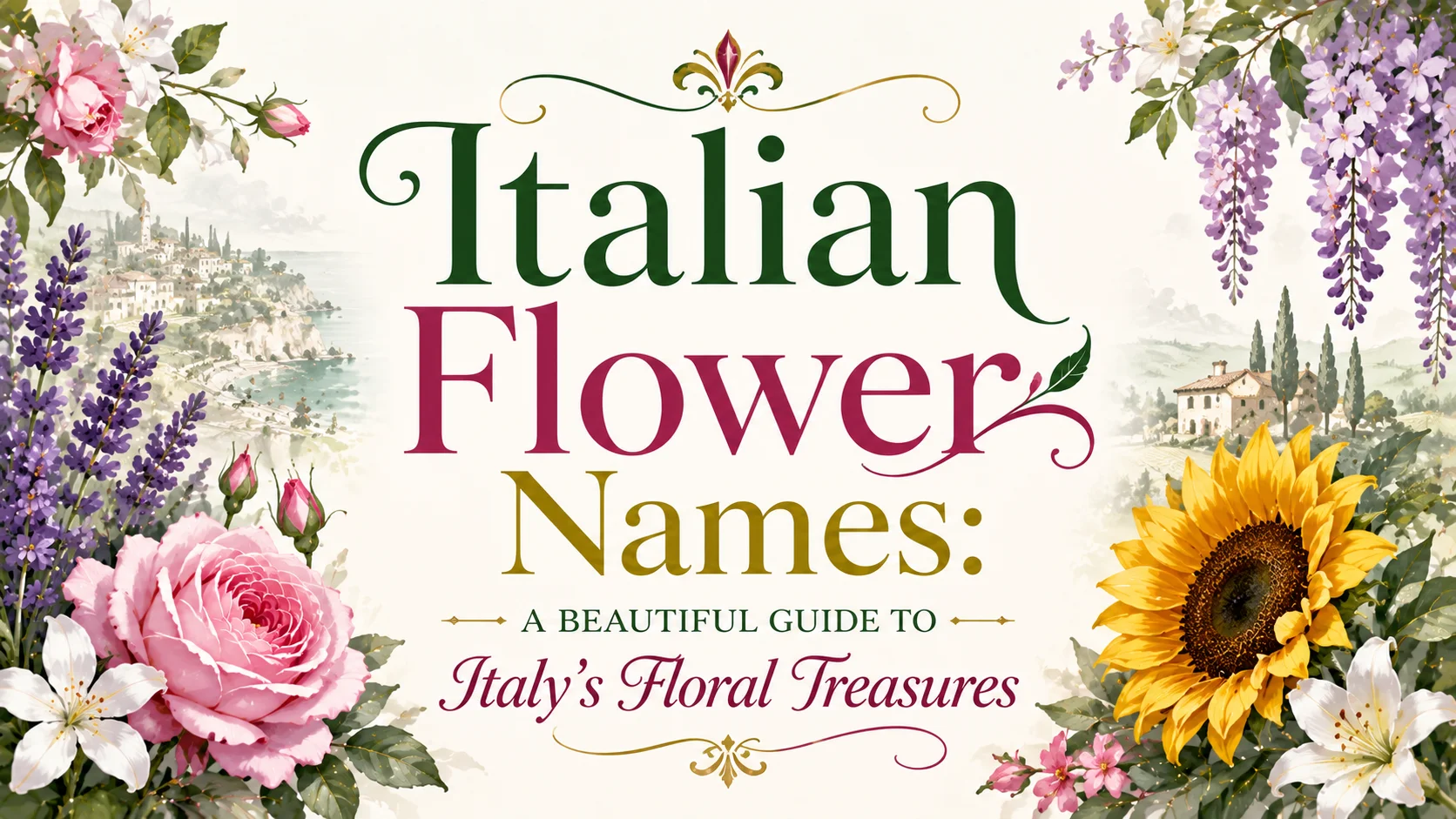
Italian flower names roll off the tongue like music, carrying the warmth, passion, and romance of Italy itself. From the red poppies dotting Tuscan hillsides to the fragrant jasmine climbing over Roman walls, from the delicate white lilies in Florentine gardens to the vibrant sunflowers of the Umbrian countryside, Italy’s floral heritage is as rich as its art, food, and wine. Learning Italian flower names not only expands your vocabulary but also opens a window into Italian culture, poetry, and a deep appreciation for natural beauty.
This comprehensive guide covers over 150 Italian flower names, organized alphabetically and by category. Whether you are learning Italian, planning a garden, naming a baby, or simply enchanted by the beauty of the Italian language, you will find everything you need here. Each entry includes the Italian name, English translation, pronunciation guide, and fascinating cultural notes. From common garden flowers to rare wildflowers, from floral baby names to the language of flowers (il linguaggio dei fiori), this guide celebrates the exquisite intersection of Italian language and botanical beauty.
Most Common Italian Flower Names
These are the Italian flower names you will encounter most frequently in gardens, florist shops, and everyday conversation.
La Rosa (Rose)
The queen of all flowers in Italy as everywhere else. Roses symbolize love, passion, and beauty. Italy has a rich tradition of rose cultivation, particularly in Tuscany and around Rome. Pronounced “lah roh-zah.”
Il Girasole (Sunflower)
Literally means “turns toward the sun.” Sunflowers are iconic in Tuscany and Umbria, where vast fields bloom in July and August. Symbolizes adoration, loyalty, and happiness. Pronounced “eel jee-rah-soh-leh.”
La Lavanda (Lavender)
Grows beautifully in the hills of Tuscany, Piedmont, and Liguria. Not as famous as French Provence, but Italian lavender has a distinct, softer fragrance. Symbolizes calm, devotion, and purity. Pronounced “lah lah-vahn-dah.”
La Margherita (Daisy)
The classic white daisy with a yellow center. Extremely common in Italian meadows and gardens. Symbolizes innocence, purity, and true love. Also a very popular Italian girl’s name. Pronounced “lah mar-gay-ree-tah.”
Il Giglio (Lily)
The lily is historically associated with Florence. The Florentine lily (giglio fiorentino) is the symbol of the city of Florence. Represents purity, royalty, and the Virgin Mary. Pronounced “eel jeel-lyoh.”
La Violeta (Violet)
Delicate purple flowers that bloom in early spring. Symbolizes modesty, faithfulness, and humble beauty. Very popular in northern Italian gardens. Pronounced “lah vee-oh-leh-tah.”
Il Papavero (Poppy)
Red poppies grow wild in wheat fields across Tuscany, Umbria, and Le Marche. They are a symbol of remembrance for fallen soldiers, similar to the Commonwealth tradition. Pronounced “eel pah-pah-veh-roh.”
Il Fiordaliso (Cornflower)
Beautiful blue cornflowers grow among grain fields across Italy. Symbolizes delicacy, elegance, and single blessedness. Pronounced “eel fyor-dah-lee-zoh.”
Il Giacinto (Hyacinth)
Very fragrant spring bulbs in purple, pink, white, and blue. Popular in Italian gardens. Symbolizes sport, playfulness, and constancy. Pronounced “eel jah-cheen-toh.”
La Gardenia (Gardenia)
Intensely fragrant white flowers. Very popular in Italian bridal bouquets and romantic gardens. Symbolizes secret love, purity, and joy. Pronounced “lah gar-deh-nyah.”
| Italian Name | English Name | Pronunciation | Symbolism |
|---|---|---|---|
| La Rosa | Rose | roh-zah | Love, passion |
| Il Girasole | Sunflower | jee-rah-soh-leh | Adoration, loyalty |
| La Lavanda | Lavender | lah-vahn-dah | Calm, devotion |
| La Margherita | Daisy | mar-gay-ree-tah | Innocence, purity |
| Il Giglio | Lily | jeel-lyoh | Purity, royalty |
| La Viola | Violet | vee-oh-lah | Modesty, faithfulness |
| Il Papavero | Poppy | pah-pah-veh-roh | Remembrance |
| Il Fiordaliso | Cornflower | fyor-dah-lee-zoh | Delicacy |
| Il Giacinto | Hyacinth | jah-cheen-toh | Playfulness |
| La Gardenia | Gardenia | gar-deh-nyah | Secret love |
Italian Flower Names A to Z
Here is a complete alphabetical list of Italian flower names with English translations.
A
- L’Acanto (Acanthus) – a-kahn-toh
- L’Achillea (Yarrow) – ah-keel-leh-ah
- L’Acino (Grape blossom – literally small grape) – ah-chee-noh
- L’Aconito (Aconite, Monkshood) – ah-koh-nee-toh
- L’Agapanto (Agapanthus, Lily of the Nile) – ah-gah-pahn-toh
- L’Agrifoglio (Holly – berries and small flowers) – ah-gree-foh-lyoh
- L’Aglio ornamentale (Ornamental Onion, Allium) – ah-lyoh or-nah-men-tah-leh
- L’Alloro (Laurel, Bay Laurel – small flowers) – ahl-loh-roh
- L’Alstroemeria (Alstroemeria, Peruvian Lily) – ahl-stroh-eh-meh-ree-ah
- L’Alyssum (Alyssum, Sweet Alyssum) – ah-lees-soom
- L’Amaranto (Amaranth) – ah-mah-rahn-toh
- L’Anemone (Anemone, Windflower) – ah-neh-moh-neh
- L’Angelica (Angelica) – ahn-jeh-lee-kah
- L’Antirrhinum (Snapdragon) – ahn-teer-ree-nuum
- L’Ape (Bee – not a flower, but associated) – ah-peh
- L’Aquilone (Delphinium – also means kite) – ah-kwee-loh-neh
- L’Arabetta (Rock Cress) – ah-rah-bet-tah
- L’Arancio (Orange blossom – flower of the orange tree) – ah-rahn-choh
- L’Arnica (Arnica) – ahr-nee-kah
- L’Asparagina (Asparagus – ornamental flowers) – ah-spah-rah-jee-nah
- L’Aster (Aster) – ah-ster
- L’Astilbe (Astilbe, False Spirea) – ah-steel-beh
- L’Asfodelo (Asphodel) – ah-sfoh-deh-loh
B
- La Begonia (Begonia) – beh-goh-nyah
- Il Biancospino (Hawthorn – white flowers) – byahn-koh-spee-noh
- La Bocca di Leone (Snapdragon – literally “lion’s mouth”) – bok-kah dee leh-oh-neh
- Il Borragine (Borage) – boh-rah-jee-neh
- La Bouganville (Bougainvillea) – boo-gahn-veel-leh
- La Bucaneve (Snowdrop – literally “snow piercer”) – boo-kah-neh-veh
- Il Buddleia (Butterfly Bush) – bood-leh-yah
- Il Bue (Oxeye daisy – “occhio di bue”) – boo-eh
C
- Il Cactus (Cactus – flowering varieties) – kahk-toos
- La Calendula (Calendula, Pot Marigold) – kah-len-doo-lah
- Il Calla (Calla Lily) – kahl-lah
- Il Calicanto (Sweet Shrub, Calycanthus) – kah-lee-kahn-toh
- Il Camelia (Camellia) – kah-meh-lyah
- La Campanella (Bellflower – little bell) – kahm-pah-nel-lah
- La Campanula (Bellflower) – kahm-pah-noo-lah
- Il Capelvenere (Maidenhair Fern – not a flower, but beautiful plant) – kah-pel-veh-neh-reh
- La Capinera (Blackcap – bird associated with flowers) – kah-pee-neh-rah
- La Caprifoglio (Honeysuckle) – kah-pree-foh-lyoh
- La Capucina (Nasturtium – also “cappuccina”) – kah-poo-chee-nah
- Il Cardo (Thistle) – kahr-doh
- Il Cardo Mariano (Milk Thistle) – kahr-doh mah-ree-ah-noh
- Il Carlino (Carline Thistle) – kahr-lee-noh
- Il Carpino (Hornbeam – flowers) – kahr-pee-noh
- Il Castagno (Chestnut – flowers) – kah-stah-nyoh
- Il Catalpa (Catalpa – tree flowers) – kah-tahl-pah
- La Catinella (Toadflax) – kah-tee-nel-lah
- Il Cedro (Cedar – flowers) – cheh-droh
- Il Celosia (Cockscomb, Celosia) – cheh-loh-zee-ah
- Il Centaurea (Centaury, Knapweed) – chen-tah-oo-reh-ah
- Il Cervello (Brain cactus, Mammillaria) – cher-vel-loh
- Il Cespuglio (Shrub – general, but used for flowering bushes) – ches-poo-lyoh
- La Ciclamino (Cyclamen) – chee-klah-mee-noh
- La Cineraria (Cineraria) – chee-neh-rah-ree-ah
- La Cinquefoglia (Cinquefoil) – cheen-kweh-foh-lyah
- La Ciriegia (Cherry blossom – more commonly “ciliegio”) – chee-ryeh-jah
- Il Citriso (Broom – flowering shrub) – chee-tree-zoh
- Il Clematide (Clematis) – kleh-mah-tee-deh
- Il Clivia (Clivia) – klee-vyah
- Il Colchico (Autumn Crocus, Meadow Saffron) – kohl-kee-koh
- Il Colle (Hill – associated with wildflowers) – kohl-leh
- La Colza (Rapeseed flower – bright yellow fields) – kohl-zah
- Il Corbezzolo (Strawberry Tree – flowers) – kor-bet-zoh-loh
- Il Coreopside (Coreopsis, Tickseed) – koh-reh-op-see-deh
- Il Corniolo (Dogwood – flowers) – kohr-nyoh-loh
- Il Craspedia (Billy Balls, Craspedia) – krah-speh-dee-ah
- Il Crisantemo (Chrysanthemum) – kree-zan-teh-moh
- Il Croco (Crocus) – kroh-koh
D
- La Dahlia (Dahlia) – dah-lyah
- Il Delfinio (Delphinium, Larkspur) – del-fee-nyoh
- Il Dentaria (Toothwort) – den-tah-ree-ah
- Il Dianthus (Dianthus, Pink) – dee-ahn-toos
- La Dicentra (Bleeding Heart) – dee-chen-trah
- La Digitalis (Foxglove) – dee-jee-tah-lees
- La Dimorfoteca (Dimorphotheca, African Daisy) – dee-mor-foh-teh-kah
- Il Dondolo (Swinging flower – nickname for some wildflowers) – dohn-doh-loh
- Il Doronico (Leopard’s Bane) – doh-roh-nee-koh
E
- L’Echinacea (Coneflower, Echinacea) – eh-kee-nah-cheh-ah
- L’Echinops (Globe Thistle) – eh-kee-nops
- L’Edera (Ivy – flowers, but more known for foliage) – eh-deh-rah
- L’Edera terrestre (Ground Ivy) – eh-deh-rah ter-res-treh
- L’Edelweiss (Edelweiss) – eh-del-vice (same as German)
- L’Elaborata (Elaborate flower – not real) – eh-lah-boh-rah-tah
- L’Elleboro (Hellebore, Christmas Rose, Lenten Rose) – el-leh-boh-roh
- L’Enotera (Evening Primrose) – eh-noh-teh-rah
- L’Epilobio (Fireweed, Willowherb) – eh-pee-loh-byoh
- L’Erica (Heather) – eh-ree-kah
- L’Erba (Grass/Herb – general flowering plants) – ehr-bah
- L’Erba Stella (Stellaria, Starwort) – ehr-bah stel-lah
- L’Eremuro (Desert Candle, Foxtail Lily) – eh-reh-moo-roh
- L’Erica (Erica, Heath) – eh-ree-kah
- L’Eringio (Sea Holly, Eryngo) – eh-reen-joh
- L’Eriofillo (Eriophyllum, Woolly Sunflower) – eh-ree-oh-feel-loh
- L’Erodio (Herodium, Stork’s Bill) – eh-roh-dyoh
- L’Esperalce (Esperance – not real) – es-peh-rahl-cheh
- L’Esposto (Espostoa – cactus flower) – es-pos-toh
- L’Estate (Summer – associated with summer flowers) – es-tah-teh
- L’Ester (Esther – not a flower, but name associated) – es-ter
- L’Eufrasia (Eyebright) – eh-oo-frah-zee-ah
- L’Euforbia (Spurge – some have showy bracts) – eh-oo-for-byah
- L’Eupatorio (Joe Pye Weed, Eupatorium) – eh-oo-pah-toh-ryoh
- L’Euryale (Euryale – water lily relative) – eh-oo-ryah-leh
F
- La Felce (Fern – not a flower, but beautiful foliage) – fel-cheh
- La Felicia (Felicia, Blue Daisy) – feh-lee-chah
- La Festuca (Fescue – grass with flowers) – fes-too-kah
- Il Fico (Fig – flowers inside the fruit) – fee-koh
- La Fienarola (Meadow grass – flowers) – fyeh-nah-roh-lah
- La Fioraia (Florist – not a flower) – fyoh-rah-yah
- Il Fiore (Flower – general term) – fyoh-reh
- Il Fiore di carta (Paper flower, Bougainvillea or Helichrysum) – fyoh-reh dee kahr-tah
- Il Fiore di cera (Wax flower, Hoya) – fyoh-reh dee cheh-rah
- Il Fiore di corallo (Coral flower) – fyoh-reh dee koh-rahl-loh
- Il Fiore di lino (Flax flower) – fyoh-reh dee lee-noh
- Il Fiore di melo (Apple blossom) – fyoh-reh dee meh-loh
- Il Fiore di pesco (Peach blossom) – fyoh-reh deh pes-koh
- Il Fiore di primavera (Spring flower – general) – fyoh-reh dee pree-mah-veh-rah
- Il Fiore di zucca (Squash blossom – also edible) – fyoh-reh dee tzook-kah
- Il Fiordaliso (Cornflower) – fyor-dah-lee-zoh
- Il Fiorrancio (Buttercup – also “ranuncolo”) – fyor-rahn-choh
- Il Fior di loto (Lotus flower) – fyor dee loh-toh
- Il Fior di neve (Snow flower – another name for snowdrop) – fyor dee neh-veh
- Il Fior di notte (Night flower – Moonflower, Evening primrose) – fyor dee not-teh
- La Fioritura (Blooming – not a flower name) – fyoh-ree-too-rah
- La Fisostegia (Physostegia, Obedient Plant) – fee-zoh-steh-jah
- La Fitolacca (Pokeweed – flowers) – fee-toh-lahk-kah
- La Flox (Phlox) – floks
- Il Foeniculum (Fennel – yellow flowers) – feh-nee-koo-loom
- La Forsizia (Forsythia) – for-see-zyah
- La Fotinia (Photinia – white flowers, red leaves) – fo-tee-nyah
- La Fragaria (Strawberry – small white flowers) – frah-gah-ree-ah
- Il Freesia (Freesia) – freh-zyah
- Il Frassinella (Gas Plant, Dictamnus) – frahs-see-nel-lah
- Il Frassino (Ash tree – flowers) – fras-see-noh
- Il Fritillaria (Fritillary) – free-teel-lah-ree-ah
- La Fuchsia (Fuchsia) – fook-syah
G
- La Gaillardia (Blanket Flower, Gaillardia) – gah-eel-lahr-dyah
- Il Galanthus (Snowdrop – alternative “bucaneve”) – gah-lahn-toos
- La Galata (Not a real flower) – gah-lah-tah
- La Galatella (Aster relative) – gah-lah-tel-lah
- Il Garofano (Carnation) – gah-roh-fah-noh
- Il Garofano selvatico (Wild carnation) – gah-roh-fah-noh sel-vah-tee-koh
- Il Gatsania (Gazania) – gaht-zah-nyah
- La Gelsomino (Jasmine) – jel-soh-mee-noh
- Il Genepy (Genepi – alpine plant) – jeh-neh-pee
- La Genista (Broom – yellow-flowering shrub) – jeh-nee-stah
- Il Genziana (Gentian) – jen-zyah-nah
- Il Geranio (Geranium) – jeh-rah-nyoh
- Il Gerbera (Gerbera Daisy) – jer-beh-rah
- Il Giallo (Yellow – not a flower, but describes many) – jahl-loh
- Il Giglio (Lily) – jeel-lyoh
- Il Giglio d’acqua (Water lily) – jeel-lyoh dahkwah
- Il Giglio di San Giovanni (St. John’s Lily) – jeel-lyoh dee sahn joh-vahn-nee
- Il Giglio di valle (Lily of the Valley – “mughetto”) – jeel-lyoh dee vahl-leh
- Il Gigliocampanula (Bellflower – not a separate name) – jeel-lyoh-kahm-pah-noo-lah
- Il Girasole (Sunflower) – jee-rah-soh-leh
- Il Girasole messicano (Mexican sunflower, Tithonia) – jee-rah-soh-leh mes-see-kah-noh
- Il Gladiolo (Gladiolus) – glah-dyoh-loh
- La Gloriosa (Glory Lily, Gloriosa Lily) – gloh-ree-oh-zah
- Il Godetia (Godetia, Farewell-to-Spring) – goh-deh-tyah
- La Gramigna (Couch grass – flowers, but weedy) – grah-mee-nyah
- La Grassula (Jade plant – flowers) – gras-soo-lah
- La Gypsophila (Baby’s Breath, Gypsophila) – jeep-soh-fee-lah
H
- L’Ibisco (Hibiscus) – ee-bee-sko
- L’Ibisco cinese (Chinese hibiscus – tropical) – ee-bee-sko chee-neh-zeh
- L’Ibisco siriano (Rose of Sharon – hardy hibiscus) – ee-bee-sko see-ree-ah-noh
- L’Idrante (Hydrant – confuses with hydrangea, not a flower) – ee-drahn-teh
- L’Idrangea (Hydrangea) – ee-drahn-jeh-ah
- L’Igname (Yam – flowering vine) – ee-nyah-meh
- L’Imperatoria (Masterwort, Peucedanum – flowers) – eem-peh-rah-toh-ryah
- L’Incensaria (Incense flower – not common) – een-chen-sah-ryah
- L’Indaco (Indigo – indigo flower) – een-dah-koh
- L’Iperico (St. John’s Wort, Hypericum) – ee-peh-ree-koh
- L’Ipomea (Morning Glory, Ipomoea) – ee-poh-meh-ah
- L’Iris (Iris) – ee-rees
- L’Iris barbuto (Bearded iris) – ee-rees bar-boo-toh
- L’Iris giapponese (Japanese iris) – ee-rees jahp-po-neh-zeh
- L’Iris siberiano (Siberian iris) – ee-rees see-beh-ryah-noh
- L’Isolepis (Fiber optic grass – flowers) – ee-zoh-leh-pees
- L’Issopo (Hyssop) – ees-soh-poh
- L’Isotoma (Isotoma, Blue Star Creeper) – ee-zoh-toh-mah
J
- Il Jacaranda (Jacaranda) – yah-kah-rahn-dah
- La Jacintilla (Small hyacinth) – yah-cheen-teel-lah
- Il Jacinto (Hyacinth – older form) – yah-cheen-toh
- Il Jasmin (Jasmine – alternate spelling “gelsomino”) – yahz-meen
- La Jasminea (Jasmine-like – rare) – yahz-mee-neh-ah
- Il Jonquille (Jonquil – sometimes used) – yohn-kee-leh
- Il Junipero (Juniper – flowers) – yoo-nee-peh-roh
K
- Il Kalmia (Kalmia, Mountain Laurel) – kahl-mee-ah
- Il Kerria (Kerria, Japanese Rose) – keh-ree-ah
- Il Kniphofia (Red Hot Poker, Torch Lily) – kneef-foh-fee-ah
L
- Il Lacrime di bambino (Bleeding heart – “lacrime di bambino” is not common) – lah-kree-meh dee bahm-bee-noh
- Il Lagurus (Hare’s Tail grass – ornamental grass with flower heads) – lah-goo-roos
- La Lamia (Deadnettle – flowering ground cover) – lah-mee-ah
- La Lampranto (Pigface, Ice Plant – flowers) – lahm-prahn-toh
- Il Lantana (Lantana) – lahn-tah-nah
- Il Lapazio (Dock – flowers) – lah-pah-zyoh
- Il Larkspur (Larkspur – same as “delfinio”) – lark-spur (English in Italian gardens)
- Il Lathyrus (Sweet Pea – “pisello odoroso”) – lah-tee-roos
- Il Lauro (Laurel – flowers) – lah-oo-roh
- Il Laurino (Cherry Laurel – flowers) – lah-oo-ree-noh
- Il Lavanda (Lavender) – lah-vahn-dah
- Il Lavandino (Lavender – small variety) – lah-vahn-dee-noh
- Il Lavatore (Lavatera, Tree Mallow – “malvone”) – lah-vah-toh-reh
- La Lentaggine (Bladder Senna – flowers) – lehn-tahd-jee-neh
- La Lenticchia (Lentil – tiny flowers) – lehn-tee-kee-ah
- Il Lenzuolo (Not a flower) – lehn-tzoo-oh-loh
- La Leontodon (Hawkbit – dandelion relative) – leh-on-toh-dohn
- Il Leopardo (Not a flower) – leh-oh-pahr-doh
- La Leptospermo (Leptospermum, Tea Tree – flowers) – lep-tos-per-moh
- La Lespedeza (Lespedeza, Bush Clover) – les-peh-deh-zah
- Il Levistico (Lovage – yellow flowers) – leh-vee-stee-koh
- La Lewisia (Lewisia) – leh-wee-zyah
- La Liatride (Liatris, Blazing Star) – lee-ah-tree-deh
- La Ligularia (Ligularia) – lee-goo-lah-ree-ah
- Il Lilac (Lilac – “lillà” more common) – lee-lahk
- Il Lillà (Lilac) – leel-lah
- Il Lillà d’estate (Butterfly bush – “buddleia”) – leel-lah des-tah-teh
- Il Limnantem (Floating heart – water flower) – leem-nahn-tem
- Il Limnocharis (Water poppy) – leem-noh-kah-rees
- Il Limonio (Limonium, Sea Lavender, Statice) – lee-moh-nyoh
- La Linaria (Linaria, Toadflax) – lee-nah-ree-ah
- Il Lino (Flax – blue flowers) – lee-noh
- La Lintea (Not a flower) – leen-teh-ah
- Il Lion’s Ear (Leonotis) – lee-onz eer (English in Italian gardens)
- La Lippia (Lippia, Fogfruit) – leep-pee-ah
- Il Liquirizia (Licorice – Glycyrrhiza, small flowers) – lee-kwee-ree-zyah
- Il Liriodendro (Tulip tree – flowers) – lee-ryoh-den-droh
- Il Liriope (Liriope, Lilyturf) – lee-ree-oh-peh
- Il Liserone (Greater bindweed, Calystegia – flowers) – lee-zeh-roh-neh
- Il Lisianthus (Lisianthus) – lee-zyah-noon-tus
- Il Liso (Not a flower) – lee-zoh
M
- La Macchia (Spotted flower or macchia mediterranean – general) – mahk-kee-ah
- La Magnolia (Magnolia) – mah-nyoh-lyah
- Il Mahonia (Mahonia, Oregon Grape) – mah-oh-nyah
- La Malva (Mallow) – mahl-vah
- Il Malvone (Tree mallow, Lavatera) – mahl-voh-neh
- La Malvavisco (Marsh mallow – flowers) – mahl-vah-vee-sko
- Il Mandarino (Mandarin orange – white fragrant flowers) – mahn-dah-ree-noh
- La Mandevilla (Mandevilla, Rocktrumpet) – mahn-deh-veel-lah
- La Margherita (Daisy) – mah-gay-ree-tah
- La Margherita di mare (Sea daisy – not a real flower) – mah-gay-ree-tah dee mah-reh
- La Margherita gialla (Yellow daisy – coreopsis) – mah-gay-ree-tah jahl-lah
- La Marianna (Not a flower) – mah-ree-ahn-nah
- La Mariliana (Not a flower) – mah-ree-lyah-nah
- La Mariposa (Butterfly flower) – mah-ree-poh-zah
- La Marittima (Sea lavender – “limonio” or “statice”) – mah-reet-tee-mah
- Il Marmorino (Not a flower) – mahr-moh-ree-noh
- Il Marrubio (White horehound – small flowers) – mahr-roo-byoh
- Il Marsileo (Marsilea, Water clover – not a true flower) – mahr-see-leh-oh
- Il Martagone (Martagon lily – Turk’s cap lily) – mahr-tah-goh-neh
- Il Martello (Not a flower) – mahr-tel-loh
- La Martina (Not a flower) – mahr-tee-nah
- Il Matricaria (Matricaria, Feverfew – flowers) – mah-tree-kah-ree-ah
- Il Mattino (Morning – associated with morning glory) – maht-tee-noh
- La Mauve (Mallow – still “malva” more common) – mah-oov
- La Mazza d’oro (Goldenrod – “verga d’oro”) – maht-zah doh-roh
- La Meconopsis (Himalayan blue poppy – “meconopsis”) – meh-koh-nop-sees
- Il Medicago (Medicago, Alfalfa relative – flowers) – meh-dee-kah-goh
- La Medinilla (Medinilla) – meh-dee-neel-lah
- Il Melo (Apple tree – blossoms) – meh-loh
- Il Melograno (Pomegranate – red flowers) – meh-loh-grah-noh
- Il Melone (Melon – yellow flowers) – meh-loh-neh
- La Mentuccia (Pennyroyal – small purple flowers) – men-toot-chah
- La Meraviglia (Marvel of Peru – “bella di notte”) – meh-rah-vee-lyah
- Il Mese (Month – associated with monthly flowers) – meh-zeh
- La Mesembria (Not a flower) – meh-zem-bree-ah
- Il Mesquite (Mesquite – yellow catkin flowers) – mehs-kee-teh
- La Meteora (Not a flower) – meh-teh-oh-rah
N
- Il Narciso (Narcissus, Daffodil) – nar-chee-zoh
- Il Narciso giallo (Yellow daffodil) – nar-chee-zoh jahl-loh
- Il Narciso poetico (Poet’s narcissus) – nar-chee-zoh poh-eh-tee-koh
- Il Narciso a tromba (Trumpet daffodil) – nar-chee-zoh ah trom-bah
- Il Nasturzio (Nasturtium) – nah-stoor-zyoh
- Il Nastro (Not a flower) – nah-stroh
- La Natteria (Not a flower) – naht-teh-ree-ah
- Il Naufrago (Not a flower) – nah-ooh-frah-goh
- La Nave (Not a flower – ship) – nah-veh
- Il Negundo (Box elder – flowers) – neh-goon-doh
- Il Nemezio (Nemesia) – neh-meh-zyoh
- Il Nemoroso (Not a flower) – neh-moh-roh-zoh
- Il Nenufar (Water lily – from Arabic, used in Italian “ninfea” more common) – neh-noo-far
- La Nemesia (Nemesia) – neh-meh-zyah
- La Neve (Snow – associated with snowdrop) – neh-veh
- La Nicandra (Nicandra, Apple of Peru – flowers) – nee-kahn-drah
- La Nicotiana (Nicotiana, Flowering Tobacco) – nee-koh-tyah-nah
- La Nigella (Nigella, Love-in-a-Mist) – nee-jel-lah
- La Nigritella (Orchid species, dark orchid) – nee-gree-tel-lah
- La Ninfea (Water lily) – neen-feh-ah
- Il Ninfee (Water lilies – plural) – neen-feh-eh
- Il Nocciolo (Hazelnut – catkins) – noh-cho-loh
- Il Noceto (Walnut grove – associated with flowers) – noh-cheh-toh
- Il Noce (Walnut – catkin flowers) – noh-cheh
- Il Nome (Name – not a flower) – noh-meh
- Il Non ti scordar di me (Forget-Me-Not) – non tee skor-dar dee meh
- Il Nord (North – associated with northern flowers) – nord
- Il Nostalgia (Nostalgia – not a flower name) – noh-stahl-jah
- Il Notte (Night – associated with night-blooming flowers) – not-teh
- La Notte (Same) – not-teh
- La Nube (Cloud – cloud of flowers) – noo-beh
- La Nucola (Not a flower) – noo-koh-lah
- La Nuova (New – new flower) – noo-oh-vah
O
- L’Occhio di bue (Oxeye daisy) – ok-kyoh dee boo-eh
- L’Occhio di pernice (Pheasant’s eye, Adonis) – ok-kyoh dee per-nee-cheh
- L’Occhio di Santa Lucia (Santa Lucia’s eye – a flower) – ok-kyoh dee sahn-tah loo-chee-ah
- L’Odontite (Odontites, Red Bartsia – flower) – oh-dohn-tee-teh
- L’Oleandro (Oleander) – oh-leh-ahn-droh
- L’Oleandro di montagna (Mountain oleander, Rhododendron) – oh-leh-ahn-droh dee mohn-tah-nyah
- L’Olivo (Olive tree – small white flowers) – oh-lee-voh
- L’Ombrella (Umbrella – not a flower) – om-brel-lah
- L’Ombrellifera (Umbrella plant – flowers) – om-brel-lee-feh-rah
- L’Omofila (Not a flower) – oh-moh-fee-lah
- L’Onagro (Evening primrose – “enotera”) – oh-nah-groh
- L’Oncidio (Oncidium orchid) – on-chee-dyoh
- L’Onisco (Woodlouse – not a flower) – oh-nee-sko
- L’Ononide (Ononis, Restharrow – small pink flowers) – oh-noh-nee-deh
- Il Papavero (Poppy) – pah-pah-veh-roh
Italian Flower Names by Color
Red Italian Flower Names (Fiori Rossi)
- La Rosa rossa (Red rose)
- Il Papavero (Poppy)
- Il Garofano rosso (Red carnation)
- Il Tulipano rosso (Red tulip)
- Il Geranio rosso (Red geranium)
- La Begonia rossa (Red begonia)
- Il Giglio rosso (Red lily)
- La Peonia rossa (Red peony)
- Il Gladiolo rosso (Red gladiolus)
- L’Anemone rossa (Red anemone)
Pink Italian Flower Names (Fiori Rosa)
- La Rosa rosa (Pink rose)
- La Peonia (Peony – usually pink)
- La Camelia rosa (Pink camellia)
- L’Azalea rosa (Pink azalea)
- Il Garofano rosa (Pink carnation)
- La Dahlia rosa (Pink dahlia)
- L’Ortensia rosa (Pink hydrangea)
- Il Ciclamino (Cyclamen – pink/magenta)
- La Margherita rosa (Pink daisy – rare)
- Il Gelsomino rosa (Pink jasmine)
Purple Italian Flower Names (Fiori Viola)
- La Viola (Violet)
- La Lavanda (Lavender)
- Il Lillà (Lilac)
- La Campanula (Bellflower – purple)
- Il Giacinto viola (Purple hyacinth)
- Il Delfinio (Delphinium – purple/blue)
- L’Aster viola (Purple aster)
- Il Giglio viola (Purple lily)
- L’Iris viola (Purple iris)
- La Digitalis (Foxglove – purple)
Blue Italian Flower Names (Fiori Azzurri)
- Il Fiordaliso (Cornflower)
- Il Non ti scordar di me (Forget-Me-Not)
- La Campanula azzurra (Blue bellflower)
- Il Delfinio azzurro (Blue delphinium)
- La Lobelia azzurra (Blue lobelia)
- La Veronica (Speedwell – blue)
- Il Lino (Flax – blue flowers)
- La Genziana (Gentian – deep blue)
- La Brunnera (Brunnera – blue)
- Il Nontiscordardimé (Forget-Me-Not, full name)
Yellow Italian Flower Names (Fiori Gialli)
- Il Girasole (Sunflower)
- La Margherita gialla (Yellow daisy – Coreopsis)
- Il Narciso (Daffodil)
- Il Tulipano giallo (Yellow tulip)
- La Calendula (Calendula, pot marigold)
- Il Ranuncolo (Buttercup)
- La Primula (Primrose – yellow varieties)
- Il Crisantemo giallo (Yellow chrysanthemum)
- La Solidago (Goldenrod)
- L’Oenothera (Evening primrose – yellow)
White Italian Flower Names (Fiori Bianchi)
- Il Giglio (Lily – white varieties)
- La Margherita (Daisy)
- Il Gelsomino (Jasmine – white)
- Il Mughetto (Lily of the Valley)
- Il Bucaneve (Snowdrop)
- La Gardenia (Gardenia)
- Il Giglio bianco (White lily)
- Il Narciso bianco (White narcissus)
- La Rosa bianca (White rose)
- Il Biancospino (Hawthorn – white flowers)
Orange Italian Flower Names (Fiori Arancioni)
- Il Papavero arancione (Orange poppy – California poppy)
- Il Tulipano arancione (Orange tulip)
- Il Garofano arancione (Orange carnation)
- Il Girasole arancione (Orange sunflower – rare)
- Il Giglio tigrato (Tiger lily – orange)
- La Calendula arancione (Orange calendula)
- Il Croco arancione (Orange crocus – saffron crocus)
- Il Nasturzio (Nasturtium – orange varieties)
- L’Azalea arancione (Orange azalea)
- Il Lantana arancione (Orange lantana)
Italian Flower Names by Season
Spring Italian Flower Names (Fiori Primaverili)
- La Primula (Primrose)
- Il Narciso (Daffodil)
- Il Tulipano (Tulip)
- Il Giacinto (Hyacinth)
- La Viola (Violet)
- Il Lillà (Lilac)
- Il Mughetto (Lily of the Valley)
- La Fresia (Freesia)
- L’Anemone (Anemone)
- Il Croco (Crocus)
Summer Italian Flower Names (Fiori Estivi)
- Il Girasole (Sunflower)
- La Rosa (Rose)
- Il Giglio (Lily)
- L’Ortensia (Hydrangea)
- La Lavanda (Lavender)
- Il Papavero (Poppy)
- La Margherita (Daisy)
- Il Garofano (Carnation)
- La Dalia (Dahlia)
- Il Gladiolo (Gladiolus)
Autumn Italian Flower Names (Fiori Autunnali)
- Il Crisantemo (Chrysanthemum)
- L’Aster (Aster)
- La Digitalis (Foxglove – continues blooming)
- Il Ciclamino (Cyclamen – autumn-blooming varieties)
- Il Colchico (Autumn crocus)
- La Verga d’oro (Goldenrod)
- Il Sedum (Sedum – Autumn Joy)
- L’Anemone giapponese (Japanese anemone)
- Il Tricyrtis (Toad lily)
- La Nerine (Nerine)
Winter Italian Flower Names (Fiori Invernali)
- La Camelia (Camellia)
- Il Bucaneve (Snowdrop)
- L’Elleboro (Hellebore, Christmas rose)
- Il Gelsomino invernale (Winter jasmine)
- La Hamamelis (Witch hazel)
- La Daphne (Daphne)
- Il Calicanto (Sweetshrub, Calycanthus)
- La Poinsettia (Poinsettia – indoor)
- Il Ciclamino (Cyclamen – hardy winter varieties)
- Il Narciso di inverno (Winter daffodil, Sternbergia)
Italian Flower Names for Baby Girls
Many Italian flower names are also popular and beautiful baby girl names. These names carry elegance, romance, and deep cultural roots.
Rosa
The most classic Italian flower name. Simply means “rose.” Timeless, elegant, and loved throughout Italy and beyond.
Margherita
The Italian daisy. Also the Italian form of Margaret. Means “pearl” as well. Very popular in Italy. Princess Margherita of Savoy inspired the name of the famous pizza Margherita.
Viola
Means “violet.” Sweet, old-fashioned charm. Also the name of a string instrument. Very popular in Italy and internationally.
Lilia
From giglio (lily). Feminine form. Elegant and pure.
Gelsomina
The Italian name for jasmine. fragrant, and beautiful. Also the name of the heroine in the play “The White Devil.”
Azalea
Same as English. A flowering shrub with beautiful pink, white, or purple blooms. Modern and fashionable.
Camelia
Italian spelling of Camellia. Elegant and sophisticated. Associated with perfection and gratitude.
Dalia
Italian form of Dahlia. Strong, bold, and beautiful. Modern and stylish.
Fiorella
Means “little flower.” Diminutive of Fiore (flower). Sweet, delicate, and charming. Very Italian.
Fiorenza
Means “flowering” or “flourishing.” Also the old name for Florence (Firenze). Elegant and historical.
| Name | Flower | Vibe | Popularity |
|---|---|---|---|
| Rosa | Rose | Classic, timeless | Very high |
| Margherita | Daisy | Cheerful, traditional | High |
| Viola | Violet | Sweet, vintage | High |
| Lilia | Lily | Elegant, pure | Moderate |
| Gelsomina | Jasmine | Romantic | Moderate |
| Azalea | Azalea | Modern, bold | Low-moderate |
| Camelia | Camellia | Sophisticated | Low |
| Dalia | Dahlia | Strong, stylish | Low-moderate |
| Fiorella | Little flower | Sweet, delicate | Low |
| Fiorenza | Flowering | Elegant, historical | Low |
The Language of Flowers (Il Linguaggio dei Fiori)
In Italian culture, as in other European cultures, flowers carried specific meanings. Here are traditional Italian flower meanings used in floriography.
| Italian Flower | English Name | Meaning in Italian Floriography |
|---|---|---|
| Rosa rossa | Red rose | Amore appassionato (Passionate love) |
| Rosa bianca | White rose | Silenzio, segreto, purezza (Silence, secret, purity) |
| Rosa gialla | Yellow rose | Gelosia (Jealousy) – use with caution |
| Margherita | Daisy | Innocenza (Innocence) |
| Mughetto | Lily of the Valley | Felicità che ritorna (Return of happiness) |
| Lillà | Lilac | Primo amore (First love) |
| Viola | Violet | Modestia, fedeltà (Modesty, faithfulness) |
| Papavero | Poppy | Consolazione (Consolation) |
| Fiordaliso | Cornflower | Delicatezza (Delicacy) |
| Giglio | Lily | Purezza, maestà (Purity, majesty) |
| Girasole | Sunflower | Adorazione, lealtà (Adoration, loyalty) |
| Lavanda | Lavender | Diffidenza (Distrust) – traditional meaning |
| Orthosia | Hydrangea | Freddezza (Coldness) |
| Garofano rosso | Red carnation | Il mio cuore ti desidera (My heart desires you) |
| Garofano bianco | White carnation | Amore puro (Pure love) |
| Tulipano rosso | Red tulip | Dichiarazione d’amore (Love declaration) |
| Tulipano giallo | Yellow tulip | Speranza (Hope) |
| Anemone | Anemone | Abbandono (Abandonment, forsaken love) |
| Camelia | Camellia | Bellezza perfetta (Perfect beauty) |
Regional Italian Flowers
Tuscany (Toscana)
- Il Girasole (Sunflower) – Iconic of Tuscan landscapes
- Il Papavero (Poppy) – Red poppies in wheat fields
- La Lavanda (Lavender) – Grows in Tuscan hills
- Il Cipresso (Cypress – not a flower, but iconic tree)
- L’Olivo (Olive tree – small white flowers)
- La Ginestra (Broom – yellow flowering shrub)
Sicily (Sicilia)
- La Bougainville (Bougainvillea) – Everywhere in Sicilian towns
- Il Limone (Lemon blossom) – Fragrant white flowers
- L’Ulivo (Olive) – Ancient olive groves
- La Palma (Palm – not a flower, but iconic)
- L’Opuntia (Prickly pear cactus – beautiful yellow flowers)
- Il Gelsomino (Jasmine) – Climbing over Sicilian walls
Umbria
- Il Girasole (Sunflower) – Vast fields in summer
- Il Papavero (Poppy) – Red dots on green hills
- La Rosa (Rose) – Medieval rose gardens
- Il Lillà (Lilac) – Spring blooming
Liguria (Italian Riviera)
- La Bougainville (Bougainvillea)
- La Rosa (Rose) – Famous rose gardens of Genoa
- Il Gelsomino (Jasmine)
- La Lavanda (Lavender)
- La Ruta (Rue – medicinal, yellow flowers)
Lombardy (Lombardia) & Italian Lakes
- La Camelia (Camellia) – Famous at Lake Como and Lake Maggiore
- La Magnolia (Magnolia)
- L’Azalea (Azalea) – Lake Maggiore gardens
- Il Rododendro (Rhododendron)
- L’Ortensia (Hydrangea)
Campania (Naples, Amalfi Coast)
- Il Limone (Lemon blossom) – Amalfi Coast terraces
- Il Gelsomino (Jasmine)
- La Bougainville (Bougainvillea)
- Il Mirto (Myrtle – white flowers, used in liquors)
Frequently Asked Questions About Italian Flower Names
What is the most famous Italian flower?
Il Girasole (sunflower) is the most iconic Italian flower, representing Tuscany and Umbria. La Rosa (rose) and Il Giglio (lily) are also extremely significant, with the lily being the symbol of Florence.
What is the Italian name for a daisy?
La Margherita. This is also a very common Italian girl’s name. It means both “daisy” and is the Italian form of Margaret.
What is the Italian flower of love?
La Rosa rossa (red rose) represents passionate love in Italian culture, just as in most Western cultures.
What is the Italian name for forget-me-not?
Non ti scordar di me. This literally translates to “do not forget me” in Italian.
What flower is the symbol of Florence?
Il Giglio (the lily) is the symbol of Florence. The Florentine lily (giglio fiorentino) appears on the city’s coat of arms.
How do you say “flower” in Italian?
Il fiore (masculine) or more commonly “il fiore” for singular, “i fiori” for plural.
What Italian flower name means “little flower”?
Fiorella. This diminutive form of Fiore means “little flower” and is a lovely girl’s name.
Is there an Italian flower that represents remembrance?
Il Papavero (red poppy) represents remembrance of fallen soldiers in Italy, similar to the Commonwealth tradition.
Conclusion
Italian flower names carry the romance, passion, and beauty of Italy itself. From the iconic Girasole (sunflower) of Tuscan fields to the fragrant Gelsomino (jasmine) climbing over Roman walls, from the elegant Giglio (lily) symbolizing Florence to the humble Margherita (daisy) growing in mountain meadows, each Italian flower name tells a story of culture, history, and natural splendor. Whether you are learning Italian, planning a garden, naming a child, or simply dreaming of Italy, these beautiful botanical names bring a touch of Italian sunshine and passion into your life. Come stai bella fiore? (How beautiful you are, flower.)

Ethan Carter is a nature enthusiast and content writer with a passion for flowers and botanical knowledge. He is the author behind FlowerNamez, where he shares simple and informative content about flower names, types, and meanings.
With a focus on clarity and accuracy, Ethan aims to help readers explore the beauty of flowers and understand their significance in everyday life.