
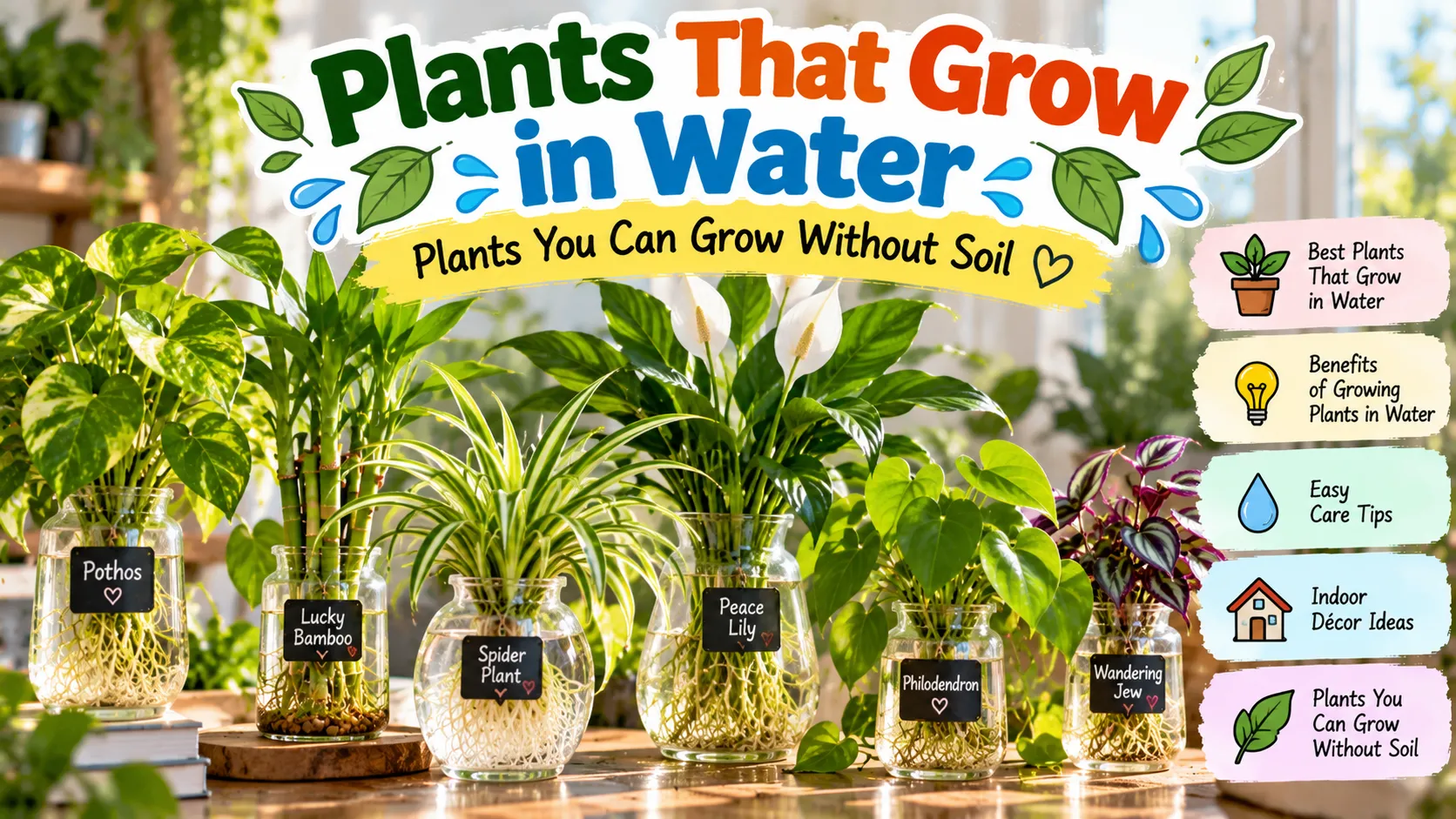
Plants that grow in water are a beautiful and easy way to bring greenery into your home without dealing with soil, messy pots, or complicated gardening routines. From lucky bamboo and pothos to elegant peace lilies and fragrant herbs, many plants can grow in water or thrive with their roots submerged in a suitable container. These plants are perfect for decorating windowsills, desks, kitchens, bathrooms, and small apartments.
Whether you want to grow indoor plants in glass jars, propagate cuttings, or create a simple water garden, there are plenty of options to explore. Some plants grow entirely in water, while others can live in water for extended periods when their leaves remain above the surface and their roots receive enough oxygen. You can even grow herbs such as mint and basil in water for convenient access to fresh flavors.
In this guide, you’ll discover more than 35 plants that grow in water, learn how to care for them, and find out which varieties work best for beginners, indoor decoration, and edible gardening.
🌿 What Are Plants That Grow in Water?
Plants that grow in water are varieties that can develop roots, produce new growth, or survive for extended periods in a water-based environment. Some naturally grow in ponds, streams, and wetlands, while others adapt well to growing indoors in containers filled with clean water.
There are three common categories to understand. Aquatic plants grow naturally in water, such as water lilies and hornwort. Hydroponic plants grow with their roots in water containing the nutrients they need. Water-propagated houseplants, including pothos and philodendrons, develop roots in water and may continue growing there with proper care.
Not every plant can thrive in water permanently. Many traditional houseplants require soil to support their long-term nutrient needs, so choosing a suitable variety makes a significant difference.
🪴 Best Indoor Plants That Grow in Water
Indoor plants that grow in water are ideal for people who want low-mess greenery and attractive displays. You can place them in clear glass vases, decorative bottles, or jars where their roots become part of the display.
Here are some of the best indoor options.
- Lucky Bamboo: A popular decorative plant that grows well in water with its roots submerged and its stalks above the surface.
- Pothos: An easy-care trailing plant that develops roots from stem cuttings and can grow in water for long periods.
- Heartleaf Philodendron: A beautiful climbing plant with heart-shaped leaves that roots readily in water.
- Peace Lily: Can adapt to water-based growing arrangements, although long-term growth requires careful attention to nutrients and root health.
- Spider Plant: Produces baby plantlets that can develop roots in water before being transferred to soil.
- English Ivy: Stem cuttings can root in water and create attractive trailing displays.
- Chinese Evergreen: Some cuttings can root in water, although permanent water culture requires appropriate nutrients.
- Coleus: Colorful stem cuttings root quickly in water and brighten indoor spaces.
- Tradescantia: This fast-growing plant develops roots readily and produces attractive purple, green, or striped foliage.
- Arrowhead Plant: Young stem cuttings can grow roots in water and develop decorative arrow-shaped leaves.
For beginners, pothos, lucky bamboo, heartleaf philodendron, and tradescantia are especially convenient choices because they are easy to propagate and generally forgiving of minor care mistakes.
🌱 Plants That Grow in Water Without Soil
Growing plants without soil is possible when their roots receive enough water, oxygen, and essential nutrients. Some houseplants can live in plain water for a while, while others need a nutrient solution to maintain healthy growth over time.
These varieties are worth considering if you want to create a soil-free indoor garden.
- Pothos: Works well in a jar or vase and produces long, trailing stems.
- Lucky Bamboo: Commonly grown in decorative water containers.
- Heartleaf Philodendron: Suitable for long-term water growing when nutrients and water quality are managed.
- Mint: Fresh cuttings can develop roots and produce new leaves in water.
- Basil: Healthy cuttings can root in water and provide fresh leaves.
- Green Onions: The white root ends can regrow green shoots when placed in shallow water.
- Celery: The base can produce new leaves and shoots in water, although full-sized stalks usually require more space and nutrients.
- Lemongrass: Rooted stalks can begin growing in water before being moved to a more suitable growing system.
- Watercress: This moisture-loving edible plant can grow in clean, flowing or nutrient-rich water.
- Water Spinach: Also known as kangkong, it grows well in warm, wet conditions and can be cultivated in suitable water-based systems.
Remember that water alone does not provide every nutrient a plant needs. If you want to maintain a plant in water permanently, use an appropriate hydroponic nutrient solution when necessary.
🌸 Flowering Plants That Grow in Water
Flowering plants can bring color and elegance to water gardens, ponds, and indoor arrangements. Some produce flowers while their roots remain submerged, whereas others are best propagated in water before being planted elsewhere.
Consider these flowering plants for your home or garden.
- Water Lily: Produces striking flowers and floating leaves in ponds or suitable aquatic containers.
- Lotus: An aquatic flowering plant known for its large leaves and impressive blooms.
- Water Hyacinth: A floating plant with attractive purple or lavender flowers; it can become invasive outside its native range.
- Water Poppy: A pond plant with yellow flowers and floating leaves.
- Water Hawthorn: An aquatic plant that can produce delicate, fragrant flowers in suitable conditions.
- Begonia: Many begonias can be propagated from stem or leaf cuttings in water, depending on the variety.
- Impatiens: Stem cuttings can develop roots in water and later produce colorful flowers.
- African Violet: Some varieties can be propagated from leaves using water, though the mature plant is usually grown in a suitable growing medium.
- Orchid: Certain orchids can be grown in specialized semi-hydroponic setups, but they require careful attention to moisture and aeration.
- Hyacinth: Bulbs can be forced to flower over water when supported above the waterline, keeping the bulb itself from sitting in water.
Water lilies and lotus are especially suitable for outdoor water gardens. For indoor displays, flowering cuttings are often easier to manage than plants that require a large aquatic environment.
🌿 Herbs That Grow in Water
Growing herbs in water is a practical way to keep fresh ingredients close at hand. A sunny kitchen windowsill can provide a convenient place for several herbs, especially when you start with healthy cuttings.
Here are some herbs that can grow roots or continue producing foliage in water.
- Mint: One of the easiest herbs to propagate in water. It develops roots quickly and produces fresh leaves.
- Basil: Healthy, non-flowering stems can root in water and continue growing with sufficient light and nutrients.
- Oregano: Stem cuttings can develop roots in water before being transferred to a growing medium.
- Thyme: Some cuttings can root in water, although long-term water culture may be more challenging.
- Rosemary: Cuttings can root in water, but the process is often slower than it is with mint or basil.
- Sage: Soft stem cuttings may develop roots in water, though it generally prefers well-drained conditions for long-term growth.
- Lemon Balm: Cuttings can root in water and produce fragrant leaves.
- Stevia: Healthy cuttings may root in water under suitable conditions.
- Watercress: Thrives in consistently wet environments and can be grown in an appropriate water-based setup.
For the best results, remove leaves that would sit underwater, change the water regularly, and place the container in bright, indirect light. If you want a steady harvest over many weeks, provide nutrients and enough room for the roots to grow.
🥬 Vegetables That Grow in Water
Some vegetables can regrow from kitchen scraps, while others can be cultivated in hydroponic systems. Regrowing scraps is a fun gardening project, but it does not always produce a full-sized vegetable or a continuous harvest.
Try these options for a simple home experiment.
- Green Onions: Place the white root ends in a small amount of water to encourage fresh green shoots.
- Lettuce: The base of a lettuce head may produce new leaves in shallow water, although sustained growth generally requires nutrients.
- Celery: A cut base can develop new shoots and leaves.
- Bok Choy: The base may regrow leaves when placed in shallow water.
- Napa Cabbage: The remaining base may produce new leaf growth, but it usually will not regenerate a full head in a small jar.
- Garlic Greens: Garlic cloves may produce green shoots in water, though keeping the cloves submerged can encourage rot.
- Water Spinach: This leafy vegetable grows well in warm, wet conditions when supplied with appropriate nutrients.
- Watercress: A useful leafy crop for suitable water-based growing environments.
- Spinach: Can be grown hydroponically, but it needs an appropriate nutrient solution and adequate root space rather than just a jar of plain water.
- Kale: Can grow in hydroponic systems when its light, nutrient, and root-space requirements are met.
For scrap regrowing, use only enough water to cover the roots or the bottom of the vegetable base. Replace the water frequently and discard any pieces that become slimy, moldy, or unpleasant-smelling.
💧 Aquatic Plants That Live in Water
Aquatic plants are naturally adapted to growing in ponds, aquariums, streams, or other water environments. Unlike many houseplants that merely tolerate water propagation, these plants have specialized growth habits that allow them to live in or on water.
Some popular aquatic plants include:
- Water Lily: Roots in pond substrate while its leaves and flowers rise to the surface.
- Lotus: Grows from a rhizome in aquatic soil and produces large leaves and flowers.
- Hornwort: A submerged aquatic plant commonly used in suitable aquariums and ponds.
- Anacharis: Also called Brazilian waterweed, it is often grown submerged in aquariums.
- Java Moss: An aquatic moss that can attach to rocks, wood, and aquarium decorations.
- Amazon Sword: A rooted aquarium plant that grows underwater when provided with appropriate conditions.
- Water Lettuce: A floating aquatic plant with rosettes of soft green leaves.
- Duckweed: A tiny floating plant that can multiply rapidly in nutrient-rich water.
- Water Sprite: A popular aquarium plant that can grow submerged or, under suitable conditions, with floating foliage.
- Vallisneria: A submerged plant with long, ribbon-like leaves that is useful in freshwater aquariums.
Before introducing aquatic plants to a pond or outdoor water feature, check local rules and invasive-species guidance. Some species spread aggressively and can damage natural waterways if released into the environment.
🏡 Plants That Grow in Water in Glass Jars
Glass jars are an attractive way to display plants because they allow you to see the roots and monitor the water level. They are especially useful for propagation and for small plants that do not need a large root system.
These plants are good choices for glass containers.
- Pothos
- Lucky bamboo
- Heartleaf philodendron
- Tradescantia
- Mint
- Basil
- Coleus
- English ivy
- Green onions
- Spider plant plantlets
Choose a clean container that supports the plant without squeezing its roots. Fill it with clean water, submerge the roots or lower stem nodes, and keep the leaves above the waterline. For plants that need light to grow, place the jar where it receives suitable light without excessive heat.
Clear jars make it easier to inspect roots, but light entering the water can encourage algae growth. If algae becomes a problem, clean the container and consider using an opaque pot or covering part of the jar.
☀️ How to Care for Plants That Grow in Water
Water-grown plants need more than a container filled with water. Light, oxygen, temperature, nutrients, and water quality all influence their health.
Provide the right light. Most common indoor water-grown plants prefer bright, indirect light. Herbs such as basil and mint generally need brighter conditions than many foliage houseplants. Avoid placing a glass container in intense sunlight if it heats the water excessively.
Change the water regularly. For simple water-propagation jars, replace the water about once a week or sooner if it becomes cloudy or develops an odor. Rinse the container when needed.
Keep the leaves above the water. Submerge roots and appropriate stem sections, not the entire plant. Leaves sitting underwater can decay and affect water quality.
Give roots enough oxygen. Stagnant, dirty water can encourage root problems. Keep containers clean, avoid overcrowding, and use suitable aeration for aquatic systems that require it.
Provide nutrients when needed. Plain water can support cuttings temporarily, but plants growing permanently in water often need a balanced hydroponic nutrient solution. Follow the product instructions rather than adding extra fertilizer.
Check root health. Healthy roots vary by species, but they should generally feel firm rather than mushy. Remove decaying plant material and refresh the water when necessary.
Choose a suitable container. A stable container with enough room for the roots helps prevent overcrowding and spills. Some plants also benefit from a support structure that keeps their stems upright.
🌱 Can Plants Grow in Water Forever?
Yes, certain plants can grow in water for years when their needs are met. However, not every plant that produces roots in water can thrive indefinitely in plain water.
Pothos, lucky bamboo, and some philodendrons can adapt to long-term water culture when they receive sufficient light, nutrients, and oxygen. Aquatic plants such as hornwort and water lilies are naturally adapted to aquatic environments, although each species has specific requirements.
A cutting that develops roots in a jar is not automatically a permanent water plant. Many cuttings grow well initially because they use stored energy, but their growth may slow when they lack essential minerals. Long-term water culture usually requires a balanced nutrient solution and suitable root conditions.
If your goal is a low-maintenance decorative plant, choose an adaptable foliage plant. If you want vegetables or herbs for regular harvesting, consider a small hydroponic system instead of relying on plain water.
⚖️ Water-Grown Plants vs. Soil-Grown Plants
Both water and soil can support healthy plant growth, but they offer different advantages.
| Feature | Water-grown plants | Soil-grown plants |
|---|---|---|
| Cleanliness | Usually less messy indoors | Soil can spill or scatter |
| Water monitoring | Water level is easy to see | Moisture is harder to judge |
| Nutrients | Often require added nutrients | Soil may supply some nutrients |
| Root visibility | Roots can be visible in clear containers | Roots are usually hidden |
| Maintenance | Requires water changes and container cleaning | Requires appropriate watering and soil care |
| Best uses | Propagation, decorative displays, hydroponics | Most houseplants and many garden crops |
Neither method is universally better. Choose water growing for plants that suit it and for situations where you want a clean, decorative display. Choose soil when a plant needs the structure, drainage, and growing conditions that a suitable potting mix provides.
🌿 Common Mistakes When Growing Plants in Water
Avoiding a few common mistakes can help your water-grown plants stay healthy.
- Submerging too much of the plant: Keep leaves and most foliage above water to reduce decay.
- Ignoring water quality: Cloudy or foul-smelling water can indicate a need for cleaning and replacement.
- Using plain water indefinitely: Many plants eventually need additional nutrients for sustained growth.
- Placing plants in harsh sunlight: Excessive heat can stress roots and encourage algae.
- Using containers that are too small: Crowded roots can make plants harder to maintain.
- Expecting every cutting to survive: Some species root easily, while others need different propagation conditions.
- Overfertilizing: Too much fertilizer can damage roots, particularly in small containers.
- Growing incompatible species together: Plants with different light, temperature, or nutrient needs may not thrive in the same container.
A little regular attention is usually enough to keep many water-grown plants looking attractive and healthy.
❓ Frequently Asked Questions About Plants That Grow in Water
What is the easiest plant to grow in water?
Pothos is one of the easiest choices for beginners. Lucky bamboo, heartleaf philodendron, and mint are also popular options because they can develop roots in water with relatively simple care.
Which plants can grow in water without soil?
Pothos, lucky bamboo, heartleaf philodendron, and certain aquatic plants can grow without soil when their other needs are met. Many herbs and vegetables can also grow in hydroponic systems that supply nutrients through water.
Can indoor plants survive in water permanently?
Some can. Pothos and certain philodendrons can grow in water for extended periods if they receive suitable light, nutrients, and oxygen. Other plants may root in water but do better when transferred to soil or a specialized growing medium.
Can I grow plants in water using tap water?
Often, yes. Many common plants tolerate tap water, but sensitivity to chlorine, chloramine, salts, and minerals varies by species and local water supply. If a plant develops problems, try letting the water stand when appropriate or using filtered water that suits the plant.
How often should I change the water?
For indoor propagation jars, changing the water approximately once a week is a useful starting point. Replace it sooner if it becomes cloudy, smells unpleasant, or contains decaying plant material. Established hydroponic systems may require a different maintenance schedule.
Do water-grown plants need sunlight?
Yes. Most plants need light to grow, although their ideal intensity varies. Bright, indirect light works well for many common indoor foliage plants, while herbs and flowering plants may need stronger light.
Can I grow vegetables in water at home?
Yes. Green onions, lettuce, basil, and other crops can regrow or grow in water-based systems. For a sustained harvest, most vegetables need adequate light, root space, and a suitable nutrient solution.
Are plants that grow in water low-maintenance?
Many are relatively easy to care for, but they still need regular attention. You may need to change the water, clean the container, remove unhealthy roots, and provide nutrients for long-term growth.
🌼 Final Thoughts
Plants that grow in water offer a simple and attractive way to enjoy greenery without traditional potting soil. From easy-care pothos and lucky bamboo to fresh herbs, regrowing vegetables, and beautiful aquatic plants, there are options for almost every space and gardening experience level.
If you are a beginner, start with pothos, heartleaf philodendron, or mint in a clean glass container. Give your plant suitable light, keep the roots healthy, and refresh the water regularly. As you gain experience, you can explore nutrient-based hydroponics or create a small aquatic garden.
With the right plant and proper care, growing greenery in water can become an enjoyable part of your home or gardening routine.

Ethan Carter is a nature enthusiast and content writer with a passion for flowers and botanical knowledge. He is the author behind FlowerNamez, where he shares simple and informative content about flower names, types, and meanings.
With a focus on clarity and accuracy, Ethan aims to help readers explore the beauty of flowers and understand their significance in everyday life.