
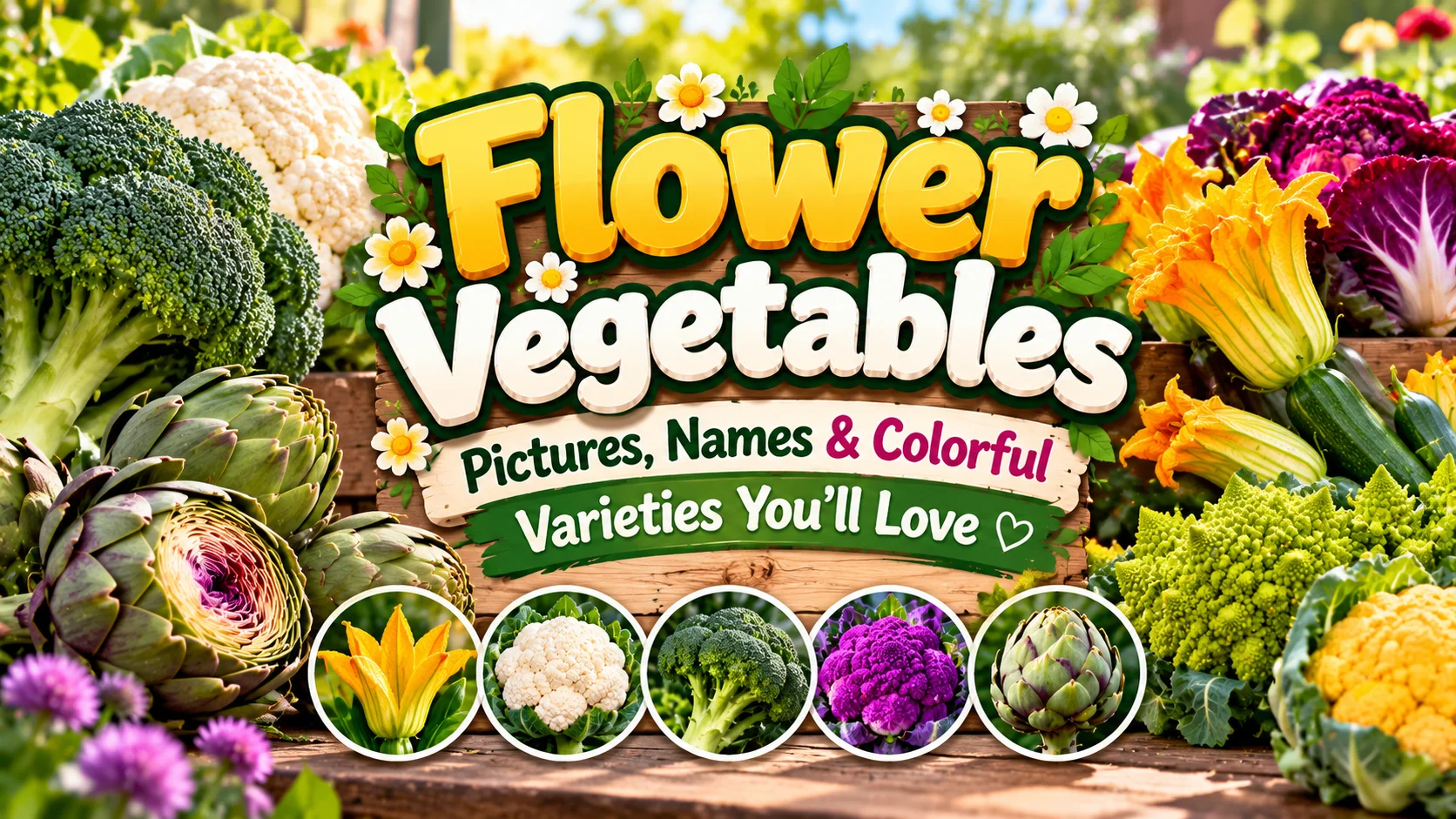
When you think about vegetables, you probably picture leafy greens, roots, pods, or colorful fruits. But some vegetables are actually flowers or immature flower structures that we eat as food. From familiar broccoli and cauliflower to delicate squash blossoms and banana flowers, these edible plants add variety, nutrition, texture, and visual appeal to the kitchen garden.
This guide to flower vegetables pictures and names introduces popular edible flowers used as vegetables, along with their common names, identifying features, and culinary uses. Some are compact heads, some are unopened buds, and others are blossoms harvested before they fully mature.
If you are learning plant names, planning a vegetable garden, creating a school project, or simply curious about edible plants, this collection offers an easy way to explore flower vegetables and recognize them.
🌼 What Are Flower Vegetables?
Flower vegetables are edible plant parts that come from flowers, flower buds, or developing flower structures. Many are harvested while the flowers are still young, which gives them a tender texture and mild flavor.
Common examples include broccoli, cauliflower, artichokes, squash blossoms, and banana flowers. Depending on the plant, people may eat the unopened flower head, immature buds, or the entire flower after removing tougher parts.
- Broccoli
- Cauliflower
- Artichoke
- Romanesco
- Broccolini
- Squash blossoms
- Banana flower
- Chive blossoms
- Daylily buds
- Globe artichoke
- Purple cauliflower
- Broccoli rabe
- Fiddlehead-like flower shoots
- Mustard flowers
- Elderflower shoots in some culinary traditions
🥦 Broccoli
Broccoli is one of the best-known flower vegetables. The familiar green head is actually made up of tightly packed, immature flower buds that are harvested before they open.
Its thick green stalks and compact florets make it easy to identify. Broccoli can be steamed, roasted, stir-fried, grilled, or eaten raw.
- Green broccoli
- Sprouting broccoli
- Purple sprouting broccoli
- Calabrese broccoli
- Broccolini
- Tenderstem broccoli
- Romanesco broccoli
- Broccoli florets
- Broccoli shoots
- Broccoli rabe
- Chinese broccoli
- Gai lan
- Broccoli heads
- Broccoli side shoots
- Young broccoli
- Baby broccoli
- Purple broccoli
- White sprouting broccoli
- Broccoli stems
- Broccoli leaves
🥬 Cauliflower
Cauliflower is another classic flower vegetable. The large white head consists of undeveloped flower structures packed closely together.
Although white cauliflower is the most familiar variety, gardeners can also grow purple, orange, green, and Romanesco types.
- White cauliflower
- Purple cauliflower
- Orange cauliflower
- Green cauliflower
- Romanesco cauliflower
- Cheddar cauliflower
- Snowball cauliflower
- Mini cauliflower
- Baby cauliflower
- Sprouting cauliflower
- Graffiti cauliflower
- Sicilian purple cauliflower
- Green cauliflower heads
- Colored cauliflower
- Heirloom cauliflower
- Early cauliflower
- Late-season cauliflower
- Compact cauliflower
- Organic cauliflower
- Garden cauliflower
🌿 Romanesco
Romanesco is famous for its unusual geometric appearance. It is related to both broccoli and cauliflower and develops a fascinating pattern of pointed green flower structures.
Its lime-green color and repeating spiral formations make Romanesco especially interesting for gardeners, photographers, and anyone studying vegetable varieties.
- Romanesco broccoli
- Romanesco cauliflower
- Romanesco head
- Green Romanesco
- Spiral Romanesco
- Fractal cauliflower
- Romanesco florets
- Romanesco vegetable
- Romanesco plant
- Italian Romanesco
🌱 Artichoke
Artichokes are another important example of a flower vegetable. The part commonly eaten is an immature flower head made up of overlapping bracts surrounding a tender heart.
If allowed to mature, the artichoke develops into a large purple flower. Gardeners therefore harvest the edible flower head before it blooms.
- Globe artichoke
- Green globe artichoke
- Purple artichoke
- Baby artichoke
- Roman artichoke
- Jerusalem artichoke
- Artichoke heart
- Artichoke bud
- Artichoke flower head
- Artichoke bracts
- Tender artichoke
- Mature artichoke flower
- Garden artichoke
- Mediterranean artichoke
- Purple globe artichoke
🌸 Squash Blossoms
Squash blossoms are edible flowers produced by squash and related plants. They are usually yellow or orange and have a soft, delicate appearance.
Both male and female blossoms can be used, although harvesting too many female flowers can reduce fruit production because female flowers develop into squash.
- Zucchini blossoms
- Yellow squash blossoms
- Pumpkin blossoms
- Winter squash blossoms
- Summer squash blossoms
- Male squash flowers
- Female squash flowers
- Pumpkin flowers
- Courgette flowers
- Garden squash blossoms
- Stuffed squash flowers
- Fried squash blossoms
- Sautéed squash blossoms
- Squash flower buds
- Fresh zucchini flowers
🍌 Banana Flower
Banana flowers, also called banana blossoms, are large purple-red flower structures that grow beneath developing bananas. They are used as vegetables in several Asian cuisines.
The outer bracts are removed to reach the tender inner flowers. Banana blossom has a distinctive texture and can be prepared in salads, curries, soups, and other dishes.
- Banana flower
- Banana blossom
- Banana heart
- Banana blossom vegetable
- Purple banana blossom
- Fresh banana flower
- Young banana blossom
- Banana flower salad
- Banana blossom curry
- Banana blossom shoots
🌺 Chive Blossoms
Chives are primarily grown for their edible leaves, but their round purple flower heads are also edible. The blossoms have a mild onion-like flavor.
Chive flowers can be separated into individual florets and used to add color and a gentle onion flavor to salads, soups, sauces, and garnishes.
- Purple chive blossoms
- Pink chive flowers
- Common chive flowers
- Garlic chive flowers
- Flowering chives
- Chive flower heads
- Chive florets
- Garlic chive blossoms
- Garden chives
- Fresh chive flowers
🌱 Broccoli Rabe
Broccoli rabe, also called rapini, produces small edible flower buds along with leafy greens and tender stems. Its flavor is more distinctly bitter than standard broccoli.
The small yellow flowers can appear when the plant begins flowering, and the entire vegetable is commonly cooked rather than eaten as a raw salad vegetable.
- Broccoli rabe
- Rapini
- Broccoli raab
- Broccoli rabe flowers
- Rapini flower buds
- Young rapini
- Flowering rapini
- Italian broccoli rabe
- Leafy broccoli rabe
- Broccoli rabe shoots
🥦 Broccolini
Broccolini is a tender vegetable with long, slender stems and small broccoli-like flower heads. Its delicate appearance makes it easy to recognize.
It can be roasted, grilled, steamed, or stir-fried. The stems, leaves, and small flower heads are generally eaten together.
- Green broccolini
- Tenderstem broccoli
- Baby broccoli
- Broccolini florets
- Broccolini stems
- Young broccolini
- Fresh broccolini
- Garden broccolini
- Broccolini shoots
- Broccolini flower heads
🌻 Flower Vegetables vs. Edible Flowers
Not every edible flower is considered a flower vegetable. The distinction generally depends on how the plant is used and which part is harvested.
Flower vegetables are often treated as vegetables in cooking, while edible flowers such as violets, nasturtiums, and pansies are more commonly used as garnishes, decorations, flavorings, or ingredients in desserts and salads.
| Flower Vegetable | Common Edible Flower |
|---|---|
| Broccoli | Nasturtium |
| Cauliflower | Pansy |
| Artichoke | Violet |
| Squash blossom | Rose |
| Banana flower | Lavender |
| Romanesco | Calendula |
| Broccoli rabe | Borage |
📸 Flower Vegetables Pictures and Names for Students
Flower vegetables are useful subjects for school projects, gardening worksheets, plant identification activities, and educational charts. Pictures can make it easier to recognize the difference between a flower bud, vegetable head, and fully opened flower.
Here are some simple names to include in a flower vegetable project:
- Broccoli
- Cauliflower
- Romanesco
- Artichoke
- Squash blossom
- Pumpkin blossom
- Zucchini flower
- Banana flower
- Broccoli rabe
- Broccolini
- Chive blossom
- Garlic chive flower
- Purple cauliflower
- Sprouting broccoli
- Globe artichoke
- Purple artichoke
- Orange cauliflower
- Green cauliflower
- Romanesco broccoli
- Rapini
🌱 How Flower Vegetables Grow
Flower vegetables develop differently depending on the plant. Some form compact heads, while others produce individual blossoms or clusters of flower buds.
Understanding how they grow can make plant identification easier. Broccoli and cauliflower are harvested for immature flower structures, while squash flowers are harvested directly from flowering plants.
- Broccoli forms a central flower head.
- Cauliflower develops a dense immature head.
- Romanesco forms pointed spiral structures.
- Artichokes produce large flower buds.
- Squash plants produce separate male and female flowers.
- Banana plants produce large hanging blossoms.
- Chives develop rounded purple flower heads.
- Broccoli rabe develops small flower buds.
- Broccolini produces slender stems with small heads.
- Some flowering vegetables continue producing side shoots after the main harvest.
🥗 How to Use Flower Vegetables in Cooking
Flower vegetables can be prepared in many ways, depending on the variety and which part of the plant is edible. Their textures range from crisp and firm to tender and delicate.
Popular cooking methods include:
- Steaming
- Roasting
- Grilling
- Stir-frying
- Sautéing
- Baking
- Boiling
- Braising
- Stuffing
- Pickling
- Adding to soups
- Adding to curries
- Mixing into salads
- Serving as a side dish
- Using as a garnish
🌼 Colorful Flower Vegetables to Grow
If you want a visually interesting vegetable garden, several flower vegetables offer unusual colors and shapes. They can make a garden more attractive while providing edible produce.
Consider varieties such as:
- Purple cauliflower
- Orange cauliflower
- Green cauliflower
- Romanesco
- Purple sprouting broccoli
- Green broccoli
- Purple artichoke
- Yellow squash blossoms
- Orange pumpkin blossoms
- Purple chive flowers
- White cauliflower
- Green Romanesco broccoli
- Purple broccoli
- Broccoli rabe
- Colorful garden cauliflower
🔎 Quick Flower Vegetables Names List
If you need a simple reference list, these are some of the most recognizable flower vegetables and edible flower-based vegetable crops.
- Broccoli
- Cauliflower
- Romanesco
- Artichoke
- Squash blossoms
- Zucchini flowers
- Pumpkin flowers
- Banana flower
- Broccoli rabe
- Broccolini
- Chive blossoms
- Garlic chive flowers
- Purple cauliflower
- Orange cauliflower
- Green cauliflower
- Purple sprouting broccoli
- Globe artichoke
- Purple artichoke
- Rapini
- Tenderstem broccoli
🌿 Final Thoughts
Flower vegetables show just how interesting the plant world can be. What looks like a simple vegetable on your plate may actually be an immature flower head, a cluster of flower buds, or an edible blossom.
Broccoli, cauliflower, Romanesco, artichokes, squash blossoms, banana flowers, broccoli rabe, broccolini, and chive blossoms are some of the most interesting examples to explore. Their different shapes, colors, and growing habits make them useful for gardeners, students, cooks, and anyone interested in plant identification.
If you are creating a flower vegetables pictures and names collection, combining clear photographs with common names is one of the easiest ways to learn how these unusual edible plants look and grow. 🌱

Ethan Carter is a nature enthusiast and content writer with a passion for flowers and botanical knowledge. He is the author behind FlowerNamez, where he shares simple and informative content about flower names, types, and meanings.
With a focus on clarity and accuracy, Ethan aims to help readers explore the beauty of flowers and understand their significance in everyday life.