
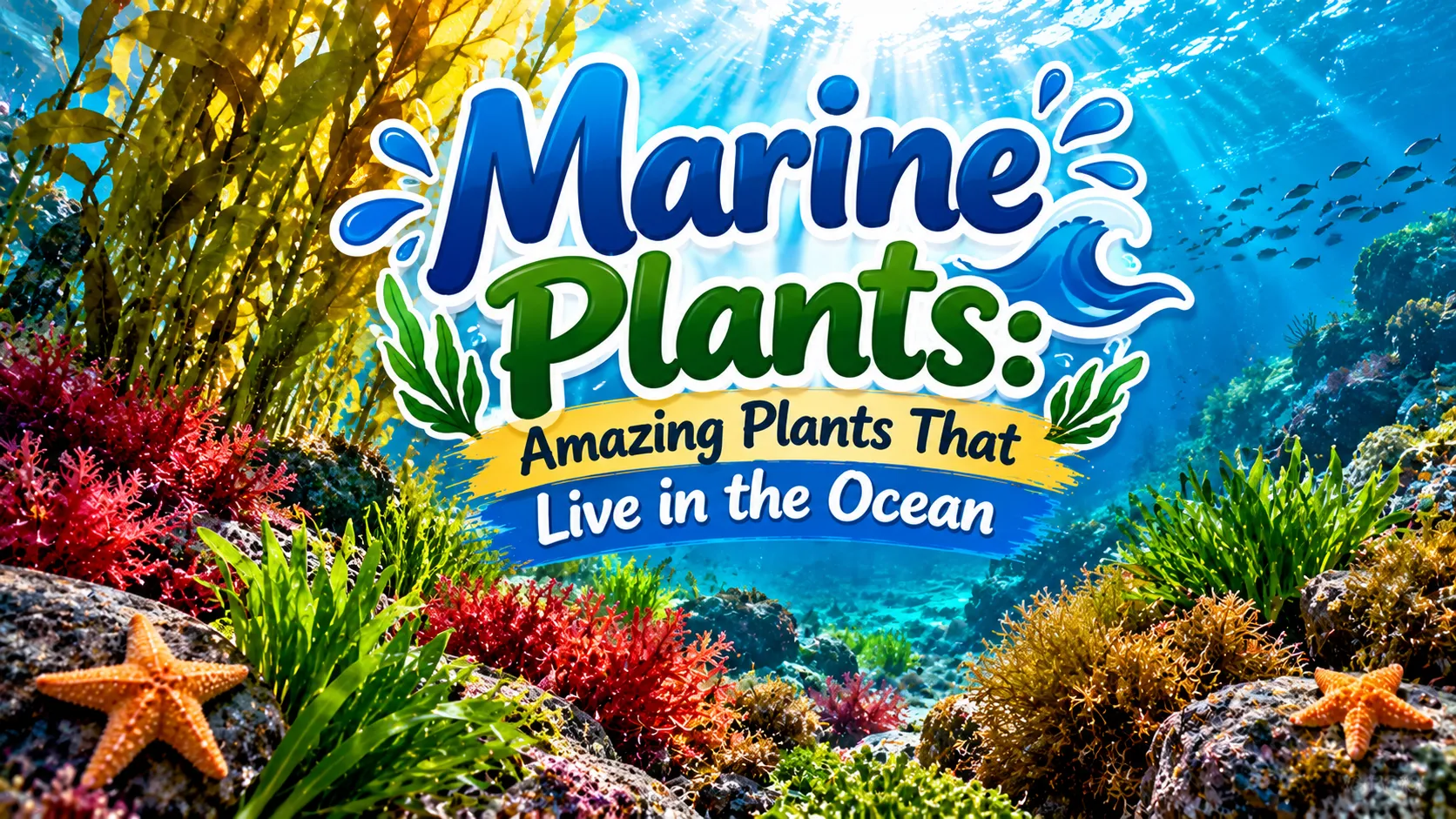
Marine plants play an essential role in keeping ocean ecosystems healthy. From underwater seagrass meadows to microscopic marine algae, these organisms provide food, produce oxygen, support marine animals, and help maintain the balance of life in the sea. Although many people imagine the ocean as a world of fish, coral reefs, and whales, plants and plant-like organisms are just as important to its survival.
Some marine plants grow in shallow coastal waters where sunlight reaches the seafloor. Others float near the ocean’s surface or form extensive underwater habitats. They come in many shapes and sizes, from tiny microscopic organisms to long, flowing seagrasses that sway with ocean currents.
Understanding marine plants helps us appreciate the complexity of ocean life and the importance of protecting coastal environments. In this guide, you’ll learn about the main types of marine plants, where they grow, how they survive underwater, and why they matter to the planet.
🌿 What Are Marine Plants?
Marine plants are photosynthetic organisms that live in saltwater environments, including oceans, seas, and coastal habitats. They use sunlight to produce energy, absorb nutrients, and support aquatic food webs.
True marine plants include seagrasses, which are flowering plants adapted to life underwater. Seaweeds, such as kelp and many other marine algae, also perform photosynthesis but belong to different biological groups. Microscopic phytoplankton contribute greatly to ocean productivity, although they are not all plants in the strict scientific sense.
These organisms occupy different parts of the marine environment. Some anchor themselves to the seafloor, while others drift through the water. Their distribution depends on sunlight, water temperature, salinity, nutrients, and the availability of suitable surfaces or sediments.
🌱 Types of Marine Plants and Plant-Like Organisms
The ocean supports several important groups of photosynthetic organisms. Each group contributes to marine ecosystems in different ways.
1. Seagrass
Seagrasses are flowering plants that grow underwater in shallow coastal waters. Unlike seaweed, they have true roots, stems, leaves, and flowers.
Common examples include eelgrass, turtle grass, and shoal grass. Seagrass meadows provide shelter for young fish, sea turtles, seahorses, and many small marine animals.
Their roots and underground stems help stabilize sediment, while their leaves slow water movement and can improve water clarity.
2. Kelp
Kelp is a large brown seaweed found mainly in cool, nutrient-rich coastal waters. Some kelp species grow into underwater forests that provide food and shelter for marine life.
Kelp attaches to rocks using a structure called a holdfast. Flexible stems and leaf-like blades allow it to move with waves and currents.
Kelp forests support fish, sea urchins, marine mammals, and numerous invertebrates. Their growth depends on factors such as water temperature, nutrients, and sunlight.
3. Green Algae
Green algae include many photosynthetic organisms that live in marine and freshwater environments. Marine examples include sea lettuce, which has thin, bright green sheets that resemble leafy vegetables.
Green algae grow on rocks, coastal surfaces, and other suitable substrates. Some species also occur as microscopic cells in the water.
They contribute to food webs and produce oxygen through photosynthesis.
4. Red Algae
Red algae are a diverse group of marine algae that often grow in coastal waters. Their pigments allow many species to absorb light at wavelengths that penetrate deeper into the water.
Some red algae form delicate, branching structures, while others have tougher or crust-like forms. Certain species contribute to reef-building processes by depositing calcium carbonate.
Red algae also provide food and habitat for various marine organisms.
5. Brown Algae
Brown algae include kelps, rockweeds, and several other types of seaweed. Most grow attached to rocks or other underwater surfaces.
They contain pigments that help them capture sunlight for photosynthesis. Some species create dense coastal habitats, while others form shorter growths along rocky shorelines.
Brown algae are important sources of food, shelter, and organic matter in many marine ecosystems.
6. Phytoplankton
Phytoplankton are microscopic organisms that float in the sunlit layers of oceans and other aquatic environments. They include photosynthetic algae and cyanobacteria.
Although they are too small to see individually without magnification, they have a major influence on marine food webs. Zooplankton eat them, small fish consume zooplankton, and larger animals feed on the organisms farther up the food chain.
Phytoplankton also play a significant role in global photosynthesis and the movement of carbon through the ocean.
🐠 Examples of Marine Plants
Marine vegetation and algae vary widely in appearance, habitat, and growth patterns. The following examples illustrate this diversity.
| Marine Organism | Group | Common Habitat |
|---|---|---|
| Eelgrass | Seagrass | Shallow coastal sediments |
| Turtle grass | Seagrass | Warm, shallow marine waters |
| Shoal grass | Seagrass | Coastal bays and lagoons |
| Giant kelp | Brown algae | Cool, rocky coastal waters |
| Sea lettuce | Green algae | Rocky shores and shallow water |
| Irish moss | Red algae | Marine coastal habitats |
| Rockweed | Brown algae | Rocky intertidal zones |
| Coralline algae | Red algae | Rocky shores and coral reef environments |
| Diatoms | Phytoplankton group | Sunlit ocean waters |
| Marine cyanobacteria | Photosynthetic bacteria | Various marine environments |
These organisms do not all belong to the same biological group. The term marine plants is often used broadly, but seagrasses are true plants, whereas seaweeds are algae and cyanobacteria are bacteria.
☀️ How Do Marine Plants Survive Underwater?
Marine plants and algae have adaptations that help them live in saltwater environments, where conditions can differ greatly from those on land.
Photosynthesis underwater: Seagrasses and marine algae use sunlight to produce energy. Most photosynthetic marine organisms grow in the sunlit zone, where enough light reaches them.
Salt tolerance: Seagrasses have adaptations that help them manage salt and maintain the balance of water inside their cells. Marine algae also possess mechanisms suited to the salinity of their habitats.
Flexible structures: Many seaweeds have flexible blades and stems that move with waves and currents. This flexibility can reduce damage from moving water.
Anchoring systems: Seagrasses use roots and underground stems to remain in sediment. Many seaweeds attach to rocks with holdfasts.
Efficient light absorption: Different photosynthetic pigments help marine organisms use the wavelengths of light available underwater. This allows certain algae to live in habitats where light conditions differ from those near the surface.
Nutrient absorption: Marine plants and algae obtain essential nutrients from surrounding water or sediment, depending on their biology and habitat.
These adaptations help different organisms survive in coastal waters, rocky shorelines, and other marine environments.
🌊 Where Do Marine Plants Grow?
Marine plants and algae grow in different parts of the ocean depending on light, temperature, water movement, nutrients, and substrate.
Shallow Coastal Waters
Shallow coastal areas often receive enough sunlight for seagrass meadows and many seaweeds to grow. Seagrasses typically root in sandy or muddy sediment, while seaweeds often attach to rocks.
These habitats can support fish, shellfish, crustaceans, and other marine animals.
Rocky Shorelines
Rocky coastlines provide surfaces where seaweeds can attach. Rockweeds and other algae may grow in the intertidal zone, where tides regularly expose them to air and cover them with seawater.
These organisms must tolerate changing moisture levels, temperature, and wave exposure.
Kelp Forests
Kelp forests grow mainly in cool coastal waters with suitable rocky surfaces and adequate nutrients. They create complex underwater habitats that support many marine species.
Their distribution can change with warming water, grazing pressure, storms, and other environmental conditions.
Open Ocean
The open ocean contains vast populations of phytoplankton. These microscopic organisms usually concentrate in sunlit waters, where they can access light for photosynthesis.
Although they do not form visible underwater meadows, phytoplankton contribute substantially to marine productivity.
🌍 Why Are Marine Plants Important?
Marine plants and photosynthetic algae provide essential services that support ocean life and contribute to the health of the planet.
They produce oxygen. Photosynthesis by marine algae and other organisms contributes substantially to Earth’s oxygen production. The exact contribution varies with environmental conditions and how oxygen production is measured.
They support food webs. Phytoplankton form the foundation of many ocean food chains. Larger algae and seagrasses also provide food directly or indirectly for marine animals.
They create habitats. Seagrass meadows and kelp forests offer shelter, nursery areas, and feeding grounds for fish and invertebrates.
They help store carbon. Seagrass ecosystems can capture and store carbon in their plants and underlying sediments over long periods. Some other marine vegetation also contributes to coastal carbon storage.
They stabilize sediment. Seagrass roots and underground stems help hold sediment in place and can reduce resuspension in suitable conditions.
They support biodiversity. Marine vegetation creates diverse habitats that allow many species to live, feed, reproduce, and find protection.
Protecting these organisms helps preserve the wider marine ecosystems that depend on them.
⚠️ Threats to Marine Plants
Marine plants and algae face several environmental pressures. Some result from human activity, while others arise from natural changes in marine conditions.
- Water pollution: Excess nutrients, chemicals, and contaminated runoff can damage sensitive habitats.
- Coastal development: Construction and dredging can disturb seagrass beds and other marine vegetation.
- Climate change: Warming water and changing ocean conditions can affect the distribution and health of marine organisms.
- Ocean acidification: Changes in seawater chemistry can affect some marine species and ecosystem relationships.
- Sediment disturbance: Cloudy water and suspended sediment can reduce the sunlight available for photosynthesis.
- Habitat destruction: Boat anchors, destructive fishing practices, and physical disturbance can damage underwater vegetation.
- Excessive nutrient runoff: Too many nutrients can encourage algal blooms that reduce water quality or block sunlight from reaching other organisms.
Not every algal bloom is harmful, and not every marine species responds to environmental change in the same way. However, protecting water quality and coastal habitats is important for maintaining healthy marine ecosystems.
🪸 Marine Plants vs. Seaweed: What’s the Difference?
The terms marine plants and seaweed are sometimes used interchangeably, but they do not mean exactly the same thing.
| Feature | Marine Plants | Seaweed |
|---|---|---|
| Biological group | True plants | Marine algae |
| Roots | Seagrasses have true roots | Usually attach using holdfasts |
| Leaves and stems | True plant structures in seagrasses | Leaf-like blades and stem-like structures are not true leaves and stems |
| Flowers and seeds | Seagrasses produce flowers and seeds | Seaweeds do not produce flowers or seeds |
| Examples | Eelgrass, turtle grass | Kelp, sea lettuce, rockweed |
The main distinction is biological. Seagrasses evolved from land plants and adapted to underwater life, while seaweeds belong to different groups of algae.
🌱 Can You Grow Marine Plants at Home?
Growing marine plants at home is possible, but it requires a suitable aquatic setup. Saltwater aquariums may support certain marine macroalgae, while seagrass cultivation requires more specialized conditions.
A successful setup depends on the species, salinity, lighting, water quality, nutrients, and water movement. Some marine algae grow relatively readily in appropriate aquariums, while seagrasses can be more challenging to maintain.
Before choosing an organism, research its exact requirements and make sure it comes from a responsible, legal source. Never collect protected seagrasses or remove organisms from sensitive coastal habitats without proper authorization.
For beginners, learning about marine algae in a well-maintained saltwater aquarium may be more practical than attempting to recreate a natural seagrass meadow.
❓ Frequently Asked Questions About Marine Plants
What are marine plants?
Marine plants are photosynthetic organisms found in saltwater environments. True marine plants include seagrasses, while seaweeds and phytoplankton are important photosynthetic organisms that are often discussed alongside them.
What are five examples of marine plants or algae?
Five familiar examples are eelgrass, turtle grass, giant kelp, sea lettuce, and rockweed. The first two are true marine plants, while the others are types of algae.
Do marine plants produce oxygen?
Yes. Seagrasses and marine algae release oxygen during photosynthesis. Marine phytoplankton also contribute significantly to oxygen production around the world.
Are seaweed and marine plants the same?
Not exactly. Seaweeds are algae, while true marine plants such as seagrasses have roots, stems, leaves, flowers, and seeds. Both groups are important to ocean ecosystems.
Do marine plants need sunlight?
Most marine plants and photosynthetic algae need light to grow. Seagrasses generally grow in shallow coastal waters, while phytoplankton and many algae occupy sunlit areas of the ocean.
Why are marine plants important to marine animals?
They provide food, shelter, breeding areas, and nursery habitats. Seagrass meadows and kelp forests support many marine species, while phytoplankton help sustain ocean food webs.
🌊 Final Thoughts
Marine plants and other photosynthetic organisms are essential to healthy ocean ecosystems. Seagrasses create underwater meadows, kelp forms impressive coastal forests, and microscopic phytoplankton support food webs across vast areas of the ocean.
Together, these organisms contribute to oxygen production, carbon cycling, habitat formation, and biodiversity. Yet pollution, coastal development, and changing ocean conditions can threaten many of the habitats where they grow.
Learning to distinguish true marine plants from seaweeds and microscopic algae helps us understand the diversity of life beneath the waves. By protecting coastal waters and reducing pollution, we can help preserve these remarkable organisms and the marine animals that depend on them.

Ethan Carter is a nature enthusiast and content writer with a passion for flowers and botanical knowledge. He is the author behind FlowerNamez, where he shares simple and informative content about flower names, types, and meanings.
With a focus on clarity and accuracy, Ethan aims to help readers explore the beauty of flowers and understand their significance in everyday life.