
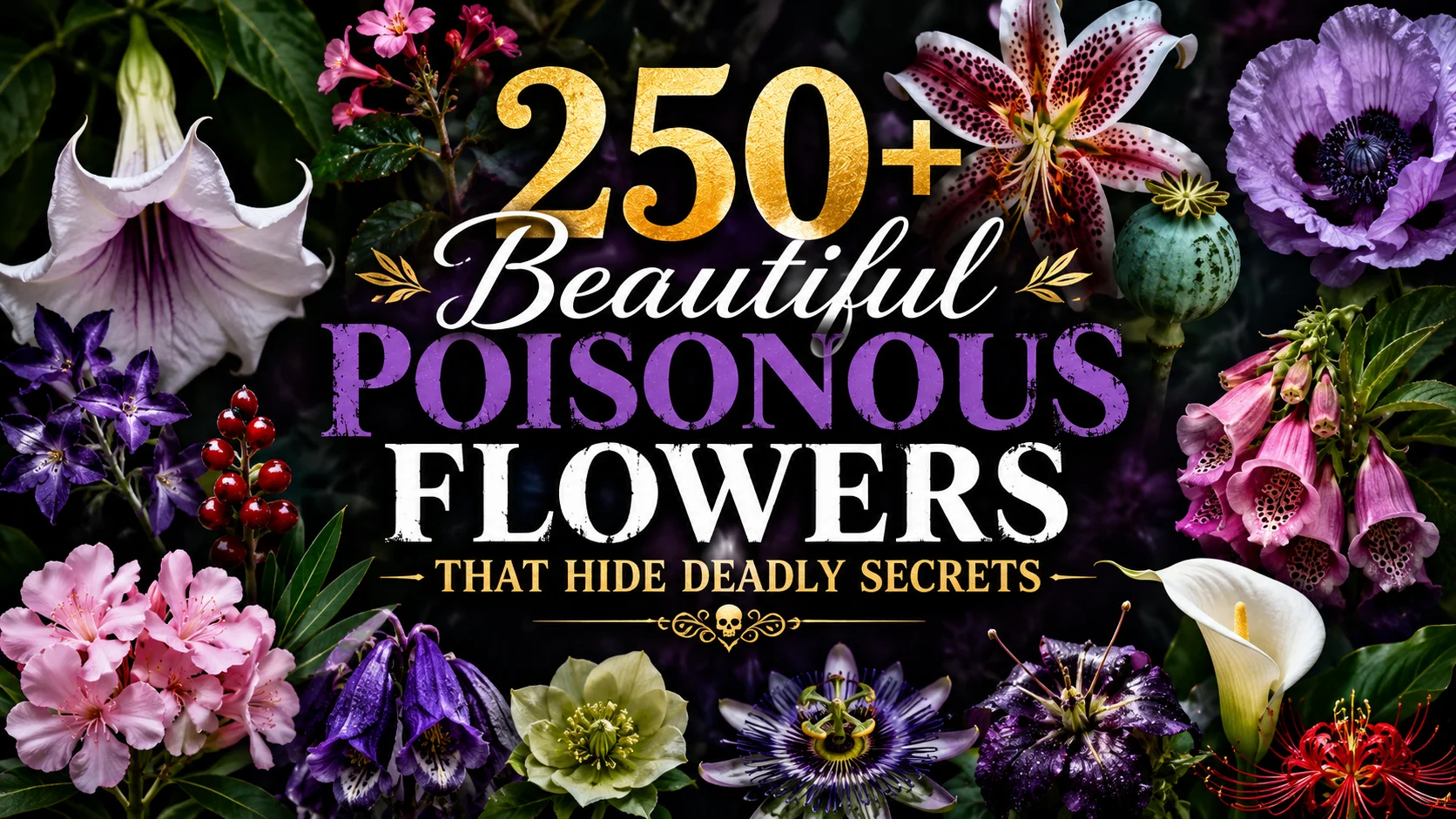
Beautiful poisonous flowers create one of nature’s most dangerous contradictions. Their striking beauty captures attention, yet many contain toxins powerful enough to cause serious harm or even death. This guide explores more than 250 of the world’s most beautiful poisonous flowers, highlighting their toxins, effects, and fascinating roles in history, medicine, and folklore. From the gardens of ancient Rome to modern floral arrangements, these flowers continue to command both admiration and respect.
Beautiful poisonous flowers also reveal nature’s extraordinary complexity. The same compounds that make these blooms dangerous have played important roles in medicine, poisons, and traditional remedies throughout history. By understanding these flowers, you can appreciate their beauty while handling them safely and responsibly.
What Are Beautiful Poisonous Flowers?
Beautiful poisonous flowers are flowering plants that contain toxic compounds capable of causing harm or death to humans and animals. Unlike harmless garden flowers, these blooms produce alkaloids, glycosides, or other chemical defenses evolved to protect the plant from herbivores. The irony is that many of these toxic flowers are among the most prized in gardens. Foxglove, oleander, lily of the valley, and wisteria are all poisonous. Millions of people grow them without ever knowing the danger hiding in their beauty.
Not all parts of a poisonous flower are equally toxic. Some flowers have poisonous seeds but harmless petals. Others have poisonous sap but edible berries. A few are so toxic that even touching them can cause a reaction. The key to safety is knowledge. Knowing which flowers are dangerous and how they can harm you allows you to appreciate their beauty without risking your health.
| Toxin Type | Common Flowers | Effect |
|---|---|---|
| Cardiac Glycosides | Foxglove, Oleander, Lily of the Valley | Disrupts heart rhythm, can cause cardiac arrest |
| Tropane Alkaloids | Angel’s Trumpet, Belladonna, Jimson Weed | Hallucinations, delirium, respiratory failure |
| Aconitine | Monkshood, Wolfsbane | Paralysis, heart failure, numbness |
| Cyanogenic Glycosides | Hydrangea, Cherry Laurel | Cyanide poisoning, respiratory failure |
| Oxalates | Calla Lily, Dieffenbachia | Burning, swelling, airway obstruction |
| Colchicine | Autumn Crocus, Glory Lily | Organ failure, bone marrow suppression |
| Ricin | Castor Bean Plant | Severe vomiting, organ failure, death |
| Alkaloids | Poppy, Nightshade, Hemlock | Nervous system depression, paralysis |
Foxglove (Digitalis purpurea)
Foxglove is one of the most recognizable beautiful poisonous flowers. Its tall spires of tubular purple, pink, white, or yellow blooms are a cottage garden favorite. But every part of this plant is highly toxic. The name “digitalis” comes from the Latin word for finger, referring to the shape of the flower that fits perfectly over a fingertip.
Foxglove contains a cardiac glycoside known as digitoxin. Doctors use this compound in small, controlled doses to treat heart failure, but larger amounts can trigger nausea, vomiting, diarrhea, irregular heartbeat, and even cardiac arrest. Some people have mistakenly identified foxglove leaves as comfrey or borage and brewed them into tea, and these mistakes have often resulted in fatal poisoning.
| Feature | Detail |
|---|---|
| Scientific Name | Digitalis purpurea |
| Common Name | Foxglove, Fairy Thimbles |
| Toxic Parts | All parts, especially leaves |
| Primary Toxin | Digitoxin (cardiac glycoside) |
| Symptoms | Nausea, irregular heartbeat, cardiac arrest |
| Lethal Dose | 2-3 leaves can be fatal |
| Native Range | Europe, Western Asia |
Oleander (Nerium oleander)
Oleander ranks among the most dangerous beautiful poisonous flowers commonly grown in gardens. Its clusters of pink, white, red, and yellow blooms create a stunning display, while the plant thrives in dry conditions with remarkable drought tolerance. Landscapers often plant oleander along highways and throughout public spaces in warm climates. However, every part of the plant contains deadly toxins, and even the smoke from burning oleander can cause serious harm.
Oleander contains oleandrin and neriine, cardiac glycosides similar to those in foxglove. Eating even a single leaf can be fatal. There are cases of people dying after roasting hot dogs on oleander sticks or using oleander branches to skewer meat. The poison causes nausea, vomiting, irregular heartbeat, and cardiac arrest. Honey made from oleander flowers is also toxic.
| Feature | Detail |
|---|---|
| Scientific Name | Nerium oleander |
| Common Name | Oleander, Rosebay |
| Toxic Parts | All parts, including smoke |
| Primary Toxin | Oleandrin, neriine |
| Symptoms | Nausea, arrhythmia, cardiac arrest |
| Lethal Dose | One leaf can be fatal |
| Native Range | Mediterranean to Southeast Asia |
Lily of the Valley (Convallaria majalis)
Lily of the Valley is the May birth flower and one of the most beloved beautiful poisonous flowers in history. Its tiny, bell-shaped white flowers have an intoxicating sweet fragrance. It is a popular ground cover in shade gardens and a classic wedding flower. Royal brides including Kate Middleton and Grace Kelly carried it in their bouquets. But this delicate beauty is hiding a deadly secret.
Every part of Lily of the Valley contains cardiac glycosides, including convallatoxin and convalloside. The poison causes nausea, vomiting, irregular heartbeat, and cardiac arrest. The water in a vase holding Lily of the Valley becomes toxic. There are cases of people drinking this water and dying. Even the red berries that appear after flowering are highly poisonous, especially attractive to children.
| Feature | Detail |
|---|---|
| Scientific Name | Convallaria majalis |
| Common Name | Lily of the Valley, May Lily |
| Toxic Parts | All parts, including vase water |
| Primary Toxin | Convallatoxin, convalloside |
| Symptoms | Nausea, irregular heartbeat, cardiac arrest |
| Lethal Dose | Several berries or leaves |
| Native Range | Europe, Asia, Eastern North America |
Angel’s Trumpet (Brugmansia)
Angel’s Trumpet stands out as one of the most visually striking beautiful poisonous flowers. Its large, pendulous trumpet-shaped blooms hang dramatically from small trees or large shrubs, creating an unforgettable display in shades of white, yellow, pink, peach, and orange. As evening falls, the flowers open and release a sweet, intoxicating fragrance that fills the air. Despite its beauty, this plant contains highly dangerous toxins and demands extreme caution.
Angel’s Trumpet contains tropane alkaloids such as scopolamine, hyoscyamine, and atropine. These compounds can trigger hallucinations, delirium, confusion, and memory loss. Severe poisoning has caused victims to behave irrationally, including running through streets disoriented or experiencing complete amnesia afterward. The toxins can also lead to seizures, respiratory failure, and death. In highly sensitive individuals, even touching the plant may cause symptoms.
| Feature | Detail |
|---|---|
| Scientific Name | Brugmansia |
| Common Name | Angel’s Trumpet |
| Toxic Parts | All parts, especially seeds and leaves |
| Primary Toxin | Scopolamine, hyoscyamine, atropine |
| Symptoms | Hallucinations, delirium, amnesia, death |
| Lethal Dose | Variable, seeds are most dangerous |
| Native Range | South America (extinct in the wild) |
Monkshood (Aconitum napellus)
Monkshood, also known as wolfsbane, is one of the most toxic beautiful poisonous flowers in existence. Its tall spires of deep purple, hooded flowers are striking in late summer and fall gardens. The name “monkshood” comes from the shape of the flower, which resembles a monk’s cowl. “Wolfsbane” comes from the ancient practice of using the poison to kill wolves.
Monkshood contains aconitine, one of the most powerful neurotoxins found in plants. This toxin can cause numbness, tingling, weakness, paralysis, and eventually death through heart failure or respiratory failure. The body can absorb the poison through the skin, and some gardeners have experienced numbness in their hands after handling the plant without gloves. In ancient times, people coated arrow tips with monkshood poison, and executioners used it during state executions.
| Feature | Detail |
|---|---|
| Scientific Name | Aconitum napellus |
| Common Name | Monkshood, Wolfsbane, Devil’s Helmet |
| Toxic Parts | All parts, especially roots |
| Primary Toxin | Aconitine |
| Symptoms | Numbness, paralysis, cardiac arrest |
| Lethal Dose | Tiny amount, absorbed through skin |
| Native Range | Europe, Asia |
Belladonna (Atropa belladonna)
Belladonna, also called deadly nightshade, has a name that means “beautiful woman” in Italian. Renaissance women used drops of belladonna extract in their eyes to dilate their pupils, a look considered fashionable at the time. The plant produces glossy black berries that look like cherries and sweet purple, bell-shaped flowers. But this is one of the most toxic beautiful poisonous flowers on earth.
The toxins in belladonna are tropane alkaloids including atropine, scopolamine, and hyoscyamine. Symptoms include dilated pupils, blurred vision, dry mouth, difficulty swallowing, rapid heartbeat, hallucinations, seizures, and death from respiratory failure. The berries are sweet and attractive to children, making belladonna one of the most dangerous plants for accidental poisoning. As few as three berries can kill a child.
| Feature | Detail |
|---|---|
| Scientific Name | Atropa belladonna |
| Common Name | Deadly Nightshade, Belladonna |
| Toxic Parts | All parts, especially berries and roots |
| Primary Toxin | Atropine, scopolamine, hyoscyamine |
| Symptoms | Dilated pupils, hallucinations, respiratory failure |
| Lethal Dose | 3-5 berries for a child |
| Native Range | Europe, North Africa, Western Asia |
Hydrangea
Hydrangeas are beloved beautiful poisonous flowers in gardens worldwide. Their large, showy clusters of blue, pink, white, or purple blooms change color based on soil pH. Acidic soil produces blue flowers. Alkaline soil produces pink. It is a favorite of gardeners and florists alike. But hydrangeas have a dangerous secret.
Hydrangeas contain cyanogenic glycosides, compounds that release hydrogen cyanide when eaten. The highest concentration is in the flower buds and leaves. Symptoms of hydrangea poisoning include nausea, vomiting, diarrhea, dizziness, and in severe cases, difficulty breathing and seizures. While fatalities are rare, the experience is extremely unpleasant. Fortunately, the bitter taste of hydrangea usually prevents large amounts from being consumed.
| Feature | Detail |
|---|---|
| Scientific Name | Hydrangea (various species) |
| Common Name | Hydrangea, Hortensia |
| Toxic Parts | Flower buds, leaves, stems |
| Primary Toxin | Hydrangin (cyanogenic glycoside) |
| Symptoms | Nausea, vomiting, dizziness, difficulty breathing |
| Lethal Dose | Large quantities rarely eaten due to bitter taste |
| Native Range | Asia, Americas |
Wisteria
Wisteria is one of the most dramatic beautiful poisonous flowers in the gardening world. Its cascading vines produce massive clusters of purple, blue, pink, or white pea-like flowers in spring. The sight of a mature wisteria in full bloom is unforgettable. But those beautiful flowers and the fuzzy seed pods that follow hide a dangerous secret.
Wisteria contains lectins and wisterin glycoside, compounds that cause severe gastrointestinal distress. The seeds and seed pods are the most toxic parts. Eating just a few seeds can cause nausea, vomiting, abdominal pain, and diarrhea that can lead to dehydration. Children are most at risk because the fuzzy seed pods are interesting to play with. There are recorded cases of children becoming seriously ill after eating wisteria seeds.
| Feature | Detail |
|---|---|
| Scientific Name | Wisteria (various species) |
| Common Name | Wisteria |
| Toxic Parts | Seeds, seed pods (most toxic), flowers |
| Primary Toxin | Lectins, wisterin glycoside |
| Symptoms | Nausea, vomiting, abdominal pain, diarrhea |
| Lethal Dose | Several seeds can cause severe illness |
| Native Range | China, Korea, Japan, Eastern US |
Autumn Crocus (Colchicum autumnale)
Autumn crocus is a beautiful poisonous flower that blooms in fall, sending up delicate pink or purple flowers without any leaves. It is often mistaken for the spring crocus, which produces the spice saffron. But the two plants are very different. Spring crocus is mildly toxic. Autumn crocus is deadly.
The toxin in autumn crocus is colchicine, which disrupts cell division. Symptoms take hours to appear and include burning in the mouth, vomiting, diarrhea, kidney failure, liver failure, and bone marrow suppression. Death can occur days after ingestion. There is no antidote for colchicine poisoning. Cases of people mistaking autumn crocus for wild garlic or saffron crocus have resulted in fatalities.
| Feature | Detail |
|---|---|
| Scientific Name | Colchicum autumnale |
| Common Name | Autumn Crocus, Meadow Saffron, Naked Lady |
| Toxic Parts | All parts, especially corms |
| Primary Toxin | Colchicine |
| Symptoms | Organ failure, bone marrow suppression, death |
| Lethal Dose | Small amount, no antidote |
| Native Range | Europe |
Daffodil (Narcissus)
Daffodils rank among the most beloved beautiful poisonous flowers of spring. Their bright yellow, white, orange, and pink blooms announce the end of winter and welcome warmer days. Gardeners plant millions of daffodils in gardens, parks, and public landscapes because they naturalize easily and return year after year. Despite their cheerful appearance, these flowers contain dangerous toxins.
Every part of the daffodil contains lycorine, an alkaloid that can cause severe vomiting. The bulb holds the highest concentration of the toxin, and people sometimes mistake it for an onion. Several recorded incidents describe people cooking daffodil bulbs instead of onions and becoming violently ill afterward. Poisoning symptoms include nausea, vomiting, diarrhea, abdominal pain, and, in some cases, cardiac arrhythmias. Fortunately, the bulbs have a very bitter taste, which usually prevents people from consuming large amounts.
| Feature | Detail |
|---|---|
| Scientific Name | Narcissus (various species) |
| Common Name | Daffodil, Narcissus, Jonquil |
| Toxic Parts | All parts, especially bulbs |
| Primary Toxin | Lycorine |
| Symptoms | Nausea, vomiting, diarrhea, abdominal pain |
| Lethal Dose | Large quantities rarely eaten |
| Native Range | Europe, North Africa |
Rhododendron and Azalea
Rhododendrons and azaleas rank among the most spectacular beautiful poisonous flowers in the gardening world. Their large clusters of pink, red, white, purple, yellow, and orange blooms cover entire shrubs each spring, making them standout features in woodland gardens and public parks. Despite their beauty, these plants have poisoned both people and livestock for thousands of years.
Rhododendrons and azaleas contain grayanotoxins, compounds that interfere with sodium channels in cell membranes. Every part of the plant contains these toxins, including the flowers and nectar. Bees that collect nectar from rhododendrons can produce “mad honey,” a toxic honey that may cause dizziness, weakness, sweating, low blood pressure, and irregular heart rhythms. Historical records even describe armies falling ill after consuming mad honey left along their routes. People who eat the leaves or flowers can experience the same dangerous effects.
| Feature | Detail |
|---|---|
| Scientific Name | Rhododendron (various species) |
| Common Name | Rhododendron, Azalea |
| Toxic Parts | All parts, including nectar |
| Primary Toxin | Grayanotoxin |
| Symptoms | Dizziness, weakness, low blood pressure, arrhythmia |
| Lethal Dose | Variable, mad honey is well documented |
| Native Range | Asia, Europe, North America |
Poppy (Papaver somniferum)
The opium poppy is one of the most historically significant beautiful poisonous flowers. Its large, delicate petals in white, pink, red, purple, and lavender have inspired artists and poets for centuries. The seed pod that follows is the source of opium, morphine, codeine, and heroin. This flower has shaped wars, economies, and medical practices.
The toxic compounds in poppies are alkaloids including morphine, codeine, thebaine, and papaverine. These compounds depress the central nervous system, causing drowsiness, slowed breathing, and in large amounts, respiratory failure and death. While poppy seeds used in baking contain only trace amounts, other parts of the plant are highly potent. Home cultivation of opium poppies is illegal in many countries due to their narcotic properties.
| Feature | Detail |
|---|---|
| Scientific Name | Papaver somniferum |
| Common Name | Opium Poppy, Breadseed Poppy |
| Toxic Parts | Latex (sap), seed pods, leaves |
| Primary Toxin | Morphine, codeine, thebaine |
| Symptoms | Drowsiness, respiratory depression, death |
| Lethal Dose | Variable, depends on potency |
| Native Range | Eastern Mediterranean |
Castor Bean Plant (Ricinus communis)
The castor bean plant is grown as an ornamental beautiful poisonous flower for its dramatic, star-shaped leaves and red, spiny seed pods. It is a fast-growing plant that adds a tropical feel to gardens. But those pretty seed pods contain one of the deadliest toxins known to science.
The seeds of the castor bean plant contain ricin, a protein that inhibits protein synthesis in cells. Ricin is so toxic that a single seed can kill a child. There is no antidote. Ricin gained notoriety in the 1978 Georgi Markov assassination, where a pellet containing ricin was injected into his leg using a modified umbrella. Symptoms of ricin poisoning include nausea, vomiting, internal bleeding, organ failure, and death within days. Despite its danger, castor oil, made by pressing seeds, is safe because the ricin is destroyed by heat during processing.
| Feature | Detail |
|---|---|
| Scientific Name | Ricinus communis |
| Common Name | Castor Bean Plant |
| Toxic Parts | Seeds (beans) |
| Primary Toxin | Ricin |
| Symptoms | Nausea, internal bleeding, organ failure, death |
| Lethal Dose | One seed can kill a child |
| Native Range | Eastern Africa, Middle East |
Calla Lily (Zantedeschia aethiopica)
Calla lilies are elegant beautiful poisonous flowers often used in weddings and formal arrangements. Their smooth, white spathes (the part we call the flower) surround a yellow spadix. They are not true lilies but are beloved for their clean, modern look. But calla lilies are hiding a burning secret.
Calla lilies contain calcium oxalate crystals, which are shaped like tiny needles. When plant tissue is chewed, these crystals embed in the mouth and throat, causing immediate intense burning, swelling, and difficulty swallowing. In severe cases, swelling can block the airway. While calla lilies are rarely fatal, the experience is extremely painful. Children and pets are most at risk due to the plant’s attractive appearance.
| Feature | Detail |
|---|---|
| Scientific Name | Zantedeschia aethiopica |
| Common Name | Calla Lily, Arum Lily |
| Toxic Parts | All parts |
| Primary Toxin | Calcium oxalate crystals |
| Symptoms | Burning, swelling, difficulty swallowing |
| Lethal Dose | Rarely fatal, but extremely painful |
| Native Range | Southern Africa |
Larkspur (Delphinium)
Larkspur, also known as delphinium, produces tall spires of blue, purple, pink, or white flowers that are the pride of many summer gardens. The name comes from the shape of the flower, which resembles the spur of a lark. These beautiful poisonous flowers are popular in cottage gardens and cutting gardens. But they are deadly to livestock and dangerous to humans.
Larkspur contains diterpene alkaloids that act on the nervous system, causing paralysis and respiratory failure. Cattle are often poisoned by grazing on larkspur in mountain pastures. Human poisonings are rare but have occurred when people mistook larkspur for a edible herb. Symptoms include nausea, muscle weakness, paralysis, and death by respiratory failure. Even the nectar is toxic to bees in large quantities.
| Feature | Detail |
|---|---|
| Scientific Name | Delphinium (various species) |
| Common Name | Larkspur, Delphinium |
| Toxic Parts | All parts, especially young plants and seeds |
| Primary Toxin | Diterpene alkaloids |
| Symptoms | Nausea, paralysis, respiratory failure |
| Lethal Dose | Variable, fatal to livestock |
| Native Range | Northern Hemisphere |
Hemlock (Conium maculatum)
Hemlock is one of the most infamous beautiful poisonous flowers in history. Socrates was executed by drinking a cup of hemlock tea. The plant produces clusters of small white flowers that look similar to Queen Anne’s Lace, wild carrot, or parsnip. It is this resemblance that has caused many accidental poisonings throughout history.
The toxin in hemlock is coniine, an alkaloid that acts on the nervous system, causing ascending paralysis. Victims remain conscious while their body becomes progressively paralyzed until they die of respiratory failure. This is exactly what happened to Socrates. He described the numbness spreading from his feet to his chest, knowing he was dying. Hemlock is a biennial plant that grows in ditches, fields, and roadsides across Europe and North America.
| Feature | Detail |
|---|---|
| Scientific Name | Conium maculatum |
| Common Name | Hemlock, Poison Hemlock |
| Toxic Parts | All parts, especially seeds and roots |
| Primary Toxin | Coniine |
| Symptoms | Ascending paralysis, respiratory failure |
| Lethal Dose | Small amount, historically used for executions |
| Native Range | Europe, North Africa, Asia |
How to Grow Beautiful Poisonous Flowers Safely
Growing beautiful poisonous flowers does not mean you cannot enjoy them. It just means you need to take precautions. Wear gloves when handling any plant you know or suspect might be toxic. Wash your hands thoroughly after gardening. Keep poisonous flowers away from children and pets. Label your plants clearly. Do not plant them near vegetable gardens where they might be mistaken for food. Do not burn plant debris of poisonous flowers; the smoke can be toxic. And always, always teach children not to put any plant part in their mouths without adult supervision.
| Safety Tip | Why It Matters |
|---|---|
| Wear gloves | Many toxins absorb through skin |
| Wash hands | Prevents accidental transfer to mouth |
| Keep away from children | Children are most at risk |
| Keep away from pets | Pets may chew on plants |
| Label plants clearly | Prevents accidental ingestion |
| Do not burn debris | Smoke from toxic plants is dangerous |
| Do not plant near vegetables | Prevents mistaken identity |
| Teach children plant safety | Education prevents accidents |
Medicinal Uses of Poisonous Flowers
Many beautiful poisonous flowers have been used as medicines for centuries. Foxglove gave us digitalis, a heart medication still used today. Poppies gave us morphine and codeine, powerful pain relievers. Belladonna gave us atropine, used in eye exams and to treat certain poisonings. Autumn crocus gave us colchicine, used to treat gout. The line between poison and medicine is often just a matter of dose. The same compound that kills in large amounts can heal in small, controlled amounts.
| Flower | Poison | Medical Use |
|---|---|---|
| Foxglove | Digitoxin | Heart failure medication |
| Opium Poppy | Morphine | Pain relief |
| Belladonna | Atropine | Eye exams, nerve agent treatment |
| Autumn Crocus | Colchicine | Gout treatment |
| Monkshood | Aconitine | Formerly used as a painkiller |
| Periwinkle | Vinblastine | Chemotherapy |
| Yew | Taxol | Chemotherapy |
Poisonous Flowers in History and Folklore
Beautiful poisonous flowers have played dramatic roles throughout history. Socrates was executed with hemlock. Cleopatra is said to have tested poisons on slaves before using them on herself. The Borgia family used cantarella, believed to be an arsenic-based poison, to eliminate rivals. In medieval Europe, belladonna was used in “flying ointments” that witches supposedly used to fly. The ointments actually contained tropane alkaloids that caused hallucinations of flight.
Mad honey made from rhododendron nectar was used as a biological weapon. Armies would leave pots of mad honey in the path of enemy soldiers, who would consume it and become too weak to fight. In ancient Rome, laurel water (distilled from cherry laurel, which contains cyanide) was used for executions. The line between medicine, poison, and magic has always been blurred with these deadly blooms.
| Historical Event | Flower Involved | Outcome |
|---|---|---|
| Execution of Socrates | Hemlock | Ascending paralysis, death |
| Borgia Poisonings | Cantarella (likely arsenic from flowers) | Elimination of political rivals |
| Mad Honey Warfare | Rhododendron | Soldiers incapacitated |
| Witch Flying Ointments | Belladonna, Henbane | Hallucinations of flight |
| Roman Executions | Cherry Laurel | Cyanide poisoning |
Poisonous Flowers in Literature and Art
Beautiful poisonous flowers have inspired writers and artists for centuries. In Shakespeare’s “Hamlet,” Ophelia distributes rue (“herb of grace”) and famously sings about “rosemary, pansies, fennel, columbines, and daisies” before her death. In “Romeo and Juliet,” Friar Laurence uses a potion made from “distilled liquor” that might have been derived from poisonous plants and also In modern literature, the “Hunger Games” series features nightlock, a fictional poisonous berry based on real deadly nightshade.
Artists have also been drawn to the dark beauty of poisonous flowers. Georgia O’Keeffe painted jimson weed, a toxic hallucinogen. Medieval illuminated manuscripts often depicted mandrake, a poisonous plant with hallucinogenic properties. The Pre-Raphaelite painters frequently included poisonous flowers in their works as symbols of hidden danger, forbidden love, or the fleeting nature of beauty.
| Work | Flower | Significance |
|---|---|---|
| Hamlet (Shakespeare) | Rue, Pansies, Daisies | Symbolism of regret, thoughts, innocence |
| Romeo and Juliet (Shakespeare) | Poison from flowers | The lovers’ tragic end |
| The Hunger Games (Collins) | Nightlock | Poisonous berry based on nightshade |
| O’Keeffe paintings | Jimson Weed | Hallucinogenic properties |
| Pre-Raphaelite art | Various poisonous flowers | Symbols of hidden danger |
Most Poisonous Flowers for Pets
Many beautiful poisonous flowers are especially dangerous for pets. Dogs and cats may chew on plants out of curiosity. Cats are particularly sensitive to lilies. True lilies (Lilium species) can cause fatal kidney failure in cats, even from small amounts of pollen. Sago palms are highly toxic to dogs, causing liver failure. Oleander is deadly to all animals. Rhododendrons and azaleas cause vomiting, weakness, and coma in pets. If you have pets, research every plant before bringing it into your home or garden.
| Flower | Danger to Dogs | Danger to Cats | Danger to Horses |
|---|---|---|---|
| Lily (true) | Moderate | Extreme (kidney failure) | Moderate |
| Oleander | Extreme | Extreme | Extreme |
| Sago Palm | Extreme (liver failure) | Extreme | Not applicable |
| Rhododendron | Moderate | Moderate | Extreme |
| Foxglove | Extreme | Extreme | Extreme |
| Autumn Crocus | Extreme | Extreme | Extreme |
| Daffodil | Moderate | Moderate | Moderate |
| Tulip (bulb) | Moderate | Moderate | Moderate |
FAQs About Beautiful Poisonous Flowers
What is the most beautiful poisonous flower?
Beauty is subjective, but many consider the rose, lily of the valley, oleander, and angel’s trumpet among the most beautiful poisonous flowers. The lotus is also stunning and contains mild psychoactive compounds. Each has its own unique form, color, and fragrance that makes it unforgettable.
What is the deadliest flower in the world?
The oleander is often cited as the deadliest common garden flower. Every part is toxic, and eating even one leaf can be fatal. The castor bean plant contains ricin, one of the most potent toxins known. However, the title of “deadliest” depends on accessibility and potency.
Can touching a poisonous flower hurt you?
For most poisonous flowers, touching is harmless as long as you wash your hands afterward. However, some flowers like monkshood, poison ivy (not a flower), and giant hogweed can cause skin reactions or absorb through the skin. Always wear gloves when handling unfamiliar plants.
Are there any poisonous flowers that smell good?
Yes. Lily of the valley has an intoxicating sweet fragrance. Hyacinths have strong, sweet scents but contain oxalic acid. Angel’s trumpet fills the evening air with a sweet, intoxicating perfume. Wisteria flowers have a sweet grape-like scent. Beauty and danger often share the same space.
What should I do if someone eats a poisonous flower?
Call poison control immediately. Do not induce vomiting unless instructed. Try to identify the plant and how much was eaten. Bring a sample of the plant to the hospital if possible. Do not wait for symptoms to appear. Early treatment saves lives.
Can I grow poisonous flowers if I have children?
Yes, but with precautions. Plant them in areas children cannot access. Teach children never to put any plant part in their mouths. Remove fallen flowers and seed pods promptly. Consider planting non-toxic alternatives in areas where children play. Education and supervision are key.
Conclusion
Beautiful poisonous flowers are nature’s reminder that not everything lovely is safe. The rose has thorns. The lily of the valley has deadly glycosides. The oleander’s pink blossoms can stop a heart. These flowers do not hide their danger. They advertise it in their toxicity and their bitterness. But they do not stop being beautiful because they are deadly. Perhaps that is the lesson. Beauty and danger can coexist. The most stunning things in life often demand the most respect.
So here is my question for you. Have you ever grown a beautiful poisonous flower without knowing its danger? Or do you grow them intentionally, respecting their power? Drop your answer in the comments below. Let us share stories of these deadly beauties. I will go first. I grew oleander for years before I learned how toxic it was and I still grow it, but now I wear gloves. What about you?

Ethan Carter is a nature enthusiast and content writer with a passion for flowers and botanical knowledge. He is the author behind FlowerNamez, where he shares simple and informative content about flower names, types, and meanings.
With a focus on clarity and accuracy, Ethan aims to help readers explore the beauty of flowers and understand their significance in everyday life.