
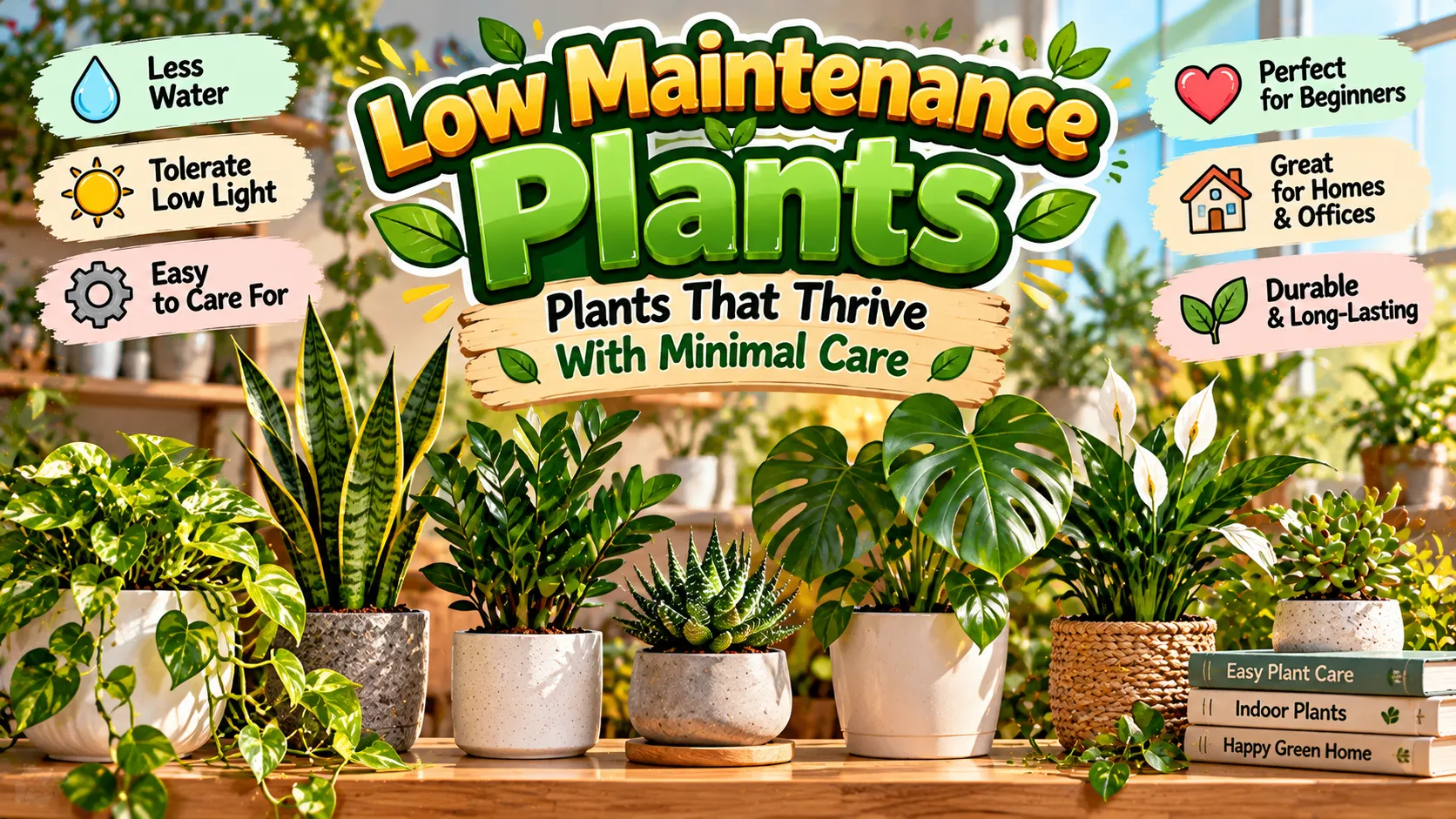
Low maintenance plants are perfect for anyone who wants a beautiful home, garden, or green space without spending hours watering, pruning, and troubleshooting plant problems. Whether you are a beginner, a busy homeowner, or someone who simply prefers easy gardening, the right plants can make caring for greenery feel effortless.
From hardy indoor houseplants to drought-tolerant outdoor flowers, plenty of plants grow well with minimal attention. Some tolerate occasional watering, others thrive in low-light rooms, and many outdoor varieties can handle heat once their roots are established.
In this guide, you will discover more than 50 low maintenance plants for indoor spaces, outdoor gardens, balconies, and small apartments. You will also learn how to choose easy-care varieties, avoid common plant care mistakes, and keep your plants healthy without creating a complicated gardening routine.
🌱 What Are Low Maintenance Plants?
Low maintenance plants are varieties that generally require less frequent watering, limited pruning, and relatively simple growing conditions compared with more demanding plants. Many are naturally hardy, tolerate occasional care mistakes, or adapt well to their environment.
However, low maintenance does not mean no maintenance. Every plant needs suitable light, water, and growing conditions. A plant that thrives in a sunny garden may struggle in a dark room, while a drought-tolerant variety may develop root problems if its soil stays wet.
The best choice depends on where you plan to grow it. Indoor plants need suitable light and drainage, while outdoor plants must tolerate your local temperatures, rainfall, and soil conditions.
Why choose easy-care plants?
- Save time: Spend less time watering and pruning.
- Beginner-friendly: Start gardening without complicated routines.
- Reduce maintenance costs: Many hardy varieties need fewer supplies.
- Enjoy lasting greenery: Choose plants suited to your environment.
- Create a relaxing space: Add natural beauty to homes, offices, patios, and gardens.
Choosing plants that naturally fit your surroundings is often the easiest way to enjoy healthy greenery.
🪴 Best Low Maintenance Indoor Plants for Beginners
Indoor plants can brighten rooms, soften furniture arrangements, and bring a natural touch to your home. The easiest varieties are usually adaptable and do not require a strict watering schedule.
Before choosing a plant, consider how much natural light your room receives. Low-light tolerant does not mean a plant can survive without light, and even hardy varieties can struggle if placed in a completely dark corner.
1. Snake Plant
The snake plant (Dracaena trifasciata) is one of the most popular choices for beginners. Its upright leaves feature attractive green patterns, and some varieties have yellow edges.
It tolerates a range of indoor light conditions and generally prefers its soil to dry between waterings. Overwatering is a more common problem than underwatering.
Care tip: Use a pot with drainage holes and avoid keeping the roots constantly wet.
2. ZZ Plant
The ZZ plant (Zamioculcas zamiifolia) has glossy, dark green leaves and thick underground rhizomes that store water.
It tolerates lower indoor light than many houseplants and usually needs watering only after its potting mix has dried considerably. It is particularly useful for people who sometimes forget their watering routine.
Care tip: Keep it away from persistently wet soil. The plant is toxic if chewed, so place it out of reach of children and pets.
3. Pothos
Pothos (Epipremnum aureum) is a trailing houseplant with heart-shaped leaves. Depending on the variety, its foliage may be green, golden, or variegated.
It grows well in bright, indirect light and can tolerate moderate indoor conditions. Its trailing stems look attractive on shelves, plant stands, and hanging baskets.
Care tip: Water when the upper portion of the potting mix begins to dry.
4. Spider Plant
The spider plant (Chlorophytum comosum) has narrow, arching leaves that may be green or striped with white.
It adapts well to many indoor environments and produces small plantlets on long stems when mature. These plantlets can be rooted to create additional plants.
Care tip: Provide bright, indirect light and water when the soil begins to dry.
5. Cast Iron Plant
The cast iron plant (Aspidistra elatior) is known for its tough, dark green leaves and tolerance of lower light.
It grows slowly and does not require frequent pruning. This makes it suitable for indoor spaces where a dramatic, fast-growing plant is not necessary.
Care tip: Allow the potting mix to dry somewhat between waterings.
6. Heartleaf Philodendron
Heartleaf philodendron (Philodendron hederaceum) is a trailing plant with soft, heart-shaped leaves.
It is adaptable and can grow in bright, indirect light or moderate indoor light. Its vines can be trained along a support or allowed to hang naturally.
Care tip: Avoid overwatering, and remember that philodendrons are toxic if chewed by pets or people.
7. Chinese Evergreen
Chinese evergreen (Aglaonema species) is valued for its attractive foliage, which may include shades of green, silver, pink, or red.
Many varieties adapt to indoor conditions and prefer indirect light. Variegated varieties may need brighter light to maintain their colors.
Care tip: Use well-draining soil and protect the plant from cold drafts.
8. Rubber Plant
The rubber plant (Ficus elastica) has large, glossy leaves and can develop into an impressive indoor tree.
It is relatively straightforward to care for when given enough light and space. Its watering needs depend on its size, pot, and growing conditions.
Care tip: Place it near a bright window with indirect light and let the upper soil dry before watering again.
9. Jade Plant
Jade plant (Crassula ovata) is a succulent with thick leaves and sturdy stems.
It stores water in its leaves, making it suitable for people who prefer less frequent watering. It needs plenty of light to maintain compact, healthy growth.
Care tip: Let the soil dry between waterings and use a well-draining succulent mix. Jade plants can be toxic to pets.
10. Aloe Vera
Aloe vera is a succulent with fleshy leaves that store water.
It prefers bright light and dry conditions between waterings. A sunny windowsill can be a good location, provided the plant adjusts gradually to direct sunlight.
Care tip: Use a pot with drainage holes. Aloe vera can be toxic to cats and dogs if ingested.
🌿 More Easy-Care Houseplants for Busy People
If you want variety beyond the most familiar indoor plants, several other houseplants offer attractive foliage without demanding an elaborate routine.
Match each variety to its light and moisture needs rather than treating every houseplant the same way.
11. Peace Lily
Peace lily (Spathiphyllum species) has deep green leaves and elegant white flower-like structures called spathes.
It prefers indirect light and evenly moist soil, so it needs more regular attention than drought-tolerant succulents. Its leaves may droop when thirsty, although it is better not to wait for severe wilting.
Care tip: Check the soil regularly and keep it away from pets because it contains irritating calcium oxalate crystals.
12. Monstera
Monstera deliciosa is known for its large leaves with distinctive splits and holes as the plant matures.
It is relatively easy to maintain in a bright room with indirect light. Given enough space and support, it can become a striking feature plant.
Care tip: Water when the upper soil begins to dry and provide a moss pole or sturdy support if desired. It is toxic if chewed.
13. Dracaena
Dracaena species include upright houseplants with narrow or broad leaves in green, yellow, and striped patterns.
Many tolerate typical indoor conditions and grow slowly enough to avoid frequent pruning.
Care tip: Provide suitable indirect light and avoid keeping the roots wet. Many dracaenas are toxic to cats and dogs.
14. Parlor Palm
Parlor palm (Chamaedorea elegans) is a compact palm that can adapt to many indoor settings.
It grows relatively slowly and prefers indirect light rather than intense midday sun. Its delicate fronds add a soft, tropical appearance to living rooms and offices.
Care tip: Water when the top layer of soil begins to dry and avoid leaving the pot in standing water.
15. Ponytail Palm
Ponytail palm (Beaucarnea recurvata) has a swollen trunk base that stores water and long, curling leaves.
Despite its common name, it is not a true palm. It thrives in bright light and tolerates periods of dry soil.
Care tip: Use a well-draining mix and avoid frequent watering.
16. Haworthia
Haworthia is a group of small succulents with fleshy leaves, often marked with stripes, spots, or raised patterns.
These compact plants work well on desks and sunny windowsills. They generally need less water than leafy tropical houseplants.
Care tip: Give them bright, indirect light and allow the soil to dry between waterings.
17. Echeveria
Echeveria succulents form attractive rosettes in shades of green, blue, pink, and purple.
They are relatively easy to care for when grown in bright light and well-draining soil. They are not ideal for dark rooms, where their growth can become stretched and weak.
Care tip: Water the soil rather than keeping the leaves wet, and allow the mix to dry before watering again.
18. English Ivy
English ivy (Hedera helix) is a trailing or climbing plant with lobed leaves.
It can grow indoors in bright, indirect light, but it may need more attention than particularly drought-tolerant houseplants because it prefers consistent moisture and good airflow.
Care tip: Check for pests and keep the plant away from pets because it can be toxic if eaten.
19. Peperomia
Peperomia species are compact houseplants with varied leaf shapes, colors, and textures.
Many varieties prefer moderate watering and indirect light. Their manageable size makes them suitable for desks, shelves, and smaller rooms.
Care tip: Let the upper soil dry before watering, and avoid placing the pot in standing water.
20. Christmas Cactus
Christmas cactus (Schlumbergera species) is a tropical cactus that grows naturally in forest environments rather than dry deserts.
It prefers bright, indirect light and a growing mix that drains well while retaining some moisture. With suitable conditions, it can produce colorful flowers.
Care tip: Water when the surface of the mix begins to dry, and avoid prolonged dryness or waterlogged roots.
🌵 Low Maintenance Outdoor Plants for Gardens and Yards
Outdoor plants must cope with the weather, soil, and sunlight in your area. Fortunately, many perennials, shrubs, and ornamental grasses grow well with relatively little care once established.
For the easiest garden, choose plants suited to your climate and group varieties with similar watering needs together.
21. Lavender
Lavender (Lavandula species) is known for its fragrant foliage and purple flower spikes.
It prefers full sun and well-drained soil. Once established in a suitable climate, it can tolerate dry periods and generally needs little pruning beyond occasional shaping.
Care tip: Avoid waterlogged soil, which can cause root problems.
22. Coneflower
Coneflower (Echinacea species) is a hardy perennial with prominent central cones and daisy-like petals.
Many varieties grow well in sunny gardens and attract pollinators. Established plants often tolerate short periods of dry weather.
Care tip: Plant in a sunny location and remove spent flowers if you want to encourage additional blooms.
23. Black-Eyed Susan
Black-eyed Susan (Rudbeckia hirta and related species) produces bright yellow flowers with dark centers.
It is popular in sunny borders and naturalistic gardens. Depending on the species and climate, it may grow as an annual, biennial, or perennial.
Care tip: Provide good drainage and water during extended dry spells.
24. Daylily
Daylilies (Hemerocallis species) are dependable flowering perennials with colorful blooms.
They grow in a range of garden conditions and generally require little more than occasional watering, cleanup, and division when clumps become crowded.
Care tip: Choose a variety suited to your climate and sunlight conditions.
25. Sedum
Sedum, also called stonecrop, includes many drought-tolerant succulents and flowering perennials.
Low-growing varieties work well as ground cover, while taller types produce clusters of flowers that attract pollinators.
Care tip: Give most garden sedums good drainage and plenty of sunlight.
26. Yarrow
Yarrow (Achillea millefolium) is a hardy perennial with finely divided leaves and clusters of small flowers.
It grows well in sunny locations and often tolerates dry soil after establishment. Some varieties spread readily, so choose a suitable cultivar for your garden.
Care tip: Avoid excessive fertilizer, which can encourage weak growth.
27. Russian Sage
Russian sage (Salvia yangii) is a woody perennial with silvery foliage and airy purple-blue flowers.
It performs well in sunny gardens with good drainage and is particularly useful in dry borders.
Care tip: Avoid planting it in soil that stays wet during winter.
28. Ornamental Grasses
Ornamental grasses include many easy-care species, such as little bluestem (Schizachyrium scoparium) and suitable fountain grass varieties.
They add movement, texture, and seasonal interest to garden beds. Native grasses are often especially useful because they are adapted to local conditions.
Care tip: Choose a species appropriate for your region and cut back dead growth when needed.
29. Rosemary
Rosemary (Salvia rosmarinus) is an aromatic evergreen shrub that can also be harvested for cooking.
It prefers plenty of sunlight and well-drained soil. In suitable climates, established plants need relatively little attention.
Care tip: Protect it from severe frost where necessary and avoid overwatering.
30. Thyme
Thyme (Thymus vulgaris and related species) is a low-growing herb with small aromatic leaves.
It works well in sunny herb gardens, containers, and some pathways. Once established, it often tolerates dry conditions.
Care tip: Use a free-draining growing mix and trim lightly to maintain compact growth.
🌼 Low Maintenance Flowering Plants for Color All Season
Flowering plants can create a colorful garden without requiring constant care. The key is to select varieties that naturally suit your growing conditions and flowering season.
Some plants bloom for months, while others provide a shorter but impressive display. Combining several varieties can help maintain interest throughout the year.
31. Zinnia
Zinnias produce colorful flowers in shades of pink, orange, red, yellow, purple, and white.
They grow well in warm weather and sunny locations. Many varieties flower generously when given adequate light and reasonable soil conditions.
Care tip: Water at the base of the plant when needed and provide enough spacing for airflow.
32. Marigold
Marigolds (Tagetes species) are popular annuals with orange, yellow, and gold flowers.
They are generally easy to grow from seed or nursery plants and perform well in sunny beds and containers.
Care tip: Avoid persistently soggy soil and remove fading flowers to keep plants tidy.
33. Portulaca
Portulaca, often called moss rose, includes heat-loving plants with colorful flowers and succulent-like leaves.
It thrives in sunny locations and well-drained soil, making it a useful option for hot gardens and containers.
Care tip: Provide plenty of light and avoid excessive watering.
34. Vinca
Annual vinca (Catharanthus roseus) produces flowers in shades of pink, white, red, and purple.
It tolerates heat and can perform well in sunny beds once established. It is often chosen for warm-weather gardens.
Care tip: Plant it in well-drained soil and avoid excessive moisture.
35. Cosmos
Cosmos are airy flowering plants with delicate foliage and daisy-like blooms.
They grow well in sunny areas and often perform best in relatively poor to moderately fertile soil. Excess fertilizer can encourage leafy growth at the expense of flowers.
Care tip: Give plants enough space and avoid overfeeding.
36. Coreopsis
Coreopsis is a group of flowering plants that includes many cheerful yellow, pink, and red varieties.
Several species are drought-tolerant once established and work well in sunny borders and pollinator gardens.
Care tip: Select a species suited to your region and remove faded flowers if desired.
37. Blanket Flower
Blanket flower (Gaillardia species) produces bright, daisy-like flowers in red, orange, and yellow.
Many varieties thrive in sunny locations and well-drained soil. They are particularly useful in warm, dry garden areas.
Care tip: Avoid planting in heavy soil that remains wet for long periods.
38. Verbena
Verbena includes annuals and perennials that produce clusters of small flowers.
Many varieties are useful in sunny borders, hanging baskets, and containers. Their care needs vary by species, but suitable types can provide long-lasting color.
Care tip: Check the plant label for watering and climate requirements before choosing a variety.
🏡 Low Maintenance Plants for Small Spaces and Apartments
You do not need a large garden to enjoy greenery. Compact houseplants, succulents, and small container plants can bring life to balconies, desks, kitchens, and apartment windows.
The best choices depend on available light, room temperature, and how much space you have for mature growth.
39. Chinese Money Plant
Chinese money plant (Pilea peperomioides) has round, coin-shaped leaves and a compact growth habit.
It prefers bright, indirect light and moderate watering. Mature plants may produce small offsets that can be propagated.
Care tip: Rotate the pot occasionally to encourage balanced growth.
40. Air Plants
Air plants (Tillandsia species) grow without traditional soil and absorb water and nutrients through their leaves.
They are often displayed in decorative holders or mounted arrangements. However, they still need suitable light, airflow, and regular hydration.
Care tip: Follow the watering requirements of the particular species, and let the plant dry appropriately after soaking or rinsing.
41. String of Hearts
String of hearts (Ceropegia woodii) is a trailing plant with small, heart-shaped leaves.
It looks attractive on shelves and in hanging pots. Its storage structures allow it to tolerate some dryness between waterings.
Care tip: Provide bright, indirect light and a well-draining mix.
42. Gasteria
Gasteria is a group of compact succulents with thick leaves, often decorated with pale spots or stripes.
Many varieties tolerate indoor conditions well when they receive suitable light and are not overwatered.
Care tip: Allow the potting mix to dry between waterings.
43. Bird’s Nest Fern
Bird’s nest fern (Asplenium nidus) has broad, rippled leaves that grow in a central rosette.
It prefers indirect light and more moisture than desert succulents. It can be a relatively manageable option in a warm room with suitable humidity.
Care tip: Keep the soil lightly moist without leaving the pot waterlogged.
44. Lucky Bamboo
Lucky bamboo is commonly sold as Dracaena sanderiana, although it is not a true bamboo.
It is often grown in water or a well-draining potting mix and is popular for desks and indoor displays.
Care tip: Use clean water if growing it hydroponically and provide bright, indirect light. It is toxic to cats and dogs.
45. Haworthiopsis Zebra Plant
Haworthiopsis attenuata, commonly called the zebra plant, is a compact succulent with white horizontal markings on its leaves.
It is a practical choice for sunny windowsills and small indoor arrangements. Its water needs are modest compared with many leafy tropical plants.
Care tip: Avoid excessive watering and harsh, sudden exposure to direct sunlight.
☀️ Low Maintenance Plants That Tolerate Drought
Drought-tolerant plants are useful in regions with hot summers, limited rainfall, or gardens where frequent watering is inconvenient.
They typically survive dry periods through water storage, deep roots, small leaves, or other adaptations. However, they still need watering while establishing, and their drought tolerance depends on soil, temperature, and local climate.
46. Agave
Agave species form bold rosettes of thick, water-storing leaves.
Many prefer full sun and very well-drained soil. Some grow quite large, and certain varieties have sharp leaf tips or edges.
Care tip: Check mature size and handle spiny varieties carefully.
47. Prickly Pear Cactus
Prickly pear (Opuntia species) has flattened, fleshy stems and is adapted to dry environments.
Suitable species can thrive in sunny gardens with excellent drainage. Some produce colorful flowers and edible fruits.
Care tip: Check cold tolerance before planting outdoors, and handle the plant carefully because its spines and tiny bristles can irritate skin.
48. Yucca
Yucca species have stiff, sword-shaped leaves and often grow well in sunny, dry locations.
Many tolerate drought once established and require little pruning. Their sharp foliage can be hazardous near narrow walkways.
Care tip: Choose a species suited to your climate and plant it away from high-traffic areas.
49. Lantana
Lantana (Lantana camara and related varieties) produces clusters of colorful flowers and can tolerate heat.
It is often used in warm-climate gardens, but some species are invasive in certain regions. The plant and its berries can also be toxic if ingested.
Care tip: Check local invasive-species guidance before planting, and keep it away from children and pets.
50. Bougainvillea
Bougainvillea is a climbing shrub known for its colorful papery bracts, which surround its small flowers.
It thrives in warm climates with plenty of sunlight and well-drained soil. Once established, it can tolerate dry periods, although it needs suitable care during establishment.
Care tip: Give it enough room and take care around its thorns.
51. Oleander
Oleander (Nerium oleander) is an evergreen shrub with flowers in white, pink, red, or other colors, depending on the variety.
It tolerates heat and dry conditions once established, making it common in some warm-climate landscapes.
Care tip: Every part of oleander is highly poisonous if ingested. Avoid planting it where children or pets could chew it, and handle it carefully.
52. Crown of Thorns
Crown of thorns (Euphorbia milii) is a succulent shrub with thorny stems and colorful bracts.
It grows well in bright light and prefers the soil to dry between waterings. It is especially suitable for warm locations and sunny containers.
Care tip: Its milky sap can irritate skin and eyes, so wear gloves when pruning.
💧 How to Care for Low Maintenance Plants
Even the easiest plants benefit from a simple routine. Rather than following a strict watering calendar, pay attention to the plant, soil, light, and season.
Water according to the plant’s needs
Succulents and drought-tolerant plants usually need the soil to dry between waterings. Tropical foliage plants may prefer more consistent moisture.
Check the soil before watering, and make sure excess water can drain away. Overwatering is a common cause of houseplant problems.
Provide suitable light
Place sun-loving plants near a bright window or in an appropriate outdoor location. Plants that prefer indirect light should be protected from harsh midday sunlight.
If a plant becomes stretched, pale, or weak, it may need better lighting. If leaves develop scorched patches, the plant may be receiving too much direct sun.
Use pots with drainage holes
Drainage helps prevent water from accumulating around roots. Choose a pot that suits the plant’s size and use a growing mix appropriate for its needs.
Cacti and succulents generally require faster-draining mixes than many tropical foliage plants.
Remove damaged leaves
Trim dead or badly damaged leaves with clean tools. Occasional cleanup keeps plants tidy and makes it easier to notice pests or disease.
Not every plant needs frequent pruning, so avoid cutting healthy growth unnecessarily.
Check for pests occasionally
Inspect the leaves, stems, and soil when watering. Look for signs of spider mites, mealybugs, scale insects, or fungus gnats.
Early detection makes problems easier to manage. Isolate a pest-affected houseplant when appropriate to reduce the risk of spreading pests to other plants.
🌤️ How to Choose the Right Easy-Care Plant
The easiest plant is not necessarily the toughest plant in general. It is the one that matches your available space and growing conditions.
Before buying a plant, consider these factors:
- Light: Does your space receive direct sun, bright indirect light, or limited natural light?
- Watering habits: Do you prefer plants that tolerate dry soil, or are you happy to water more frequently?
- Climate: Will the plant experience frost, intense heat, humidity, or strong winds?
- Space: How large will the plant become, and how much room will its roots need?
- Safety: Is the plant toxic to children, cats, or dogs?
- Maintenance: Does it require frequent pruning, repotting, deadheading, or pest checks?
Read the plant label carefully and confirm the botanical name when possible. Common names can refer to different species, so accurate identification helps you understand the plant’s true needs.
⚠️ Common Mistakes to Avoid With Easy-Care Plants
Low maintenance plants can still develop problems when their basic needs are overlooked. A few simple habits can prevent many common issues.
Watering too often: Plants that store water may suffer when the soil remains wet. Check moisture before watering instead of following a rigid schedule.
Choosing plants for appearance alone: A sun-loving succulent may not survive in a dark room. Match the plant to the available light.
Using the same soil for every plant: Succulents, tropical foliage plants, and outdoor perennials often need different growing mixes.
Ignoring drainage: Pots without adequate drainage can leave roots sitting in water and increase the risk of rot.
Overfertilizing: Excess fertilizer can damage roots or produce weak growth. Follow the needs of the species and the product instructions.
Forgetting seasonal changes: Plants often grow more slowly during cooler or darker periods. Their water and fertilizer needs may change throughout the year.
Ignoring pet safety: Some attractive houseplants are toxic when chewed. Check the plant’s identity and toxicity before bringing it into a home with pets.
❓ Frequently Asked Questions About Low Maintenance Plants
What are the easiest plants to take care of?
Snake plants, ZZ plants, pothos, spider plants, and many succulents are popular easy-care choices. Their exact needs vary, but most are manageable when given suitable light and watering.
Which indoor plants need the least water?
Snake plants, ZZ plants, jade plants, aloe vera, and many other succulents tolerate longer periods between waterings than moisture-loving tropical plants.
What are the best low maintenance plants for beginners?
Snake plants, pothos, spider plants, and ZZ plants are good starting points for many beginners. Choose based on your room’s light and remember that drainage is important.
Which outdoor plants need little care?
Lavender, sedum, yarrow, coneflowers, and suitable ornamental grasses can be relatively easy to maintain in the right climate and soil.
Are low maintenance plants suitable for apartments?
Yes. Pothos, snake plants, ZZ plants, peperomia, and compact succulents can work well in apartments. Check the available light and the plant’s mature size before buying.
Which plants are best for hot weather?
Depending on the climate, suitable choices may include portulaca, lantana, bougainvillea, agave, and many drought-tolerant succulents. Newly planted varieties still need appropriate watering while their roots establish.
Do low maintenance plants need fertilizer?
Some benefit from occasional feeding during active growth, while others need very little fertilizer. Follow the requirements of the species and avoid excessive applications.
What are the best low maintenance plants for offices?
ZZ plants, snake plants, pothos, and certain dracaenas are popular office choices. They still need suitable light, occasional watering, and adequate drainage.
Are all succulents low maintenance?
Many succulents need relatively little watering, but they still require appropriate light, drainage, and temperature. Some are difficult to grow indoors if light levels are too low.
Can low maintenance plants improve indoor air quality?
Plants can make indoor spaces more pleasant, but ordinary houseplants should not be relied on to significantly remove indoor air pollution. Ventilation, source control, and appropriate air filtration are more effective ways to manage indoor air quality.
🌿 Conclusion
Low maintenance plants make it easier to enjoy greenery without building your life around a demanding gardening routine. From hardy snake plants and ZZ plants indoors to lavender, sedum, and suitable ornamental grasses outdoors, there are options for almost every type of space.
The secret is to select varieties that fit your light, climate, soil, and watering habits. Give each plant the conditions it needs, use appropriate drainage, and check for problems occasionally.
With the right choices, you can create a beautiful, welcoming home or garden that stays attractive without requiring constant attention.

Ethan Carter is a nature enthusiast and content writer with a passion for flowers and botanical knowledge. He is the author behind FlowerNamez, where he shares simple and informative content about flower names, types, and meanings.
With a focus on clarity and accuracy, Ethan aims to help readers explore the beauty of flowers and understand their significance in everyday life.