
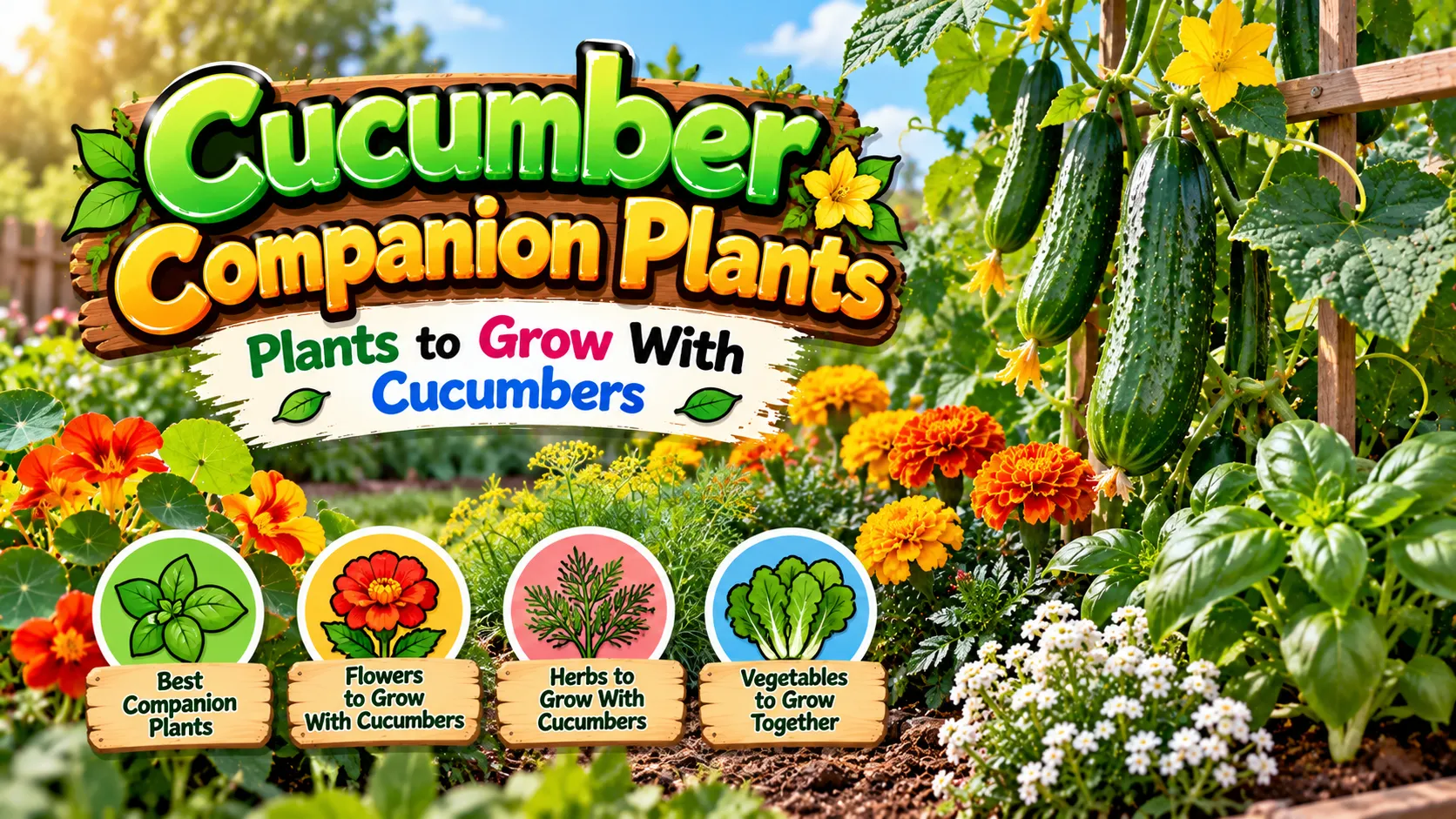
Cucumber companion plants can help you create a healthier, more productive vegetable garden by bringing beneficial insects, attracting pollinators, supporting soil health, and making better use of your growing space. Whether you grow cucumbers in raised beds, containers, or a backyard vegetable patch, choosing the right neighbors can make garden maintenance easier and help your plants thrive.
Cucumbers (Cucumis sativus) are warm-season vegetables that need plenty of sunlight, consistent moisture, fertile soil, and good airflow. Although they grow well alongside many vegetables, herbs, and flowers, some plants compete with them for nutrients, attract similar pests, or take up too much space. Understanding these relationships can help you avoid common gardening mistakes.
In this guide, you will discover the best cucumber companion plants, including beans, peas, radishes, dill, nasturtiums, marigolds, and sunflowers. You will also learn which plants to avoid, how to arrange companions in your garden, and how to create a productive cucumber planting plan for a healthier harvest.
🌱 What Are Cucumber Companion Plants?
Cucumber companion plants are vegetables, herbs, flowers, or other plants grown near cucumbers to make better use of garden space or support a healthier growing environment.
Companion planting is a traditional gardening approach based on the idea that certain plants can benefit one another when grown nearby. Some benefits have a clear biological explanation, such as flowers attracting pollinators or flowering herbs providing food for beneficial insects. Other commonly repeated claims, including that particular plants automatically improve cucumber flavor or repel every pest, have limited scientific evidence.
The most useful cucumber companions can help you:
- Attract bees and other pollinators.
- Encourage beneficial insects that prey on garden pests.
- Use vertical and horizontal growing space efficiently.
- Add diversity to a vegetable garden.
- Improve soil fertility through suitable crop choices.
- Reduce competition when plants have different growth habits.
- Create a more attractive and productive garden.
Remember that companion planting does not replace good gardening practices. Cucumbers still need adequate water, sunlight, healthy soil, appropriate spacing, and regular pest monitoring.
🥒 1. Beans
Beans are among the most practical vegetable companions for cucumbers. Bush beans grow relatively compactly, while pole beans climb vertically and can make efficient use of limited garden space.
Beans are legumes, meaning they can form relationships with soil bacteria that convert atmospheric nitrogen into forms the plant can use. However, most of that nitrogen remains in the bean plant during active growth, so growing beans beside cucumbers does not automatically provide a large nitrogen boost to the cucumbers.
Why beans make good companions:
- They provide another productive crop in the same garden bed.
- Bush varieties can fit into mixed vegetable plantings.
- Pole varieties use vertical space.
- Their flowers may attract pollinators and other beneficial insects.
- Legumes can contribute to soil fertility over the longer term when roots and plant residues are managed appropriately.
Growing tips:
- Choose bush beans if cucumbers already have a trellis.
- Give both crops enough sunlight and airflow.
- Avoid crowding cucumber leaves with vigorous bean vines.
- Water consistently during flowering and fruit development.
Beans are a useful companion when you plan the layout carefully. Avoid allowing pole beans and cucumber vines to become tangled together, as dense growth can make harvesting and disease management more difficult.
🌿 2. Peas
Peas can be useful cucumber companions in gardens where the growing seasons overlap. They are cool-season crops, while cucumbers prefer warm soil and warm weather, so peas are often grown before cucumbers or during a brief transition between seasons.
Like beans, peas are legumes that can form nitrogen-fixing relationships with soil bacteria.
Benefits of growing peas near cucumbers:
- They provide an additional harvest from the same garden area.
- Trellised peas can make use of vertical space.
- They can fit into a seasonal crop rotation.
- Their flowers may support pollinators and beneficial insects.
Growing tips:
- Grow peas during cool weather.
- Plant cucumbers after peas finish if the seasons are different.
- Remove diseased pea vines promptly.
- Avoid placing both crops so close that they compete for light.
In many climates, succession planting works better than growing peas and cucumbers side by side throughout the entire season.
🌼 3. Nasturtiums
Nasturtiums (Tropaeolum majus) are attractive flowering plants that can grow alongside cucumbers in vegetable gardens. Their rounded leaves and bright flowers add color to garden beds and may attract pollinating insects.
Nasturtiums are also sometimes used as trap crops because certain aphids and other insects may prefer them. However, they can also host pests, so gardeners should monitor both the flowers and nearby cucumber plants.
Why gardeners plant nasturtiums near cucumbers:
- Their flowers add color to vegetable beds.
- They can attract pollinators.
- They may draw some pests away from other plants.
- Their trailing growth can cover unused ground.
- Both leaves and flowers are edible for people when correctly identified and grown without unsuitable chemical treatments.
Growing tips:
- Plant them where they will not smother cucumber seedlings.
- Allow enough room for trailing stems.
- Check the leaves regularly for aphids.
- Remove heavily infested growth when necessary.
Nasturtiums can be helpful companions, but they should not be treated as a guaranteed pest-control solution.
🌻 4. Sunflowers
Sunflowers (Helianthus annuus) can attract bees and other insects to a vegetable garden. Their tall stems may also provide a vertical element in a garden layout.
However, sunflowers can grow large and cast significant shade, so their placement matters. Cucumbers generally need full sun for healthy growth and good fruit production.
Benefits of sunflowers:
- Their flowers attract pollinators.
- They add height and visual interest.
- They can support insect diversity.
- They may provide seeds for wildlife or harvesting, depending on the variety.
Growing tips:
- Plant sunflowers where they will not shade cucumbers during much of the day.
- Choose a suitable distance based on the mature sunflower size.
- Avoid using them as an improvised cucumber trellis unless the structure is sturdy enough.
- Monitor water competition during hot weather.
Sunflowers are best planted along the north side of a garden bed in many Northern Hemisphere gardens, where they are less likely to shade shorter crops. In the Southern Hemisphere, the ideal arrangement may differ.
🌿 5. Dill
Dill (Anethum graveolens) is a useful herb for vegetable gardens because its small flowers can attract beneficial insects, including certain predatory and parasitic species.
These insects may help regulate populations of aphids, caterpillars, and other pests, although the results depend on the insects present in your garden.
Why dill works well near cucumbers:
- Its flowers provide nectar and pollen for beneficial insects.
- It adds culinary value to the garden.
- It occupies relatively little space when young.
- It can increase plant diversity around cucumber beds.
Growing tips:
- Plant dill near the edges of cucumber beds.
- Allow some plants to flower to attract beneficial insects.
- Avoid crowding young cucumber plants.
- Provide sufficient sunlight and drainage.
Dill is generally more useful for supporting beneficial insects than for directly improving cucumber growth. Letting a few dill plants flower can make them especially valuable in a mixed vegetable garden.
🌼 6. Marigolds
Marigolds (Tagetes species) are popular companion flowers because they are easy to grow and bring bright color to vegetable beds.
Some marigold species and cultivars have been studied for their effects on certain soil pests, especially plant-parasitic nematodes. However, these effects depend on the species, cultivar, pest, and growing method. Simply planting a few marigolds beside cucumbers does not guarantee nematode control.
Benefits of marigolds:
- They add color to the garden.
- Their flowers may attract pollinators and other insects.
- Some species can be useful in targeted nematode-management plans.
- They fit well along garden borders.
- They are relatively easy to grow from seed or transplants.
Growing tips:
- Place marigolds along bed edges.
- Avoid crowding cucumbers.
- Choose varieties suited to your climate.
- Remove diseased plant material when necessary.
Marigolds are useful garden companions, but they should be combined with crop rotation, healthy soil practices, and appropriate pest management.
🌿 7. Radishes
Radishes (Raphanus sativus) are fast-growing root vegetables that can be planted near cucumbers while the cucumber vines are still small.
Because radishes mature relatively quickly, they can provide an early harvest before the cucumber canopy expands.
Why radishes are good companions:
- They mature quickly.
- They make productive use of open soil.
- They can provide an early crop before cucumber vines spread.
- Their flowers, if allowed to bloom, can support some insects.
Radishes are sometimes recommended as a way to repel cucumber beetles, but the evidence for reliable protection from nearby radishes is limited. Do not rely on them as your only pest-control method.
Growing tips:
- Sow radishes between young cucumber plants if space allows.
- Harvest them before the cucumber vines become crowded.
- Keep the soil consistently moist.
- Avoid planting too densely.
Radishes are particularly useful as a temporary intercrop rather than a permanent neighbor throughout the entire cucumber growing season.
🥬 8. Lettuce
Lettuce (Lactuca sativa) can fit well near young cucumber plants because it grows quickly and generally stays low to the ground.
In hot weather, however, lettuce may bolt or become bitter. Large cucumber leaves can provide some shade later in the season, but too much shade can also reduce lettuce growth.
Benefits of lettuce:
- It provides an additional edible crop.
- Leaf lettuce can be harvested repeatedly.
- It makes use of open space while cucumbers are small.
- Its low growth habit usually does not interfere with a trellised cucumber vine.
Growing tips:
- Plant lettuce around the outer edges of the cucumber bed.
- Harvest leaves regularly.
- Choose heat-tolerant varieties for warmer climates.
- Avoid overcrowding the cucumber roots.
Lettuce is a space-sharing companion rather than a plant that directly improves cucumber health. It works best when the planting arrangement allows both crops enough light and moisture.
🌿 9. Spinach
Spinach (Spinacia oleracea) is another cool-season crop that can share space with young cucumbers in spring or in regions with suitable growing conditions.
It grows relatively quickly but generally struggles in hot weather, so it may be more useful before cucumber vines become large.
Why spinach can work:
- It produces an edible harvest in a short growing period.
- It can use space before cucumber vines spread.
- It fits into seasonal succession planting.
- It can be grown along the edges of a vegetable bed.
Growing tips:
- Sow spinach during cooler weather.
- Harvest it before hot conditions cause bolting.
- Keep the soil evenly moist.
- Avoid letting cucumber vines completely shade the spinach.
For many gardeners, planting spinach before cucumbers is more effective than trying to grow both crops together for the entire season.
🌱 10. Carrots
Carrots (Daucus carota subsp. sativus) can be grown near cucumbers when the soil and spacing suit both crops.
Carrots grow downward, while cucumber vines spread along the ground or climb a trellis. This difference can help gardeners use space efficiently, although their roots still compete for water and nutrients.
Benefits of carrots:
- They provide a separate root crop.
- They use a different part of the growing space.
- They fit into mixed vegetable beds.
- They can be harvested while cucumber vines continue producing.
Growing tips:
- Use loose, stone-free soil for well-shaped carrots.
- Keep carrot seedlings free from heavy shade.
- Avoid crowding the cucumber root zone.
- Maintain consistent moisture for both crops.
Carrots are a reasonable space-sharing companion, but there is limited evidence that they directly repel cucumber pests or improve cucumber yields.
🌿 11. Beets
Beets (Beta vulgaris) are versatile root vegetables that can share a garden with cucumbers when there is enough space.
Their leafy tops and edible roots provide a different harvest from the climbing or trailing cucumber vines.
Why beets can be useful:
- They diversify the vegetable harvest.
- They can occupy available ground around young cucumbers.
- Their leaves and roots are edible.
- They fit into many mixed vegetable garden plans.
Growing tips:
- Sow beets where they will receive adequate light.
- Thin seedlings to provide room for root development.
- Avoid placing them under dense cucumber foliage.
- Water consistently to support root growth.
Beets do not have a proven special relationship with cucumbers, but they can be practical neighbors in a carefully spaced garden.
🌿 12. Garlic
Garlic (Allium sativum) is sometimes recommended as a companion plant because its strong aroma may affect the behavior of certain insects. However, planting garlic beside cucumbers does not reliably prevent cucumber beetles, aphids, or other pests.
Garlic can still be included in a diverse vegetable garden if both crops have enough space and suitable growing conditions.
Possible benefits:
- It provides an additional edible crop.
- Its upright leaves occupy relatively little horizontal space.
- It can fit into a crop rotation plan.
- It adds diversity to mixed plantings.
Growing tips:
- Avoid planting garlic so densely that it competes with cucumbers.
- Ensure the soil drains well.
- Follow the garlic variety’s planting season.
- Keep both crops adequately watered without waterlogging the roots.
Garlic is best viewed as a useful neighboring crop rather than a dependable cucumber pest repellent.
🌿 13. Onions
Onions (Allium cepa) can grow near cucumbers when the garden layout gives both crops adequate room.
Their upright growth makes them relatively easy to fit along bed edges, although they still need sufficient light and nutrients.
Benefits of onions:
- They add another useful food crop.
- They use space differently from sprawling cucumber vines.
- They can fit into mixed vegetable beds.
- Their flowers, if allowed to mature, may attract some insects.
Growing tips:
- Plant onions where they receive enough light.
- Keep the bed free of excessive weeds.
- Avoid overcrowding the cucumber root zone.
- Harvest or remove onions before cucumber vines become too dense.
Claims that onions reliably repel cucumber pests are not strongly supported for ordinary backyard plantings. Use physical barriers, pest monitoring, and crop rotation when appropriate.
🌼 14. Calendula
Calendula (Calendula officinalis), also called pot marigold, is a flowering annual that can bring color and insect activity to a vegetable garden.
It is different from the Tagetes marigolds commonly sold as bedding plants.
Why calendula can be a useful companion:
- Its flowers attract pollinating insects.
- It adds visual interest around vegetable beds.
- It can provide a source of nectar for some beneficial insects.
- It grows well in many cool or mild-season gardens.
Growing tips:
- Plant calendula along the edges of cucumber beds.
- Allow some flowers to remain open.
- Remove plants that become diseased.
- Leave enough space for cucumber vines to spread.
Calendula supports garden diversity, but its presence does not guarantee that pests will stay away from cucumbers.
🌿 15. Oregano
Oregano (Origanum vulgare) is a useful culinary herb that can be grown near cucumbers in suitable garden conditions.
Its small flowers may attract beneficial insects when the plant is allowed to bloom. Oregano also provides a harvest for cooking.
Benefits of oregano:
- Culinary use.
- Flowers that can support beneficial insects.
- Compact growth when regularly trimmed.
- A perennial herb in suitable climates.
Growing tips:
- Plant oregano along the edge of a sunny bed.
- Provide well-drained soil.
- Avoid excessive watering.
- Trim the plant to prevent it from spreading into cucumber space.
Oregano generally prefers conditions that are somewhat drier than the consistently moist soil cucumbers need, so use a layout that allows you to water each crop appropriately.
🌿 16. Chives
Chives (Allium schoenoprasum) are compact perennial herbs with narrow leaves and rounded purple flowers.
Their blossoms can attract pollinating insects, and the leaves are useful in cooking.
Why chives can work near cucumbers:
- They take up relatively little space.
- Their flowers add color.
- They provide a culinary harvest.
- They fit along garden borders.
- They add diversity to vegetable plantings.
Growing tips:
- Plant chives near the edge of the bed.
- Give the clumps enough room to grow.
- Allow some plants to flower for beneficial insects.
- Avoid crowding cucumber stems.
Chives are a convenient companion for small gardens, but they should not be treated as a guaranteed deterrent for cucumber beetles.
🌻 17. Borage
Borage (Borago officinalis) is an annual herb with blue, star-shaped flowers. Bees and other pollinators frequently visit its blossoms.
It can be a useful addition to a mixed vegetable garden, but mature borage plants can become large and may self-seed.
Benefits of borage:
- Flowers that attract bees.
- Additional diversity in the garden.
- A striking blue flower display.
- Potential to support beneficial insects.
Growing tips:
- Plant it where its mature size will not shade cucumbers.
- Allow enough room for spreading foliage.
- Remove unwanted seedlings if it self-seeds.
- Avoid crowding cucumber vines.
Borage is not essential for cucumber production, but it can contribute to a more varied and pollinator-friendly garden.
🌼 18. Cosmos
Cosmos are flowering annuals with delicate foliage and daisy-like flowers in shades of pink, white, purple, and orange.
They can attract pollinators and provide nectar for certain beneficial insects, especially when grown as part of a diverse flowering border.
Why cosmos are useful:
- They add colorful flowers.
- They can support pollinator activity.
- They grow well in many sunny gardens.
- They fit into ornamental vegetable borders.
Growing tips:
- Choose a location that does not shade cucumbers.
- Select a variety suited to the available space.
- Avoid excessive fertilizer, which can encourage foliage at the expense of flowers.
- Remove unwanted seedlings if needed.
Cosmos are best planted at the edge of the vegetable garden, where they can attract insects without competing heavily with cucumber vines.
🌿 19. Cilantro (Coriander)
Cilantro (Coriandrum sativum) is a cool-season herb that produces aromatic leaves and, if allowed to flower, small blossoms attractive to certain beneficial insects.
It tends to bolt quickly in hot weather, so it is often more useful in spring or fall than during peak summer.
Benefits of cilantro:
- Fresh leaves for cooking.
- Flowers that can attract beneficial insects.
- Quick growth in suitable weather.
- A useful addition to mixed herb and vegetable beds.
Growing tips:
- Sow cilantro during mild weather.
- Let some plants flower if you want to support beneficial insects.
- Harvest leaves before excessive heat causes bolting.
- Avoid planting too densely beneath cucumber vines.
Cilantro is a practical herb companion, but it does not reliably prevent cucumber pests by itself.
🌿 20. Lettuce and Radish as Temporary Companions
Growing lettuce and radishes together around young cucumbers can make good use of available space.
Both crops can mature relatively quickly, allowing you to harvest them before cucumber vines spread across the bed.
Why this combination works:
- It provides multiple crops from the same area.
- Radishes can mature quickly.
- Leaf lettuce can be harvested in stages.
- Early crops can be removed before cucumbers become large.
Growing tips:
- Plant lettuce and radishes around the edges of young cucumber plants.
- Harvest them promptly.
- Avoid overcrowding the cucumber seedlings.
- Keep all crops adequately watered.
This approach is best described as intercropping or succession planting. Its main advantage is efficient use of space rather than a special biological effect on cucumbers.
🌱 How to Choose the Best Companion Plants for Cucumbers
The best cucumber companion plants depend on the size of your garden, the local climate, your pest problems, and whether you grow cucumbers vertically or along the ground.
Consider these factors before planting:
- Space: Avoid pairing cucumbers with plants that will overwhelm their growing area.
- Sunlight: Cucumbers generally need full sun, so tall companions should be positioned carefully.
- Water needs: Choose neighbors that can tolerate similar watering conditions.
- Growth season: Cool-season crops may work better before or after cucumbers rather than throughout summer.
- Pollinator value: Flowering herbs and annuals can attract beneficial insects.
- Pest management: Select companions as one part of an integrated approach rather than expecting them to eliminate pests.
- Harvesting: Leave enough room to pick cucumbers without damaging neighboring plants.
For most home gardens, a combination of cucumbers, flowering herbs, and compact vegetables provides a practical starting point.
🪴 Best Cucumber Companion Plants for Raised Beds
Raised beds have limited growing space, so the most useful companions are those that fit around cucumber vines without creating too much competition.
Good choices include:
- Bush beans: Compact and productive.
- Radishes: Fast-growing and easy to harvest early.
- Leaf lettuce: Useful in the cooler part of the growing season.
- Dill: Valuable for attracting beneficial insects.
- Chives: Compact and suitable for borders.
- Calendula: Adds flowers around the edge.
- Nasturtiums: Useful as a trailing border if kept under control.
If your raised bed is small, avoid planting too many companions. A crowded bed can reduce airflow, make watering difficult, and increase the risk of fungal diseases.
🌿 Best Companion Plants for Trellised Cucumbers
Trellising cucumbers allows vines to grow upward instead of spreading across the soil. This creates room for compact crops around the base.
Consider growing:
- Radishes before the cucumber canopy becomes dense.
- Leaf lettuce during cooler weather.
- Bush beans where they will not tangle with the cucumber vines.
- Chives along the bed edges.
- Dill in an accessible corner.
- Calendula or compact flowers near the outside of the trellis.
Leave enough room to inspect the underside of leaves, remove diseased foliage, and harvest cucumbers easily.
Avoid placing large sunflowers or other tall plants where they block sunlight from the trellised cucumbers.
💧 How Companion Planting Affects Cucumber Growth
Companion planting can support cucumber production, but it is not a substitute for the growing conditions cucumbers need.
Healthy cucumber plants generally require:
- Full sun, usually around six to eight hours of direct sunlight or more.
- Warm soil and frost-free growing conditions.
- Fertile, well-drained soil.
- Consistent moisture.
- Adequate spacing and airflow.
- Pollinator access for many standard cucumber varieties.
- Regular monitoring for pests and disease.
Some cucumber varieties produce fruit without pollination, particularly certain greenhouse types. However, many outdoor varieties rely on pollination for good fruit development.
Flowering companion plants may help attract pollinators, but healthy flowers and suitable growing conditions remain essential.
🐛 Can Companion Plants Keep Cucumber Beetles Away?
Cucumber beetles are important pests because they can feed on leaves, flowers, and fruits. Some species can also spread bacterial wilt, a serious disease affecting cucumbers and related crops.
Certain companion plants are often promoted as cucumber beetle repellents, but evidence for reliable protection from most individual companion plants is limited.
More dependable management strategies include:
- Inspecting plants regularly for beetles.
- Using suitable floating row covers while plants are young, removing them when pollination is needed unless the variety does not require pollination.
- Choosing resistant varieties when available.
- Removing severely affected plant material where appropriate.
- Rotating cucurbit crops to new garden areas.
- Controlling weeds that can host pests.
- Using locally recommended integrated pest-management methods.
Companion flowers and herbs can contribute to garden diversity, but do not rely on them alone to protect cucumbers from cucumber beetles or bacterial wilt.
🚫 Plants to Avoid Growing Near Cucumbers
There is no universal list of plants that must never grow near cucumbers. Many commonly cited incompatibilities are based on tradition rather than strong scientific evidence.
Instead of treating every plant as a strict enemy, focus on plants that create practical problems through competition, shared pests, disease, or incompatible growing conditions.
🌿 1. Potatoes
Potatoes and cucumbers can compete for space, water, and nutrients when planted too closely. They also have different growth habits, and potato harvesting may disturb nearby cucumber roots.
Potatoes can share some disease and pest concerns with other garden crops, although they are not members of the cucumber family.
Better approach: Give potatoes and cucumbers separate areas with enough space for harvesting and airflow.
🌱 2. Other Cucurbits
Cucumbers belong to the cucurbit family, which also includes squash, pumpkins, melons, and many gourds.
These plants can share pests and diseases, including cucumber beetles, powdery mildew, and other common cucurbit problems. Growing them close together does not automatically cause disease, but it can make pest movement and disease management more difficult.
Better approach: Provide adequate spacing, monitor all cucurbits, and rotate crops to different areas between seasons when practical.
🌻 3. Very Large, Shading Plants
Large sunflowers, corn, or other tall crops can block sunlight if planted too close to cucumbers.
Because cucumbers need abundant light, excessive shade may reduce growth and fruit production.
Better approach: Position tall plants where they will not shade the cucumbers during the main daylight hours.
🌿 4. Vigorous, Spreading Plants
Some pumpkins, squash, and other sprawling crops can overwhelm a small garden bed. Their vines and broad leaves may crowd cucumber plants and make harvesting difficult.
Better approach: Separate vigorous crops or provide them with dedicated trellises and enough space.
🌱 5. Plants With Very Different Water Needs
Cucumbers generally need consistent moisture, while many Mediterranean herbs, such as rosemary and thyme, prefer drier soil once established.
Growing them in the same small container or tightly managed bed can make watering difficult.
Better approach: Place drought-tolerant herbs in separate containers or in a bed where they can receive less water.
🌼 Sample Cucumber Companion Planting Layout
A simple garden layout can help you combine cucumber vines, flowers, and smaller crops without overcrowding.
For a sunny backyard bed, consider this arrangement:
- Back or north side: A trellis for cucumbers, positioned to minimize shade on other crops.
- Along one edge: Dill or chives for culinary use and flowering-insect support.
- Near the outside border: Calendula or compact marigolds.
- Between young cucumber plants: Radishes or leaf lettuce for an early harvest.
- Nearby but not tangled with the vines: Bush beans, if space allows.
Adjust the arrangement to your climate and garden size. In a small bed, it is better to grow fewer plants well than to squeeze every possible companion into the available space.
❓ Frequently Asked Questions About Cucumber Companion Plants
🥒 What is the best companion plant for cucumbers?
Beans, dill, nasturtiums, radishes, calendula, and marigolds can all be useful companions for different reasons. The best choice depends on whether your main goal is attracting beneficial insects, using space efficiently, or adding another harvest.
🌼 Can I plant marigolds next to cucumbers?
Yes. Marigolds can be planted along cucumber bed edges. They add color and may support insect diversity, but a few marigolds will not reliably eliminate cucumber beetles or other pests.
🌿 Are beans good companion plants for cucumbers?
Yes, beans can be useful neighbors because they provide another crop and can fit into mixed vegetable gardens. Keep enough space between the plants to prevent excessive competition and tangled growth.
🌱 Can cucumbers grow with tomatoes?
Cucumbers and tomatoes can grow in the same garden, provided they have sufficient space, sunlight, water, and airflow. However, both can develop certain diseases and pests, so avoid overcrowding and monitor plants regularly.
🌻 Are sunflowers good companion plants for cucumbers?
Sunflowers can attract pollinators, but their height may shade cucumbers. Plant them far enough away or position them where they will not block sunlight.
🥬 Can lettuce grow next to cucumbers?
Yes. Lettuce can grow around young cucumbers, especially during cooler weather. Harvest it before the cucumber vines create excessive shade or crowd the bed.
🌿 Does dill help cucumber plants?
Dill flowers can attract beneficial insects that may help regulate some garden pests. However, dill does not directly guarantee higher cucumber yields or prevent every pest problem.
🚫 What should not be planted near cucumbers?
Avoid placing cucumbers where large plants block sunlight, vigorous vines crowd the bed, or neighboring crops create incompatible watering needs. Other cucurbits may share important pests and diseases, so monitor them carefully and rotate crops when possible.
🐝 Do cucumbers need pollinator companion plants?
Flowering companion plants can help attract bees and other insects, which may support pollination. Many standard outdoor cucumber varieties benefit from pollination, although some varieties can produce fruit without it.
🪴 Can I grow cucumber companion plants in containers?
Yes. Dill, chives, compact flowers, and some radishes can grow in containers alongside cucumbers if there is enough room. Use a sufficiently large pot, provide drainage, and avoid overcrowding the cucumber’s roots.
🌱 Do companion plants increase cucumber yield?
Companion plants may support pollinators, beneficial insects, and efficient use of garden space, but they do not automatically increase yields. Sunlight, watering, soil fertility, variety selection, and pest management remain the main factors.
🌿 Conclusion: Choose the Right Cucumber Companion Plants
Cucumber companion plants can make a vegetable garden more diverse, attractive, and productive when selected carefully. Beans, peas, nasturtiums, dill, marigolds, radishes, lettuce, and calendula are useful options, depending on your climate and planting goals.
The key is to understand what each companion actually contributes. Flowering herbs and annuals can attract beneficial insects, while fast-growing vegetables can make better use of open soil before cucumber vines spread. At the same time, overcrowding, excessive shade, and incompatible watering needs can create problems.
Start with a sunny, well-drained growing area, give cucumbers enough room, and choose only a few suitable companions. Combine companion planting with regular pest monitoring, good watering practices, and crop rotation to give your cucumbers the best chance of producing a healthy harvest.

Ethan Carter is a nature enthusiast and content writer with a passion for flowers and botanical knowledge. He is the author behind FlowerNamez, where he shares simple and informative content about flower names, types, and meanings.
With a focus on clarity and accuracy, Ethan aims to help readers explore the beauty of flowers and understand their significance in everyday life.