
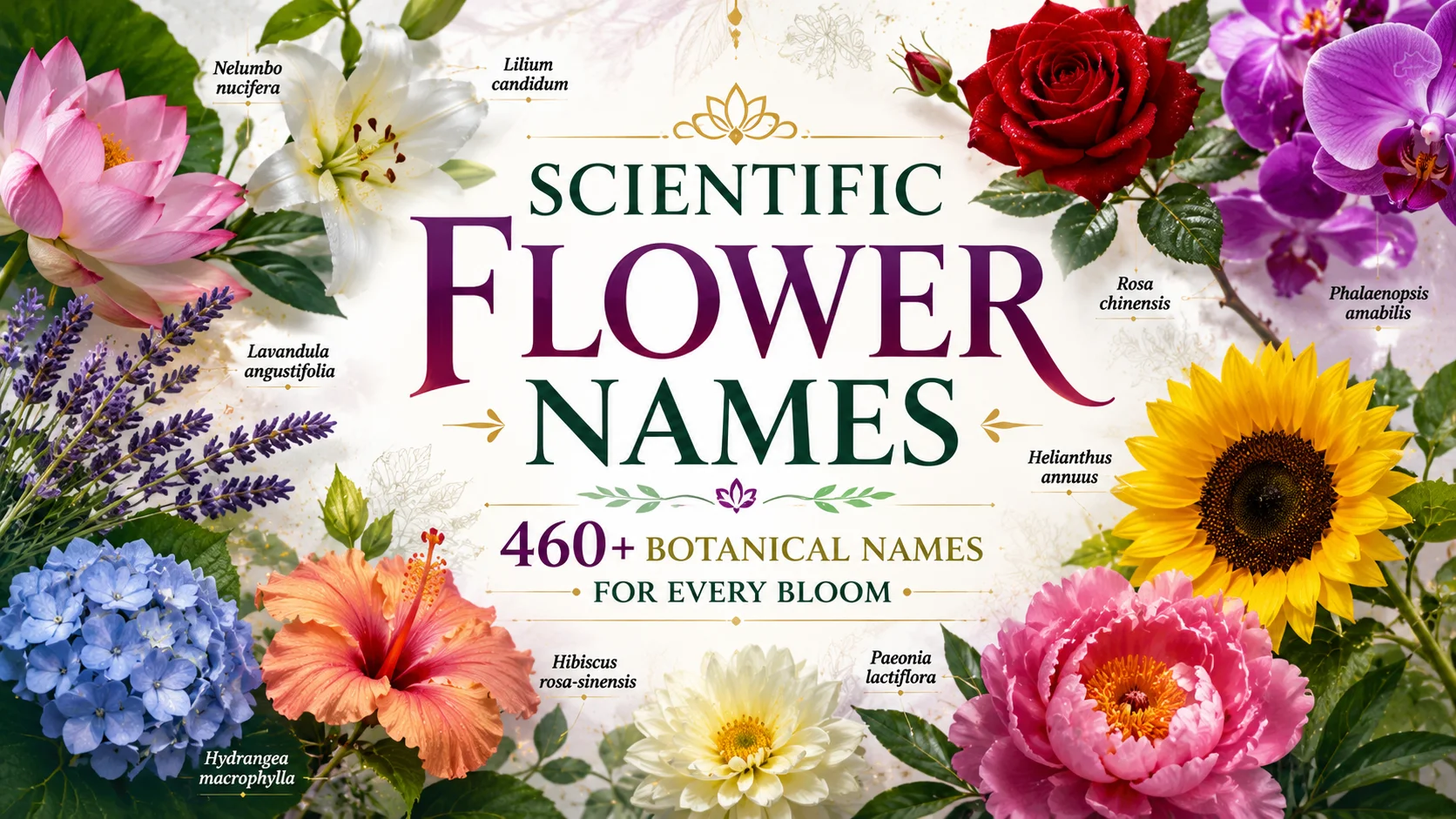
Every flower has a story hidden in its scientific name. These Latin and Greek names reveal a flower’s family, its discoverer, its shape, or where it grows. The system of binomial nomenclature, developed by Carl Linnaeus, gives every plant a unique two-part name: the genus and the species . This guide explores over 460 scientific flower names, from common garden favorites to rare botanical treasures. Whether you are a gardener, a student, or simply curious about the hidden meanings behind flower names, this comprehensive list will help your knowledge blossom. 🌸
What Are Scientific Flower Names?
Scientific flower names follow a binomial system developed by Swedish botanist Carl Linnaeus. Every plant receives a two-part name: the genus (first, capitalized) and the species (second, lowercase) . This universal system allows scientists and gardeners worldwide to communicate clearly about plants, avoiding the confusion of common names that vary by region and language. For example, the common daisy is Bellis perennis, with Bellis meaning “pretty” and perennis meaning “through the years” or perennial .
Common Scientific Flower Names 🌷
These scientific names belong to familiar garden flowers that you likely recognize by their common names.
- Rosa – rose
- Tulipa – tulip
- Lilium – lily
- Bellis perennis – daisy
- Helianthus annuus – sunflower
- Narcissus – daffodil
- Lavandula – lavender
- Viola – violet
- Dianthus caryophyllus – carnation
- Chrysanthemum – chrysanthemum
- Gerbera – gerbera daisy
- Freesia – freesia
- Gladiolus – gladiolus
- Iris – iris
- Peonia – peony
- Hydrangea – hydrangea
- Hibiscus – hibiscus
- Gardenia – gardenia
- Camellia – camellia
- Azalea – azalea
- Rhododendron – rhododendron
- Syringa vulgaris – lilac
- Forsythia – forsythia
- Magnolia – magnolia
- Wisteria – wisteria
- Clematis – clematis
- Dahlia – dahlia
- Zinnia – zinnia
- Cosmos – cosmos
- Marigold – Tagetes
Scientific Names of Spring Flowers 🌷
These flowers bloom in spring and are known by their botanical names worldwide.
- Narcissus pseudonarcissus – daffodil
- Tulipa gesneriana – garden tulip
- Hyacinthus orientalis – hyacinth
- Crocus vernus – spring crocus
- Galanthus nivalis – snowdrop
- Primula vulgaris – primrose
- Viola tricolor – heartsease
- Hyacinthoides non-scripta – bluebell
- Syringa vulgaris – common lilac
- Wisteria sinensis – Chinese wisteria
- Prunus serrulata – Japanese cherry
- Magnolia × soulangeana – saucer magnolia
- Paeonia lactiflora – Chinese peony
- Convallaria majalis – lily of the valley
- Lamprocapnos spectabilis – bleeding heart
- Forsythia × intermedia – border forsythia
- Anemone nemorosa – wood anemone
- Ranunculus asiaticus – Persian buttercup
- Freesia refracta – freesia
- Muscari armeniacum – grape hyacinth
- Camellia japonica – Japanese camellia
- Rhododendron simsii – indoor azalea
- Lathyrus odoratus – sweet pea
- Caltha palustris – marsh marigold
- Pulsatilla vulgaris – pasque flower
- Eranthis hyemalis – winter aconite
- Scilla siberica – Siberian squill
- Chionodoxa forbesii – glory of the snow
- Leucojum vernum – spring snowflake
- Anemone blanda – Greek windflower
Scientific Names of Summer Flowers ☀️
Summer blooms have distinct botanical names that reflect their vibrant colors and forms.
- Helianthus annuus – sunflower
- Rosa gallica – French rose
- Lilium candidum – Madonna lily
- Dahlia pinnata – garden dahlia
- Hydrangea macrophylla – bigleaf hydrangea
- Lavandula angustifolia – English lavender
- Gerbera jamesonii – Barberton daisy
- Hibiscus rosa-sinensis – Chinese hibiscus
- Zinnia elegans – common zinnia
- Tagetes erecta – African marigold
- Cosmos bipinnatus – garden cosmos
- Echinacea purpurea – purple coneflower
- Rudbeckia hirta – black-eyed Susan
- Monarda didyma – bee balm
- Delphinium elatum – candle larkspur
- Digitalis purpurea – foxglove
- Alcea rosea – hollyhock
- Lantana camara – lantana
- Verbena bonariensis – vervain
- Phlox paniculata – garden phlox
- Salvia splendens – scarlet sage
- Centaurea cyanus – cornflower
- Papaver rhoeas – common poppy
- Agapanthus africanus – African lily
- Crocosmia × crocosmiiflora – montbretia
- Kniphofia uvaria – red-hot poker
- Hemerocallis fulva – orange daylily
- Achillea millefolium – yarrow
- Coreopsis grandiflora – tickseed
- Gaillardia aristata – blanket flower
Scientific Names of Fall Flowers 🍂
These flowers bloom in autumn and add color to the season.
- Chrysanthemum × morifolium – florist’s chrysanthemum
- Dahlia variabilis – dahlia
- Aster novi-belgii – New York aster
- Sedum spectabile – showy stonecrop
- Tagetes patula – French marigold
- Solidago canadensis – Canada goldenrod
- Helenium autumnale – sneezeweed
- Colchicum autumnale – autumn crocus
- Anemone hupehensis – Japanese anemone
- Eupatorium maculatum – Joe Pye weed
- Liriope muscari – lilyturf
- Tricyrtis hirta – toad lily
- Nerine bowdenii – nerine
- Schizachyrium scoparium – little bluestem
- Symphyotrichum novae-angliae – New England aster
- Vernonia noveboracensis – ironweed
- Gentiana scabra – Japanese gentian
- Lespedeza thunbergii – bush clover
- Physostegia virginiana – obedient plant
- Persicaria virginiana – jumpseed
- Chelone obliqua – turtlehead
- Tradescantia virginiana – spiderwort
- Heuchera americana – coral bells
- Bergenia cordifolia – heartleaf bergenia
- Amaryllis belladonna – belladonna lily
- Cyclamen hederifolium – ivy-leaved cyclamen
- Saxifraga stolonifera – strawberry geranium
- Kirengeshoma palmata – yellow waxbells
- Sanguisorba canadensis – Canadian burnet
- Veronicastrum virginicum – Culver’s root
Scientific Names of Winter Flowers ❄️
Winter blooms that brave the cold with their botanical names.
- Galanthus nivalis – snowdrop
- Camellia sasanqua – sasanqua camellia
- Helleborus niger – Christmas rose
- Jasminum nudiflorum – winter jasmine
- Erica carnea – winter heath
- Hamamelis mollis – Chinese witch hazel
- Chimonanthus praecox – wintersweet
- Daphne odora – winter daphne
- Mahonia japonica – Japanese mahonia
- Sarccocca confusa – sweet box
- Viburnum x bodnantense – winter viburnum
- Winterberry – Ilex verticillata
- Pieris japonica – Japanese andromeda
- Skimmia japonica – skimmia
- Edgeworthia chrysantha – paperbush
- Lonicera fragrantissima – winter honeysuckle
- Hepatica nobilis – hepatic
- Iris unguicularis – Algerian iris
- Lunaria annua – honesty
- Pulmonaria saccharata – lungwort
- Eranthis hyemalis – winter aconite
- Helleborus orientalis – Lenten rose
- Cyclamen coum – eastern cyclamen
- Primula acaulis – primrose
- Viola cornuta – horned violet
- Garrya elliptica – silk tassel bush
- Cornus mas – Cornelian cherry
- Corylopsis pauciflora – buttercup winter hazel
- Stachyurus praecox – stachyurus
- Parrotia persica – Persian ironwood
Unfamiliar Scientific Flower Names 🌺
These unfamiliar blooms have fascinating scientific names from around the world.
- Strelitzia reginae – bird of paradise
- Protea cynaroides – king protea
- Plumeria rubra – frangipani
- Heliconia rostrata – hanging lobster claw
- Bougainvillea spectabilis – bougainvillea
- Passiflora caerulea – blue passionflower
- Nelumbo nucifera – sacred lotus
- Canna indica – Indian shot
- Musa acuminata – banana blossom
- Hibiscus schizopetalus – fringed hibiscus
- Clianthus puniceus – glory pea
- Tibouchina urvilleana – princess flower
- Medinilla magnifica – Malaysian orchid
- Rafflesia arnoldii – corpse flower
- Strongylodon macrobotrys – jade vine
- Tacca chantrieri – black bat flower
- Euryale ferox – prickly water lily
- Victoria amazonica – Amazon water lily
- Dendrobium kingianum – pink rock orchid
- Cymbidium lowianum – cymbidium orchid
- Paphiopedilum insigne – slipper orchid
- Phalaenopsis amabilis – moth orchid
- Vanda coerulea – blue orchid
- Anthurium andraeanum – flamingo flower
- Calathea crocata – eternal flame
- Guzmania lingulata – scarlet star
- Nepenthes rajah – pitcher plant
- Aechmea fasciata – urn plant
- Billbergia nutans – queen’s tears
- Tillandsia cyanea – pink quill
Scientific Names of Aquatic Flowers 🌊
These water-loving flowers have distinctive botanical names.
- Nymphaea odorata – American water lily
- Nelumbo lutea – American lotus
- Pontederia cordata – pickerelweed
- Sagittaria latifolia – broadleaf arrowhead
- Hydrocleys nymphoides – water poppy
- Aponogeton distachyos – water hawthorn
- Eichhornia crassipes – water hyacinth
- Ludwigia sedoides – mosaic flower
- Myosotis scorpioides – water forget-me-not
- Echinodorus cordifolius – Amazon sword
- Zantedeschia aethiopica – calla lily
- Iris laevigata – Japanese iris
- Caltha palustris – marsh marigold
- Alisma plantago-aquatica – European water plantain
- Butomus umbellatus – flowering rush
- Houttuynia cordata – chameleon plant
- Menyanthes trifoliata – bog bean
- Saururus cernuus – lizard’s tail
- Nelumbo nucifera – sacred lotus
- Nymphaea caerulea – blue water lily
- Nymphaea lotus – tiger lotus
- Nymphaea rubra – red water lily
- Nymphaea stellata – star lotus
- Nymphaea tetragona – pygmy water lily
- Nuphar lutea – yellow pond lily
- Brasenia schreberi – watershield
- Cabomba caroliniana – fanwort
- Ceratophyllum demersum – hornwort
- Hippuris vulgaris – mare’s tail
- Hottonia palustris – water violet
Scientific Names of Blue Flowers 💙
Blue flowers are rare and prized for their unique botanical names.
- Cichorium intybus – common chicory
- Centaurea cyanus – cornflower
- Campanula rotundifolia – harebell
- Myosotis scorpioides – forget-me-not
- Veronica spicata – spiked speedwell
- Linum perenne – blue flax
- Echium vulgare – viper’s bugloss
- Borago officinalis – borage
- Felicia amelloides – blue daisy
- Alyogyne huegelii – blue hibiscus
- Platycodon grandiflorus – balloon flower
- Gentiana acaulis – gentian
- Echinops ritro – globe thistle
- Baptisia australis – blue false indigo
- Commelina dianthifolia – bird-bill dayflower
- Chionodoxa luciliae – glory of the snow
- Evolvulus glomeratus – dwarf morning glory
- Agapanthus praecox – African lily
- Convolvulus tricolor – dwarf morning glory
- Ipomoea indica – blue morning glory
- Jasminum officinale – common jasmine
- Scilla peruviana – Peruvian squill
- Muscari armeniacum – grape hyacinth
- Hyacinthoides non-scripta – English bluebell
- Vanda coerulea – blue orchid
- Passiflora caerulea – blue passionflower
- Phacelia campanularia – desert bluebell
- Omphalodes verna – blue-eyed Mary
- Polemonium caeruleum – Jacob’s ladder
- Cyanus segetum – cornflower
Scientific Names of White Flowers 🤍
White flowers have clean, elegant botanical names.
- Leucanthemum vulgare – oxeye daisy
- Gardenia jasminoides – cape jasmine
- Magnolia grandiflora – southern magnolia
- Lilium candidum – Madonna lily
- Convallaria majalis – lily of the valley
- Jasminum officinale – common jasmine
- Galanthus nivalis – snowdrop
- Helleborus niger – Christmas rose
- Anemone nemorosa – wood anemone
- Matricaria chamomilla – German chamomile
- Sambucus nigra – black elderberry
- Bellis perennis – daisy
- Tussilago farfara – coltsfoot
- Narcissus poeticus – poet’s daffodil
- Ornithogalum umbellatum – star-of-Bethlehem
- Leucojum aestivum – summer snowflake
- Polygonatum odoratum – Solomon’s seal
- Astilbe chinensis – Chinese astilbe
- Gypsophila paniculata – baby’s breath
- Vinca minor – lesser periwinkle
- Clematis montana – mountain clematis
- Syringa vulgaris – common lilac (white variety)
- Rhododendron dauricum – daurian rhododendron
- Camellia sinensis – tea plant
- Plumeria alba – white frangipani
- Stephanotis floribunda – Madagascar jasmine
- Jasminum polyanthum – pink jasmine
- Lonicera japonica – Japanese honeysuckle
- Lobularia maritima – sweet alyssum
- Iberis sempervirens – candytuft
Scientific Names of Yellow Flowers 💛
Yellow flowers bring sunshine with their botanical names.
- Calendula officinalis – pot marigold
- Taraxacum officinale – common dandelion
- Helianthus annuus – sunflower
- Rudbeckia hirta – black-eyed Susan
- Solidago canadensis – Canada goldenrod
- Eschscholzia californica – California poppy
- Forsythia × intermedia – border forsythia
- Senna siamea – cassia fistula
- Hypericum perforatum – St. John’s wort
- Oenothera biennis – evening primrose
- Lysimachia punctata – yellow loosestrife
- Genista tinctoria – dyer’s broom
- Helenium autumnale – sneezeweed
- Gaillardia aristata – blanket flower
- Coreopsis grandiflora – tickseed
- Heliopsis helianthoides – oxeye sunflower
- Inula helenium – elecampane
- Ligularia dentata – leopard plant
- Doronicum orientale – leopard’s bane
- Trollius europaeus – globe flower
- Ranunculus ficaria – lesser celandine
- Caltha palustris – marsh marigold
- Primula veris – cowslip
- Narcissus pseudonarcissus – wild daffodil
- Fritillaria imperialis – crown imperial
- Lilium bulbiferum – orange lily
- Achillea filipendulina – fernleaf yarrow
- Tanacetum vulgare – tansy
- Tagetes patula – French marigold
- Chrysanthemum segetum – corn marigold
Scientific Names of Pink Flowers 🩷
Pink flowers have romantic and delicate botanical names.
- Paeonia suffruticosa – tree peony
- Dianthus plumarius – cottage pink
- Rosa centifolia – cabbage rose
- Spiraea japonica – Japanese meadowsweet
- Astilbe arendsii – Arends’s astilbe
- Phlox subulata – moss phlox
- Pulmonaria saccharata – Bethlehem sage
- Geranium sanguineum – bloody cranesbill
- Saxifraga x arendsii – mossy saxifrage
- Persicaria amplexicaulis – red bistort
- Knautia macedonica – Macedonian scabious
- Scabiosa caucasica – Caucasian scabious
- Astrantia major – great masterwort
- Echinacea purpurea – purple coneflower
- Monarda didyma – bee balm
- Bergenia cordifolia – heartleaf bergenia
- Heuchera sanguinea – coral bells
- Penstemon digitalis – beardtongue
- Chelone obliqua – turtlehead
- Physostegia virginiana – obedient plant
- Silene dioica – red campion
- Lychnis coronaria – rose campion
- Agrostemma githago – corn cockle
- Armeria maritima – thrift
- Dianthus barbatus – sweet William
- Gypsophila paniculata – baby’s breath
- Eryngium maritimum – sea holly
- Saponaria officinalis – soapwort
- Silene vulgaris – bladder campion
- Succisa pratensis – devil’s bit scabious
Scientific Names of Purple Flowers 💜
Purple flowers add royalty with their beautiful botanical names.
- Lavandula angustifolia – English lavender
- Syringa vulgaris – common lilac
- Viola odorata – sweet violet
- Hebe speciosa – showy hebe
- Salvia nemorosa – woodland sage
- Veronica longifolia – longleaf speedwell
- Teucrium chamaedrys – wall germander
- Ajuga reptans – bugleweed
- Glechoma hederacea – ground ivy
- Lamium maculatum – spotted dead nettle
- Stachys byzantina – lamb’s ears
- Nepeta cataria – catnip
- Agastache foeniculum – anise hyssop
- Hyssopus officinalis – hyssop
- Origanum vulgare – oregano
- Thymus vulgaris – common thyme
- Rosmarinus officinalis – rosemary
- Salvia officinalis – sage
- Perovskia atriplicifolia – Russian sage
- Verbena bonariensis – vervain
- Lantana camara – lantana
- Vitex agnus-castus – chaste tree
- Caryopteris × clandonensis – bluebeard
- Clerodendrum trichotomum – glorybower
- Buddleja davidii – butterfly bush
- Callicarpa americana – American beautyberry
- Leptospermum scoparium – manuka
- Choisya ternata – Mexican orange blossom
- Skimmia japonica – Japanese skimmia
- Daphne odora – winter daphne
Scientific Names of Red Flowers ❤️
Red flowers carry passion with their strong botanical names.
- Papaver rhoeas – common poppy
- Rosa gallica – French rose
- Tulipa fosteriana – Foster’s tulip
- Lilium bulbiferum – orange lily
- Hibiscus rosa-sinensis – Chinese hibiscus
- Gerbera jamesonii – Barberton daisy
- Dianthus caryophyllus – carnation
- Anemone coronaria – poppy anemone
- Amaryllis belladonna – belladonna lily
- Canna indica – Indian shot
- Gladiolus cardinalis – water gladiolus
- Iris germanica – German iris
- Paeonia lactiflora – Chinese peony
- Rhododendron ferrugineum – rusty-leaved alpenrose
- Camellia japonica – Japanese camellia
- Begonia coccinea – scarlet begonia
- Fuchsia magellanica – hardy fuchsia
- Impatiens walleriana – busy Lizzie
- Pelargonium zonale – horse-shoe geranium
- Salvia splendens – scarlet sage
- Verbena hybrida – garden verbena
- Zinnia elegans – common zinnia
- Dahlia coccinea – red dahlia
- Cosmos atrosanguineus – chocolate cosmos
- Lobelia cardinalis – cardinal flower
- Monarda didyma – bee balm
- Penstemon digitalis – beardtongue
- Physostegia virginiana – obedient plant
- Sanguisorba officinalis – great burnet
- Knautia arvensis – field scabious
Scientific Names of Edible Flowers 🌿
These edible flowers are used in cooking and have useful botanical names .
- Borago officinalis – borage
- Calendula officinalis – pot marigold
- Tropaeolum majus – garden nasturtium
- Viola tricolor – heartsease
- Viola odorata – sweet violet
- Dianthus caryophyllus – carnation
- Rosa rugosa – rugosa rose
- Lavandula angustifolia – English lavender
- Syringa vulgaris – common lilac
- Taraxacum officinale – common dandelion
- Matricaria recutita – German chamomile
- Chrysanthemum morifolium – florist’s chrysanthemum
- Helianthus annuus – sunflower
- Hemerocallis fulva – orange daylily
- Musa acuminata – banana blossom
- Phaseolus vulgaris – common bean
- Sesbania grandiflora – West Indian pea
- Tilia cordata – small-leaved lime
- Trifolium pratense – red clover
- Salvia officinalis – common sage
- Thymus vulgaris – common thyme
- Rosmarinus officinalis – rosemary
- Mentha spicata – spearmint
- Ocimum basilicum – sweet basil
- Foeniculum vulgare – fennel
- Levisticum officinale – lovage
- Galium odoratum – sweet woodruff
- Malus domestica – apple blossom
- Prunus avium – cherry blossom
- Sambucus nigra – elderflower
Scientific Names of Garden Flowers 🌻
These popular garden flowers have well-known botanical names.
- Zantedeschia aethiopica – calla lily
- Alstroemeria aurantiaca – Peruvian lily
- Antirrhinum majus – snapdragon
- Begonia semperflorens – wax begonia
- Calendula officinalis – pot marigold
- Celosia argentea – cockscomb
- Cosmos bipinnatus – garden cosmos
- Dahlia pinnata – garden dahlia
- Dianthus barbatus – sweet William
- Digitalis purpurea – foxglove
- Echinacea purpurea – purple coneflower
- Fuchsia magellanica – hardy fuchsia
- Geranium sanguineum – bloody cranesbill
- Gladiolus hortulanus – gladiolus
- Helianthus annuus – sunflower
- Hibiscus rosa-sinensis – Chinese hibiscus
- Hydrangea macrophylla – bigleaf hydrangea
- Impatiens walleriana – busy Lizzie
- Iris germanica – German iris
- Lathyrus odoratus – sweet pea
- Lavandula angustifolia – English lavender
- Lilium regale – regal lily
- Lobelia erinus – trailing lobelia
- Marigold – Tagetes patula – French marigold
- Nasturtium – Tropaeolum majus
- Paeonia lactiflora – Chinese peony
- Pelargonium zonale – horse-shoe geranium
- Petunia × hybrida – garden petunia
- Phlox paniculata – garden phlox
- Salvia splendens – scarlet sage
Scientific Names of Woodland Flowers 🌲
These flowers grow in forests and woodlands with fascinating botanical names.
- Anemone nemorosa – wood anemone
- Hyacinthoides non-scripta – bluebell
- Primula vulgaris – primrose
- Oxalis acetosella – wood sorrel
- Ranunculus ficaria – lesser celandine
- Lamium galeobdolon – yellow archangel
- Glechoma hederacea – ground ivy
- Viola reichenbachiana – early dog violet
- Lamiastrum galeobdolon – yellow dead nettle
- Silene dioica – red campion
- Geranium robertianum – herb Robert
- Galium odoratum – sweet woodruff
- Mercurialis perennis – dog’s mercury
- Urtica dioica – common nettle
- Allium ursinum – ramsons
- Arum maculatum – lords-and-ladies
- Dactylorhiza fuchsii – common spotted orchid
- Platanthera bifolia – lesser butterfly orchid
- Neottia nidus-avis – bird’s-nest orchid
- Epipactis helleborine – broad-leaved helleborine
- Cephalanthera damasonium – white helleborine
- Listera ovata – common twayblade
- Ophrys apifera – bee orchid
- Orchis mascula – early purple orchid
- Dactylorhiza maculata – heath spotted orchid
- Coeloglossum viride – frog orchid
- Gymnadenia conopsea – fragrant orchid
- Platanthera chlorantha – greater butterfly orchid
- Spiranthes spiralis – autumn lady’s tresses
- Goodyera repens – creeping lady’s tresses
Scientific Names of Marsh and Wetland Flowers 💧
These flowers thrive in wet conditions with unique botanical names.
- Caltha palustris – marsh marigold
- Ranunculus flammula – lesser spearwort
- Cardamine pratensis – cuckoo flower
- Myosotis scorpioides – water forget-me-not
- Veronica beccabunga – brooklime
- Lythrum salicaria – purple loosestrife
- Epilobium hirsutum – great willowherb
- Chamerion angustifolium – rosebay willowherb
- Lysimachia vulgaris – yellow loosestrife
- Stachys palustris – marsh woundwort
- Mentha aquatica – water mint
- Lychnis flos-cuculi – ragged robin
- Silene flos-cuculi – ragged robin
- Sagittaria sagittifolia – arrowhead
- Alisma plantago-aquatica – common water plantain
- Butomus umbellatus – flowering rush
- Sparganium erectum – branched bur-reed
- Typha latifolia – bulrush
- Phragmites australis – common reed
- Glyceria maxima – reed sweet-grass
- Carex acutiformis – lesser pond sedge
- Iris pseudacorus – yellow flag
- Iris laevigata – Japanese iris
- Pontederia cordata – pickerelweed
- Acorus calamus – sweet flag
- Nuphar lutea – yellow water lily
- Nymphaea alba – white water lily
- Nymphoides peltata – fringed water lily
- Hydrocharis morsus-ranae – frogbit
- Stratiotes aloides – water soldier
Scientific Names of Herbaceous Flowers 🌿
These non-woody plants have diverse botanical names.
- Achillea millefolium – yarrow
- Alchemilla mollis – lady’s mantle
- Aquilegia vulgaris – columbine
- Armeria maritima – thrift
- Artemisia absinthium – wormwood
- Aster novi-belgii – New York aster
- Bergenia cordifolia – heartleaf bergenia
- Campanula persicifolia – peach-leaved bellflower
- Centaurea montana – mountain cornflower
- Coreopsis verticillata – threadleaf coreopsis
- Delphinium grandiflorum – Chinese delphinium
- Dianthus plumarius – cottage pink
- Echinops ritro – globe thistle
- Erigeron karvinskianus – Mexican fleabane
- Eryngium planum – blue eryngo
- Gaillardia aristata – blanket flower
- Geranium endressii – Endres’s cranesbill
- Gypsophila paniculata – baby’s breath
- Helenium autumnale – sneezeweed
- Helleborus orientalis – Lenten rose
- Hemerocallis fulva – orange daylily
- Heuchera sanguinea – coral bells
- Iris sibirica – Siberian iris
- Liatris spicata – gayfeather
- Lobelia siphilitica – great blue lobelia
- Lupinus polyphyllus – large-leaved lupin
- Lychnis chalcedonica – Maltese cross
- Mimulus guttatus – monkey flower
- Monarda didyma – bee balm
- Nepeta faassenii – catmint
Scientific Names of Shrub Flowers 🌳
These woody shrubs have important botanical names.
- Rhododendron ponticum – common rhododendron
- Camellia japonica – Japanese camellia
- Gardenia jasminoides – cape jasmine
- Hibiscus syriacus – rose of Sharon
- Syringa vulgaris – common lilac
- Forsythia × intermedia – border forsythia
- Philadelphus coronarius – sweet mock orange
- Weigela florida – weigela
- Deutzia scabra – fuzzy deutzia
- Kolkwitzia amabilis – beauty bush
- Buddleja davidii – butterfly bush
- Ceanothus americanus – New Jersey tea
- Kalmia latifolia – mountain laurel
- Pieris japonica – Japanese andromeda
- Rhododendron catawbiense – Catawba rhododendron
- Azalea – Rhododendron simsii
- Calluna vulgaris – heather
- Erica carnea – winter heath
- Erica tetralix – cross-leaved heath
- Daboecia cantabrica – St Dabeoc’s heath
- Arbutus unedo – strawberry tree
- Viburnum opulus – guelder rose
- Sambucus nigra – elderberry
- Lonicera periclymenum – honeysuckle
- Clematis vitalba – traveller’s joy
- Rosa canina – dog rose
- Rosa rugosa – rugosa rose
- Rosa gallica – French rose
- Rosa × alba – white rose of York
- Rosa × centifolia – cabbage rose
Scientific Names of Climbing Flowers 🧗
These climbing plants have fascinating climbing botanical names.
- Clematis vitalba – traveller’s joy
- Clematis montana – mountain clematis
- Clematis jackmanii – Jackman’s clematis
- Clematis tangutica – golden clematis
- Lonicera periclymenum – honeysuckle
- Lonicera japonica – Japanese honeysuckle
- Lonicera sempervirens – trumpet honeysuckle
- Jasminum officinale – common jasmine
- Jasminum nudiflorum – winter jasmine
- Wisteria sinensis – Chinese wisteria
- Passiflora caerulea – blue passionflower
- Ipomoea tricolor – morning glory
- Convolvulus arvensis – field bindweed
- Calystegia sepium – hedge bindweed
- Campsis radicans – trumpet vine
- Rosa banksiae – Banksian rose
- Rosa multiflora – Japanese rose
- Rosa setigera – prairie rose
- Rosa arvensis – field rose
- Rosa rubiginosa – sweet briar
- Rosa canina – dog rose
- Humulus lupulus – hop
- Hedera helix – common ivy
- Hedera colchica – Persian ivy
- Ficus pumila – creeping fig
- Trachelospermum jasminoides – star jasmine
- Mandevilla sanderi – Brazilian jasmine
- Dioscorea bulbifera – air potato
- Fallopia japonica – Japanese knotweed
- Solanum dulcamara – bittersweet
Scientific Names of Medicinal Flowers 🌿
These flowers have been used in traditional medicine for centuries.
- Calendula officinalis – pot marigold
- Echinacea purpurea – purple coneflower
- Chamomilla recutita – German chamomile
- Hypericum perforatum – St. John’s wort
- Passiflora incarnata – maypop
- Valeriana officinalis – valerian
- Lavandula angustifolia – English lavender
- Melissa officinalis – lemon balm
- Mentha piperita – peppermint
- Salvia officinalis – sage
- Thymus vulgaris – thyme
- Rosmarinus officinalis – rosemary
- Aloe vera – aloe vera
- Digitalis purpurea – foxglove
- Atropa belladonna – deadly nightshade
- Hyoscyamus niger – henbane
- Mandragora officinarum – mandrake
- Belladonna – Atropa belladonna
- Stramonium – Datura stramonium
- Aconitum napellus – monkshood
- Ruta graveolens – rue
- Artemisia absinthium – wormwood
- Artemisia vulgaris – mugwort
- Tanacetum parthenium – feverfew
- Symphytum officinale – comfrey
- Althaea officinalis – marshmallow
- Malva sylvestris – common mallow
- Verbascum thapsus – great mullein
- Tussilago farfara – coltsfoot
- Bellis perennis – daisy
Scientific Names of Wildflowers 🌾
These wildflowers grow naturally in meadows and grasslands.
- Centaurea cyanus – cornflower
- Papaver rhoeas – common poppy
- Leucanthemum vulgare – oxeye daisy
- Ranunculus acris – meadow buttercup
- Rhinanthus minor – yellow rattle
- Crepis capillaris – smooth hawk’s-beard
- Picris echioides – bristly oxtongue
- Sonchus arvensis – perennial sow-thistle
- Taraxacum officinale – common dandelion
- Bellis perennis – daisy
- Achillea millefolium – yarrow
- Agrostemma githago – corn cockle
- Bromus secalinus – rye brome
- Centaurea nigra – black knapweed
- Cirsium arvense – creeping thistle
- Cirsium vulgare – spear thistle
- Crepis vesicaria – beaked hawk’s-beard
- Cynosurus cristatus – crested dog’s-tail
- Dactylis glomerata – cock’s-foot
- Festuca rubra – red fescue
- Holcus lanatus – Yorkshire fog
- Lathyrus pratensis – meadow vetchling
- Lotus corniculatus – bird’s-foot trefoil
- Medicago lupulina – black medick
- Plantago lanceolata – ribwort plantain
- Poa annua – annual meadow grass
- Potentilla erecta – tormentil
- Prunella vulgaris – self-heal
- Rumex acetosa – common sorrel
- Senecio jacobaea – common ragwort
Scientific Names of Cultivated Varieties 🏡
These are popular cultivars with specific botanical names.
- Rosa ‘Peace’ – Peace rose
- Rosa ‘Iceberg’ – Iceberg rose
- Rosa ‘Double Delight’ – Double Delight rose
- Rosa ‘Mister Lincoln’ – Mister Lincoln rose
- Rosa ‘Queen Elizabeth’ – Queen Elizabeth rose
- Tulipa ‘Apeldoorn’ – Apeldoorn tulip
- Tulipa ‘Queen of Night’ – Queen of Night tulip
- Tulipa ‘Spring Green’ – Spring Green tulip
- Narcissus ‘Tete-a-Tete’ – Tete-a-Tete daffodil
- Narcissus ‘King Alfred’ – King Alfred daffodil
- Narcissus ‘Dutch Master’ – Dutch Master daffodil
- Dahlia ‘Bishop of Llandaff’ – Bishop of Llandaff dahlia
- Dahlia ‘Cafe au Lait’ – Cafe au Lait dahlia
- Dahlia ‘Karma Choc’ – Karma Choc dahlia
- Peony ‘Sarah Bernhardt’ – Sarah Bernhardt peony
- Peony ‘Karl Rosenfield’ – Karl Rosenfield peony
- Peony ‘Bowl of Beauty’ – Bowl of Beauty peony
- Hydrangea ‘Endless Summer’ – Endless Summer hydrangea
- Hydrangea ‘Annabelle’ – Annabelle hydrangea
- Hydrangea ‘Limelight’ – Limelight hydrangea
- Lavandula ‘Hidcote’ – Hidcote lavender
- Lavandula ‘Munstead’ – Munstead lavender
- Lavandula ‘Grosso’ – Grosso lavender
- Syringa ‘Charles Joly’ – Charles Joly lilac
- Syringa ‘Miss Kim’ – Miss Kim lilac
- Syringa ‘President Grevy’ – President Grevy lilac
- Forsythia ‘Lynwood’ – Lynwood forsythia
- Forsythia ‘Arnold Dwarf’ – Arnold Dwarf forsythia
- Philadelphus ‘Belle Etoile’ – Belle Etoile mock orange
- Weigela ‘Bristol Ruby’ – Bristol Ruby weigela
How Scientific Flower Names Are Formed 🎯
Scientific names follow a binomial system where the first word is the genus and the second is the species . The genus is always capitalized, and the species is always lowercase. Both are italicized. Many scientific names are descriptive. For example, Bellis perennis combines Bellis (pretty) and perennis (through the years), describing the common daisy’s perennial nature . Others honor people, like Magnolia, named after French botanist Pierre Magnol. Some describe where the plant grows, like natalensis meaning “from Natal.” Understanding these patterns helps decode the hidden meanings behind flower names .
Why Scientific Flower Names Matter 💖
Scientific names provide a universal language for identifying plants across the world. Common names vary by region and culture, but scientific names remain consistent. This is crucial for botanists, gardeners, and plant enthusiasts who need to communicate accurately about specific species . Scientific names also reveal relationships between plants. Species in the same genus share evolutionary history and often similar characteristics . For example, all species in the genus Rosa are true roses. Knowing the scientific name also helps with plant care. Different species within the same genus may have different growing requirements, and the scientific name tells you exactly which plant you are dealing with.
What Makes a Scientific Flower Name Special ✨
A flower’s scientific name often tells a story about its discoverer or its characteristics . Names like Forsythia honor the botanist William Forsyth. Names like japonica indicate the plant’s origin in Japan. Descriptive names like odorata mean “fragrant,” while gigantea means “giant.” Some scientific names describe the plant’s shape or color, such as rotundifolia (round-leaved) or purpurea (purple). Understanding these elements enriches our appreciation of the plant and the history behind its discovery.
Frequently Asked Questions (FAQ) ❓
What Is the Scientific Name of the Rose?
The scientific name for the rose is Rosa. There are over 100 species in the Rosa genus, along with thousands of cultivars and hybrids. Popular garden roses include Rosa gallica, Rosa centifolia, and Rosa rugosa.
What Is the Scientific Name of the Sunflower?
The scientific name of the sunflower is Helianthus annuus. The name Helianthus comes from the Greek words helios (sun) and anthos (flower), while annuus means “annual,” describing its one-year life cycle.
What Is the Scientific Name of the Daisy?
The common daisy is scientifically known as Bellis perennis. The genus name Bellis means “beautiful” or “pretty,” and perennis translates to “lasting through the years,” highlighting its perennial growth habit.
What Is the Scientific Name of the Lotus Flower?
The sacred lotus is known scientifically as Nelumbo nucifera. Other notable lotus species include Nelumbo lutea (American lotus) and Nymphaea nouchali (blue star lotus), which is often referred to as a lotus in some regions.
What Is the Scientific Name of the Lavender Plant?
The scientific name of English lavender is Lavandula angustifolia, while French lavender is Lavandula stoechas. The genus name Lavandula is derived from the Latin word lavare, meaning “to wash,” due to its historical use in bathing and fragrance.
What Is the Scientific Name of the Marigold?
Several flowers are called marigolds. The pot marigold is Calendula officinalis, while the French marigold is Tagetes patula. Both species are widely grown for their bright blooms and ornamental value.
What Is the Scientific Name of the Violet?
The sweet violet is scientifically known as Viola odorata, while the heartsease or wild pansy is Viola tricolor. The Viola genus contains more than 500 species, including many violets and pansies found around the world.
Conclusion 🌸
Scientific flower names open a window into the fascinating world of botany. From Rosa to Zinnia, each name carries meaning, history, and connection. Understanding these names enriches our appreciation of flowers and their place in the natural world. Whether you are a gardener seeking the perfect addition to your border or a nature lover simply curious about the names behind the blooms, knowing the scientific names adds depth to your knowledge and wonder.
May your garden bloom with beautiful flowers, and may you always remember the stories behind their names. 🌷💐

Ethan Carter is a nature enthusiast and content writer with a passion for flowers and botanical knowledge. He is the author behind FlowerNamez, where he shares simple and informative content about flower names, types, and meanings.
With a focus on clarity and accuracy, Ethan aims to help readers explore the beauty of flowers and understand their significance in everyday life.