
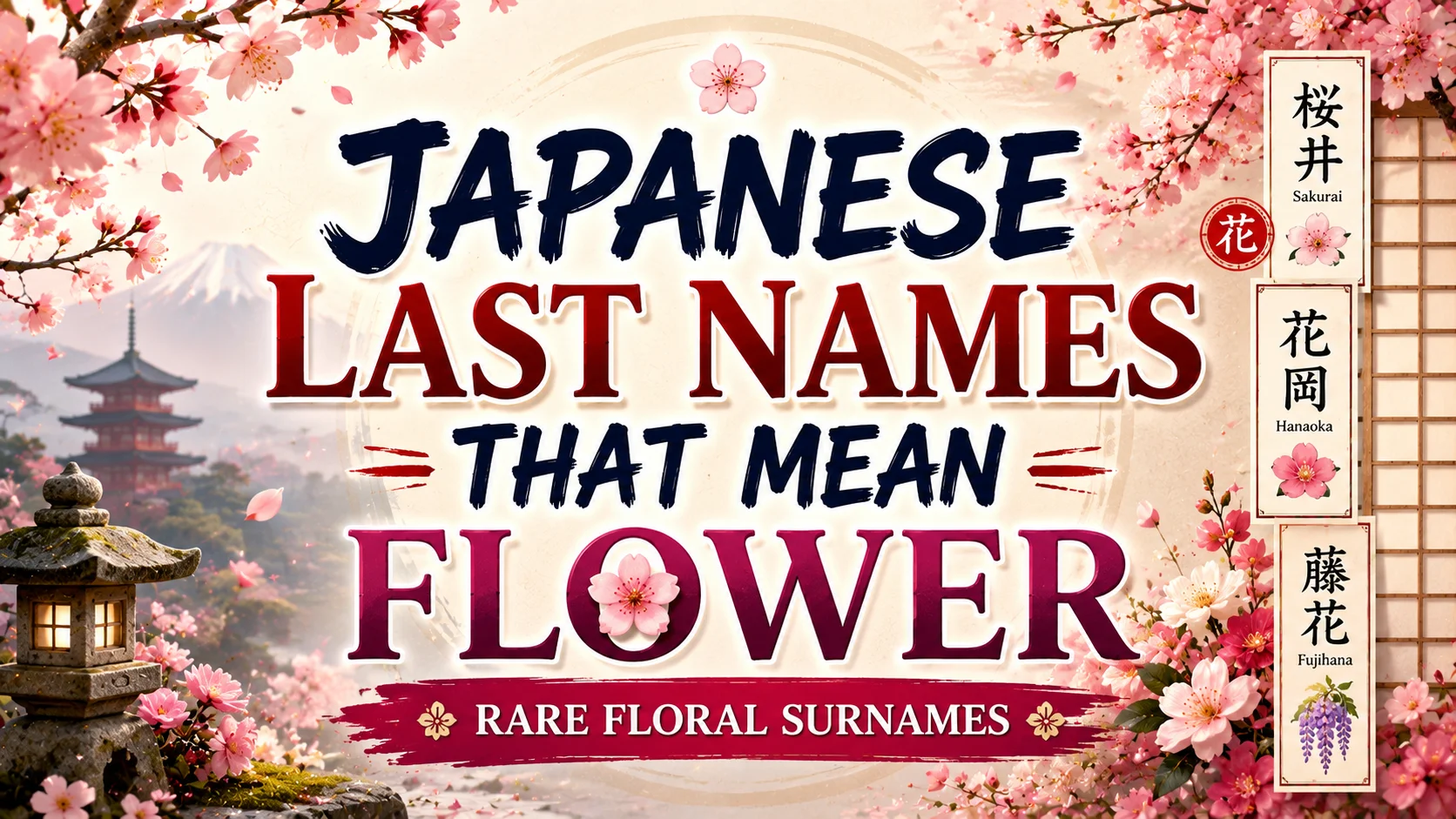
Japanese surnames often have beautiful connections to nature, including flowers, trees, mountains, rivers, gardens, and fields. If you are searching for Japanese last names that mean flower, there are several ways to approach the topic. Some Japanese surnames contain 花 (hana), the kanji meaning “flower” or “blossom,” while others contain characters representing specific flowers such as 桜 (sakura) for cherry blossom, 藤 (fuji) for wisteria, 菊 (kiku) for chrysanthemum, 椿 (tsubaki) for camellia, 梅 (ume) for plum, and 蓮 (ren/hasu) for lotus.
One important thing to understand is that a Japanese surname usually does not translate into a single English word. The meaning comes from the combination of kanji characters. For example, Hanada (花田) combines “flower” with “rice field,” while Hanazono (花園) combines “flower” with “garden.” Similarly, Sakurada (桜田) combines “cherry blossom” with “rice field.”
This guide explores beautiful Japanese surnames that either literally contain flower-related kanji or have a strong association with a particular flower. You’ll find names connected with flowers, cherry blossoms, wisteria, chrysanthemums, camellias, lotus flowers, plum blossoms, and other botanical imagery.
Understanding Japanese Flower Surnames
Before choosing a Japanese floral surname, it helps to understand how Japanese names work.
Japanese surnames are written using kanji, and the same pronunciation can sometimes be written with completely different characters. Those different characters can change the meaning considerably.
For example, a surname pronounced similarly to “Hana” might use 花, meaning flower, but another spelling could use different kanji with an unrelated meaning.
That means the English spelling alone is not enough to determine a Japanese surname’s meaning.
The Most Important Flower Kanji
Here are some of the most useful flower-related kanji:
- 花 (hana) — flower, blossom
- 華 (hana/ka) — flower, splendor, brilliance
- 桜 (sakura) — cherry blossom
- 藤 (fuji) — wisteria
- 菊 (kiku) — chrysanthemum
- 椿 (tsubaki) — camellia
- 梅 (ume) — Japanese plum or plum blossom
- 蓮 (ren/hasu) — lotus
- 菫 (sumire) — violet
- 葵 (aoi) — a botanical term used for several plants, including hollyhock-related plants depending on context
So, if you want a surname that literally contains the general idea of “flower,” 花 is the clearest character to look for.
Japanese Last Names With 花 Meaning “Flower”
The most direct floral surnames are those containing 花. This kanji means flower, blossom, or to bloom.
Japanese surname references list a variety of family names containing 花, including combinations with fields, hills, villages, valleys, wells, gardens, and other landscape features.
Hanazono — 花園
Hanazono (花園) is one of the most beautiful and direct floral Japanese surnames.
- 花 = flower
- 園 = garden, park, cultivated area
Together, 花園 literally gives the image of a flower garden. The surname is uncommon, and the dominant kanji spelling is 花園.
For a fictional character, Hanazono works particularly well if you want a surname that immediately creates a floral image.
Hanada — 花田
Hanada (花田) combines:
- 花 = flower
- 田 = rice field or cultivated field
The surname therefore has the imagery of a flower field or flower rice field. The 花田 spelling is a recognized Japanese surname and is associated with a topographic floral meaning.
Hanaoka — 花岡
Hanaoka (花岡) combines:
- 花 = flower
- 岡 = hill or elevated land
This creates the beautiful image of a flower-covered hill.
Hanamura — 花村
Hanamura (花村) combines:
- 花 = flower
- 村 = village
The name can evoke a flower village, making it particularly suitable for a fictional setting surrounded by gardens or countryside.
Hanai — 花井
Hanai (花井) combines:
- 花 = flower
- 井 = well
The literal kanji imagery is flower + well.
Hanaya — 花谷
Hanaya (花谷) can be written with:
- 花 = flower
- 谷 = valley
The combination creates the image of a flower valley.
Hanazawa — 花沢 / 花澤
Hanazawa can be written with flower-related kanji such as 花沢 or 花澤.
- 花 = flower
- 沢 / 澤 = marsh, swamp, or wetland
The surname therefore carries the imagery of flowers near a marsh or wetland.
Japanese Last Names Related to Cherry Blossoms
Few flowers are as strongly associated with Japan as the cherry blossom.
The Japanese word sakura is written 桜, and surnames containing this character have a direct connection to cherry blossoms.
Cherry blossoms are commonly associated with spring, beauty, renewal, and the temporary nature of life.
Sakurai — 桜井
Sakurai (桜井) combines:
- 桜 = cherry blossom
- 井 = well
The surname therefore creates the imagery of a cherry-blossom well.
Sakurai is a recognizable Japanese surname and is a good choice if you want a floral surname without using the general flower character 花.
Sakurada — 桜田
Sakurada (桜田) combines:
- 桜 = cherry blossom
- 田 = rice paddy or field
The dominant spelling 桜田 therefore creates the image of a cherry-blossom field or cherry-blossom paddy. Japanese dictionary sources also identify 桜田 as a surname and use the word in connection with places where many cherry trees grow or cherry blossoms are abundant.
Sakuragi — 桜木
Sakuragi (桜木) combines:
- 桜 = cherry blossom
- 木 = tree
The name creates a simple image of a cherry blossom tree.
Sakuraba — 桜庭
Sakuraba (桜庭) combines:
- 桜 = cherry blossom
- 庭 = garden or courtyard
The result is a beautiful cherry blossom garden image.
Sakurayama — 桜山
Sakurayama (桜山) combines:
- 桜 = cherry blossom
- 山 = mountain
The name evokes a cherry blossom mountain.
Other Sakura-Related Surnames
Other floral surname forms containing 桜 include:
- Sakuramoto — 桜本
- Sakuragawa — 桜川
- Sakurano — 桜野
- Sakurashima — 桜島
- Sakurazawa — 桜沢
- Sakuramori — 桜森
- Sakurabayashi — 桜林
- Sakurayama — 桜山
- Sakurata — 桜田
- Sakuragi — 桜木
The exact meaning depends on the second kanji, so these should be understood as cherry-blossom-associated surnames, not as names that all literally mean “flower.”
Japanese Last Names Related to Wisteria
The character 藤 (fuji) means wisteria, a flowering vine known for its beautiful hanging blossoms.
藤 appears in many Japanese surnames. Some are extremely familiar, including surnames such as Sato, Ito, and Kato. The flower-related character is only one part of the full surname meaning.
Fujiwara — 藤原
Fujiwara (藤原) combines:
- 藤 = wisteria
- 原 = field, plain, or open land
The resulting imagery is a wisteria plain or wisteria field.
Fujiwara is also historically significant as a Japanese family name, so it has cultural importance beyond its botanical meaning.
Fujita — 藤田
Fujita (藤田) combines:
- 藤 = wisteria
- 田 = rice field
The surname creates the image of a wisteria field.
Fujimoto — 藤本
Fujimoto (藤本) combines:
- 藤 = wisteria
- 本 = base, origin, or root
This can create the imagery of the base or root of a wisteria plant.
Fujimura — 藤村
Fujimura (藤村) combines:
- 藤 = wisteria
- 村 = village
The resulting image is a wisteria village.
Fujioka — 藤岡
Fujioka (藤岡) combines:
- 藤 = wisteria
- 岡 = hill or ridge
This gives the imagery of a wisteria-covered hill.
Fujisawa — 藤沢
Fujisawa (藤沢) combines:
- 藤 = wisteria
- 沢 = marsh, wetland, or valley
It creates a natural image involving wisteria and a wetland landscape.
Other Surnames Containing 藤
- Sato — 佐藤
- Ito — 伊藤
- Kato — 加藤
- Goto — 後藤
- Saito — 斎藤
- Endo — 遠藤
- Kondo — 近藤
- Saito — 齋藤
- Fujii — 藤井
- Fujimori — 藤森
- Fujisaki — 藤崎
- Fujikawa — 藤川
- Fujisaki — 藤崎
- Fujinami — 藤浪
These are best described as wisteria-associated surnames rather than surnames that literally mean “flower.”
Japanese Last Names Related to Chrysanthemums
The Japanese chrysanthemum is represented by 菊 (kiku).
Chrysanthemums have a strong traditional association with Japan, making 菊 an especially interesting character for a floral surname.
Kikuchi — 菊地
Kikuchi (菊地) combines:
- 菊 = chrysanthemum
- 地 = land, ground, earth
The imagery can be understood as chrysanthemum land. Japanese surname references list this as a recognized surname with approximately 45,000 households.
Kikuchi — 菊池
Another Kikuchi spelling is 菊池:
- 菊 = chrysanthemum
- 池 = pond
This creates the imagery of a chrysanthemum pond.
Kikuta — 菊田
Kikuta (菊田) combines:
- 菊 = chrysanthemum
- 田 = rice field or countryside
The result is a chrysanthemum field.
Kikukawa — 菊川
Kikukawa (菊川) combines:
- 菊 = chrysanthemum
- 川 = river
The name creates the image of a chrysanthemum river.
Kikuno — 菊野
Kikuno (菊野) combines:
- 菊 = chrysanthemum
- 野 = field or open plain
This creates the imagery of a chrysanthemum field.
Japanese Last Names Related to Camellia
The Japanese camellia is written 椿 (tsubaki).
The camellia is a flowering tree with strong cultural associations in Japan, making 椿 an appealing character for a floral name.
Tsubaki — 椿
Tsubaki (椿) is the most direct camellia-associated surname.
The single kanji 椿 refers to the camellia.
Tsubakiyama — 椿山
Tsubakiyama (椿山) combines:
- 椿 = camellia
- 山 = mountain
The imagery is a camellia mountain.
Tsubakihara — 椿原
Tsubakihara (椿原) combines:
- 椿 = camellia
- 原 = plain or field
The name evokes a camellia-covered plain.
Tsubakimoto — 椿本
Tsubakimoto (椿本) combines:
- 椿 = camellia
- 本 = base or origin
It has a botanical and traditional feel.
Japanese Last Names Related to Lotus Flowers
The lotus is represented by 蓮, commonly read ren or hasu, depending on the word or name.
Lotus imagery can evoke water, ponds, purity, beauty, and tranquility.
Hasumi — 蓮見
Hasumi (蓮見) combines:
- 蓮 = lotus
- 見 = see or view
The name can evoke the idea of viewing lotus flowers.
Hasuike — 蓮池
Hasuike (蓮池) combines:
- 蓮 = lotus
- 池 = pond
The imagery is a peaceful lotus pond.
Hasunuma — 蓮沼
Hasunuma (蓮沼) combines:
- 蓮 = lotus
- 沼 = marsh or swamp
This creates the image of lotus growing in a wetland.
Hasuda — 蓮田
Hasuda (蓮田) combines:
- 蓮 = lotus
- 田 = field
The surname evokes a lotus field.
Japanese Last Names Related to Plum Blossoms
The Japanese plum is represented by 梅 (ume).
Plum blossoms are associated with the transition from winter into spring and have a long history in Japanese art and poetry.
Umeda — 梅田
Umeda (梅田) combines:
- 梅 = plum
- 田 = rice field
The imagery is a plum field.
Umehara — 梅原
Umehara (梅原) combines:
- 梅 = plum
- 原 = plain or field
The name evokes a plum-covered plain.
Umeno — 梅野
Umeno (梅野) combines:
- 梅 = plum
- 野 = open field
The imagery is a plum blossom field.
Umemoto — 梅本
Umemoto (梅本) combines:
- 梅 = plum
- 本 = base or origin
It has a distinctly botanical character.
Umegaki — 梅垣
Umegaki (梅垣) combines:
- 梅 = plum
- 垣 = fence or hedge
The name can evoke a plum tree growing beside a garden boundary.
Japanese Surnames Associated With Violet
The Japanese kanji 菫 can represent the violet flower.
Violet-related surname usage is less straightforward than the common surname groups containing 花, 桜, 藤, or 菊. This is another reason why checking the exact kanji is important.
Potential floral or botanical surname-inspired forms include:
- Sumire
- Sumida
- Sumino
- Sumimoto
- Sumitani
- Sumizawa
- Sumiyama
- Sumikawa
- Sumihara
- Sumisaka
However, these should not automatically be translated as “violet.” A surname’s actual meaning depends on its written kanji.
Japanese Flower Surnames by Floral Theme
If you’re choosing a surname based on a particular flower, this quick guide can make the search easier.
General Flower
Look for:
- 花 — flower
- 華 — flower, splendor
Good examples include:
- Hanada — 花田
- Hanaoka — 花岡
- Hanamura — 花村
- Hanazono — 花園
- Hanai — 花井
- Hanaya — 花谷
- Hanazawa — 花沢
Cherry Blossom
Look for:
- 桜 — cherry blossom
Examples:
- Sakurai — 桜井
- Sakurada — 桜田
- Sakuragi — 桜木
- Sakuraba — 桜庭
- Sakurayama — 桜山
- Sakuragawa — 桜川
- Sakuramoto — 桜本
Wisteria
Look for:
- 藤 — wisteria
Examples:
- Fujiwara — 藤原
- Fujita — 藤田
- Fujimoto — 藤本
- Fujimura — 藤村
- Fujioka — 藤岡
- Fujisawa — 藤沢
- Fujimori — 藤森
Chrysanthemum
Look for:
- 菊 — chrysanthemum
Examples:
- Kikuchi — 菊地
- Kikuchi — 菊池
- Kikuta — 菊田
- Kikukawa — 菊川
- Kikuno — 菊野
Camellia
Look for:
- 椿 — camellia
Examples:
- Tsubaki — 椿
- Tsubakiyama — 椿山
- Tsubakihara — 椿原
- Tsubakimoto — 椿本
Lotus
Look for:
- 蓮 — lotus
Examples:
- Hasumi — 蓮見
- Hasuike — 蓮池
- Hasunuma — 蓮沼
- Hasuda — 蓮田
Plum Blossom
Look for:
- 梅 — plum
Examples:
- Umeda — 梅田
- Umehara — 梅原
- Umeno — 梅野
- Umemoto — 梅本
- Umegaki — 梅垣
50+ Beautiful Japanese Floral Surname Ideas
Here is a convenient shortlist of flower-related Japanese surnames to explore:
- Hanazono — 花園
- Hanada — 花田
- Hanaoka — 花岡
- Hanamura — 花村
- Hanai — 花井
- Hanaya — 花谷
- Hanazawa — 花沢
- Hanamoto — 花本
- Hanakawa — 花川
- Hanatani — 花谷
- Sakurai — 桜井
- Sakurada — 桜田
- Sakuragi — 桜木
- Sakuraba — 桜庭
- Sakurayama — 桜山
- Sakuragawa — 桜川
- Sakuramoto — 桜本
- Sakurano — 桜野
- Sakurazawa — 桜沢
- Sakuramori — 桜森
- Fujiwara — 藤原
- Fujita — 藤田
- Fujimoto — 藤本
- Fujimura — 藤村
- Fujioka — 藤岡
- Fujisawa — 藤沢
- Fujimori — 藤森
- Fujikawa — 藤川
- Fujisaki — 藤崎
- Fujii — 藤井
- Kikuchi — 菊地
- Kikuchi — 菊池
- Kikuta — 菊田
- Kikukawa — 菊川
- Kikuno — 菊野
- Tsubaki — 椿
- Tsubakiyama — 椿山
- Tsubakihara — 椿原
- Tsubakimoto — 椿本
- Hasumi — 蓮見
- Hasuike — 蓮池
- Hasunuma — 蓮沼
- Hasuda — 蓮田
- Umeda — 梅田
- Umehara — 梅原
- Umeno — 梅野
- Umemoto — 梅本
- Umegaki — 梅垣
- Sato — 佐藤
- Ito — 伊藤
- Kato — 加藤
Best Japanese Last Names That Mean Flower
If you want the strongest options rather than a huge list, these are some of the best choices.
Hanazono — 花園
Best for: A direct flower meaning
Hanazono is arguably the strongest choice because 花 means flower and 園 means garden. The dominant spelling literally creates the image of a flower garden.
Hanada — 花田
Best for: Flower field imagery
Hanada combines flower and rice field, creating a natural flower-field image.
Hanaoka — 花岡
Best for: A scenic floral surname
Hanaoka combines flower and hill, giving it a peaceful countryside feeling.
Sakuraba — 桜庭
Best for: Cherry blossom imagery
Sakuraba combines cherry blossom with garden, making it particularly attractive for a character or story.
Sakuragi — 桜木
Best for: A simple cherry blossom name
Sakuragi combines cherry blossom and tree, creating an instantly understandable botanical image.
Fujiwara — 藤原
Best for: Traditional wisteria association
Fujiwara combines wisteria with a plain or field and also carries substantial historical significance.
Kikuchi — 菊池
Best for: Chrysanthemum imagery
The characters combine chrysanthemum and pond, producing the image of a chrysanthemum pond.
Hasuike — 蓮池
Best for: Peaceful lotus imagery
Hasuike combines lotus with pond, making it one of the most visually tranquil choices.
Umeda — 梅田
Best for: Plum blossom imagery
Umeda combines plum with rice field and has a classic Japanese surname structure.
Tsubaki — 椿
Best for: Direct camellia association
Tsubaki is especially appealing when you want the surname itself to correspond directly to a flower.
How to Choose a Japanese Last Name That Means Flower
The best surname depends on the exact feeling you want.
If you want a general flower meaning, choose a surname containing 花. Names such as Hanazono, Hanada, Hanaoka, and Hanamura are the clearest choices.
If you want something strongly connected to Japanese seasonal beauty, cherry blossom surnames containing 桜 are excellent. Sakurai, Sakurada, Sakuragi, and Sakuraba all create different images.
For a more traditional and elegant botanical feeling, consider 藤, the character for wisteria. Fujiwara and Fujita are familiar examples.
For a surname associated with traditional Japanese floral imagery, chrysanthemum names containing 菊 are another option.
If you prefer something peaceful and nature-focused, lotus surnames such as Hasuike and Hasunuma can evoke water, ponds, and flowers.
Consider the Character’s Personality
A floral surname can also complement a character’s personality.
A gentle character might suit:
- Hanazono
- Hanaoka
- Sakuraba
- Hasuike
- Hanamura
A mysterious character might suit:
- Sakuragi
- Fujimori
- Tsubaki
- Kikukawa
- Umehara
A traditional character might suit:
- Fujiwara
- Sakurai
- Kikuchi
- Umeda
- Fujita
A cheerful character might suit:
- Hanada
- Hanazono
- Sakurada
- Hanaoka
- Kikuta
Why Exact Kanji Matters
The most important rule when researching Japanese last names that mean flower is to check the kanji spelling.
A surname’s pronunciation does not automatically tell you its meaning. Japanese surname references explicitly note that the meaning of a name changes depending on the kanji used. Hanazono, for example, has multiple possible kanji spellings, with 花園 being the dominant form and literally combining flower and garden.
Likewise, Hanada has multiple possible spellings, but 花田 is the spelling that gives the flower + rice field meaning.
This is particularly important if you’re choosing a surname for a novel, anime-inspired character, game, or baby. Don’t rely only on a website that provides a Romanized spelling and a one-word English translation. Check the actual Japanese characters.
Are These Surnames Literal Translations?
Not always.
A surname like Hanazono (花園) is very straightforward: flower + garden.
But Sakurai (桜井) does not simply mean “flower.” It combines cherry blossom with well.
Likewise, Fujita (藤田) combines wisteria with rice field.
This reflects how many Japanese surnames developed from places, landscapes, geographic features, and local environments. The floral character can describe something associated with the family’s ancestral location rather than functioning as a poetic first name.
Therefore, it’s more accurate to call these flower-related Japanese surnames rather than claiming that every surname literally translates to “flower.”
Frequently Asked Questions
What Japanese last name means flower?
Hanazono (花園) is one of the clearest examples because 花 means “flower” and 園 means “garden.” Hanada (花田) and Hanaoka (花岡) are other surnames that directly contain 花.
What Japanese surname means flower garden?
Hanazono (花園) means flower garden in its dominant kanji spelling. It is one of the most direct and visually beautiful Japanese floral surnames.
What Japanese surname means flower field?
Hanada (花田) combines 花, meaning flower, with 田, meaning rice field or cultivated field. It can therefore be understood as flower field or flower rice field.
What Japanese last name means cherry blossom?
Surnames containing 桜, the kanji for cherry blossom, include Sakurai, Sakurada, Sakuragi, Sakuraba, and Sakurayama.
What Japanese surname means wisteria?
藤 (fuji) means wisteria. Surnames containing this character include Fujiwara, Fujita, Fujimoto, Fujimura, Fujioka, and Fujisawa.
What Japanese surname means chrysanthemum?
Surnames containing 菊 (kiku), meaning chrysanthemum, include Kikuchi, Kikuta, Kikukawa, and Kikuno. For example, 菊田 combines chrysanthemum with rice field.
What Japanese surname means lotus?
Lotus-related surnames include Hasumi (蓮見), Hasuike (蓮池), Hasunuma (蓮沼), and Hasuda (蓮田). These combine 蓮, meaning lotus, with other landscape-related characters.
What Japanese surname means plum blossom?
Surnames containing 梅, associated with the Japanese plum, include Umeda, Umehara, Umeno, Umemoto, and Umegaki.
What Japanese surname means camellia?
Tsubaki (椿) is directly associated with the Japanese camellia. Compound surnames can also combine 椿 with landscape characters.
Is Sakura a Japanese last name?
Sakura is primarily known as the Japanese word for cherry blossom and is also used in given names and place names. Surnames such as Sakurai, Sakurada, Sakuragi, and Sakuraba contain the cherry-blossom kanji 桜.
Is Hanazono a real Japanese surname?
Yes. Hanazono (花園) is a real, though relatively uncommon, Japanese surname. The dominant spelling literally combines flower and garden.
What is the prettiest Japanese flower surname?
This depends on personal preference, but Hanazono, Sakuraba, Sakuragi, Hasuike, Hanaoka, and Fujiwara are especially appealing because their kanji create strong floral or natural imagery.
Are all Japanese floral surnames literally “flower”?
No. Some contain the character 花 and therefore directly include the word “flower,” while others represent specific flowers such as cherry blossom, wisteria, chrysanthemum, lotus, camellia, or plum. The rest of the surname can describe a field, pond, mountain, garden, river, or another geographic feature.
Conclusion
Japanese surnames connected with flowers offer a beautiful combination of nature, culture, history, and symbolism. If you want a surname that directly contains the general concept of flower, names such as Hanazono (花園), Hanada (花田), Hanaoka (花岡), and Hanamura (花村) are strong choices.
For a specific flower, you can look at the kanji. 桜 represents cherry blossom, 藤 represents wisteria, 菊 represents chrysanthemum, 椿 represents camellia, 蓮 represents lotus, and 梅 represents Japanese plum. These characters appear in a wide range of Japanese surnames and create different natural images when combined with characters for fields, gardens, ponds, hills, rivers, villages, and other landscapes.
Among all the options, Hanazono is one of the clearest floral choices because its dominant spelling, 花園, literally combines flower + garden. Hanada gives a flower-field feeling, while Sakuraba suggests a cherry blossom garden and Hasuike evokes a peaceful lotus pond.
The most important thing to remember is that Japanese surname meanings depend on kanji. A Romanized surname may have several possible spellings, and those spellings can carry different meanings. If accuracy matters, always check the exact Japanese characters before using a surname for a character, story, genealogy project, or other purpose.

Ethan Carter is a nature enthusiast and content writer with a passion for flowers and botanical knowledge. He is the author behind FlowerNamez, where he shares simple and informative content about flower names, types, and meanings.
With a focus on clarity and accuracy, Ethan aims to help readers explore the beauty of flowers and understand their significance in everyday life.