
Last Updated: Aug 09, 2026
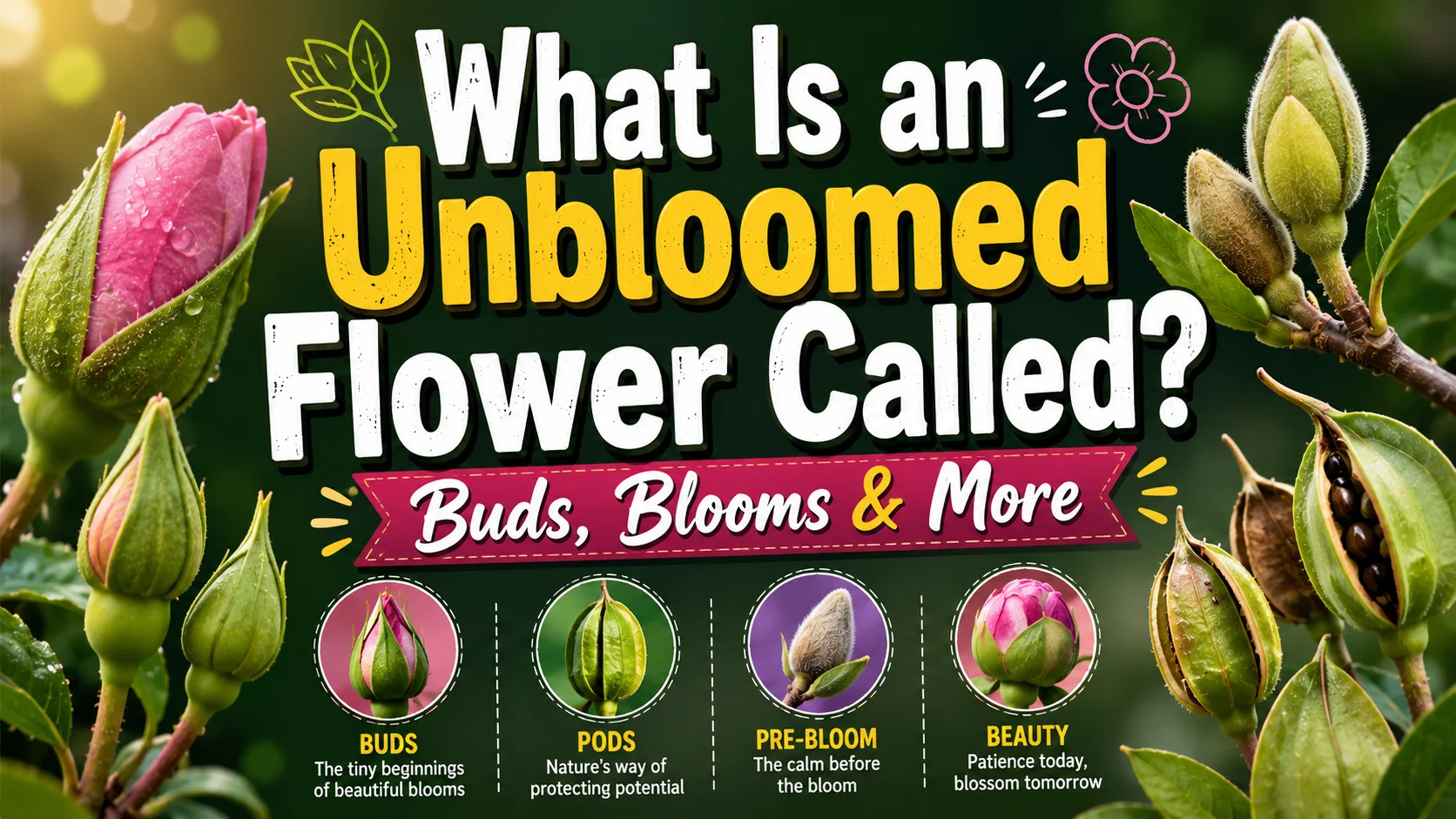
Have you ever noticed the tiny, tightly closed treasures on a plant and wondered what they are called? The answer is a flower bud. An unbloomed flower is simply a flower that has not yet opened. These small packages hold all the potential of a future bloom, waiting for the right conditions to unfurl. Whether you are a gardener, a florist, or just someone who loves nature, knowing the names for flowers at their pre-bloom stage opens up a whole new world of appreciation. This collection is different. You will find names for buds, unopened blossoms, and the fascinating structures that appear before the petals show themselves.
You may also enjoy learning about how long do flowers last, exploring creative cactus flower names, or discovering meaningful healing flower names as you explore the fascinating world of flowers.
What Are Unbloomed Flowers Called?
An unbloomed flower is most commonly called a bud. A bud is a small protuberance on a stem or branch, sometimes enclosed in protective scales, containing an undeveloped leaf, flower, or leafy shoot . When we specifically refer to a bud that will become a flower, it is called a flower bud . In botany, a flower bud is defined as a bud that develops into a flower. These structures can be in various stages, from tightly closed and protected to partially opened, often referred to as a “blossom before blooming” .
- A bud is a flower that has not bloomed yet or a leaf that will soon unfurl
- Winter buds hold all the potential of spring in small, gift-wrapped packages
- A flower bud is a small, undeveloped flower enclosed in protective outer parts
- The term “unbloomed” simply means not having blossomed or opened
- Unbloomed flowers are also described as being in the pre-floral stage
- Some plants are interesting even before they flower, like agapanthus and allium
- A blossom before blooming is a semi-open or partially opened flower
- Buds can be found at the end of a branch (terminal) or at leaf axils (axillary)
- Unopened flowers display a wide range of textures, sizes, and shapes
- The protective outer layer of a bud is often covered in scales or fine hairs
General Bud and Flower Bud Names
These are the general scientific and descriptive terms for unbloomed flowers.
- Flower Bud
- Floral Bud
- Bud
- Bloom Bud
- Floweret (small bud)
- Budlet (tiny bud)
- Unopened Blossom
- Pre-bloom
- Primordium (earliest stage of development)
- Inflorescence Bud (for a cluster of flowers)
- Naked Bud (a bud without protective scales)
- Terminal Bud (bud at the end of a branch)
- Axillary Bud (bud at the leaf joint)
- Adventitious Bud (bud appearing on roots or trunks)
- Dormant Bud (resting stage)
- Active Bud (growing stage)
- Leaf Bud (develops into leaves)
- Mixed Bud (develops into both leaves and flowers)
- Scale Bud (protected by scales)
- Accessory Bud (extra bud near a primary bud)
- Latent Bud (bud that remains dormant for years)
- Reproductive Bud (bud that becomes a flower)
- Vegetative Bud (bud that becomes a stem or leaf)
- Resting Bud (winter dormancy stage)
- Swelling Bud (preparing to open)
- Cracking Bud (scales separating to reveal color)
- Pip (a seed or bud, especially of fruits)
- Eye (another term for a bud, especially on a potato or tuber)
- Flower bud is the botanical term for any bud that develops into a flower
- A naked bud has no protective scales, only fine hairs
- Terminal buds are found at the very tip of a branch
- Axillary buds are found where leaves attach to stems
- Mixed buds contain both leaves and flowers inside
- Resting buds are dormant, often waiting out winter
- Swelling buds are actively growing and preparing to open
- Cracking buds are beginning to separate their protective layers
- Latent buds can stay dormant for years before growing
- Adventitious buds appear unexpectedly on roots or trunks
Fruit Tree Flower Buds
These are the unbloomed flowers of fruit trees, often harvested or prized for their own beauty.
- Peach Bud
- Apple Bud
- Pear Bud
- Cherry Bud
- Plum Bud
- Apricot Bud
- Nectarine Bud ( Explore Turquoise Flower Names)
- Quince Bud
- Fig Bud
- Olive Bud
- Lemon Bud
- Orange Bud
- Lime Bud
- Grapefruit Bud
- Almond Bud
- Persimmon Bud
- Pomegranate Bud
- Peach buds are small, plump, fuzzy, unopened blooms enclosed in a natural fuzzy protective exterior layer
- Peach buds are traditionally harvested from trees 1 to 7 meters tall
- Peach buds are collected when the buds are closed or nearly open
- In Japan, peach buds are a seasonal specialty for the Hinamatsuri festival
- Peach buds measure 3 to 6 millimeters in diameter
- The buds enclose 4 to 5 papery, delicate, soft, and velvety petals
- As the buds approach maturity, they expand in size, swelling in diameter
- The petals are found in red, pink, and white shades when open
- Peach buds have an edible, mild, floral, subtly nutty, sweet, and earthy taste
- Peach buds are preferred for culinary use over open blossoms because they are hardier
Ornamental Flower Buds
These are the unbloomed stages of popular garden flowers, each with unique characteristics.
- Rosebud
- Tulip Bud
- Peony Bud
- Lily Bud
- Daisy Bud
- Sunflower Bud
- Hydrangea Bud
- Orchid Bud
- Daffodil Bud
- Crocus Bud
- Hyacinth Bud
- Iris Bud
- Lilac Bud
- Magnolia Bud
- Camellia Bud
- Azalea Bud
- Rhododendron Bud
- Gardenia Bud
- Hollyhock Bud
- Foxglove Bud
- Delphinium Bud
- Allium Bud
- A peony bud can be round or cone-shaped with tightly packed petals
- A daffodil bud has a hint of its yellow trumpet before fully opening
- A rosebud is a classic symbol of potential and beauty
- A camellia bud has a striking reddish hue before opening
- A sunflower bud turns to follow the sun even before it opens
- A magnolia bud has fuzzy bud scales to help insulate the developing flower
- Magnolias have soft fur on their buds that varies in color
- Azalea buds show an astonishing variety of form, color, and texture
- Allium buds are interesting before, during, and after bloom
Wildflower Buds
These are the unbloomed stages of wildflowers found in meadows and woodlands.
- Bluebell Bud
- Primrose Bud
- Buttercup Bud
- Violet Bud
- Clover Bud
- Thistle Bud
- Dandelion Bud (tightly closed green)
- Cowparsnip Bud
- Queen Anne’s Lace Bud (flat, green, lacy before opening)
- Milkweed Bud
- Goldenrod Bud
- Aster Bud
- Black Eyed Susan Bud
- Coneflower Bud (green cone before petals emerge)
- Bee Balm Bud
- Fireweed Bud
- Lupine Bud
- Primrose buds are pale yellow clusters before they open
- Coltsfoot flowers appear before its leaves do
- Texas bluebell buds are spindly with a paintbrush shape
- Texas bluebell buds keep forming well into summer
- Squarebud daisy has green bracts that create a boxy, dumpling-like shape
- American basket-flower buds have stiff, straw-colored bracts around the flower head
- Purple leatherflower buds nod from ends of slender stems
- Wildflower buds are often more subtle than garden varieties
- Many wildflower buds have unique protective bracts
Edible and Culinary Buds
These are unbloomed flowers that are harvested and eaten before they open.
- Peach Bud (edible, used in Japanese cuisine)
- Nasturtium Bud (capers substitute)
- Capers (unopened flower buds of Capparis shrub)
- Broccoli Buds (the entire vegetable is unopened flower heads)
- Cauliflower Buds (dense cluster of unopened flower buds)
- Artichoke Bud (the large vegetable is a giant flower bud)
- Saffron Crocus Bud (stigmas harvested from unopened flowers)
- Daylily Bud (edible, tastes like green beans)
- Honeysuckle Bud (sweet nectar inside closed buds)
- Linden Bud (edible, nutty flavor)
- Violet Bud (edible, mild flavor)
- Rosebud (edible, used in teas and desserts)
- Chive Bud (pungent, purple globes before opening)
- Garlic Bud (scapes are the unopened flower stalks)
- Onion Bud (flower heads before opening)
- Broccoli rabe buds (smaller, bitterer than broccoli)
- Peach buds are pickled as a tangy condiment in Japan
- Peach buds can be fried into tempura
- Peach buds can be salted and added to sushi
- Edible buds are often pickled, candied, or infused into syrups
- The woody branches of peach buds are discarded, only the buds are used
- Capers are perhaps the most famous pickled flower bud
- Artichokes are the flower buds of the thistle family
- Saffron comes from the stigmas of crocus flowers
- Chive buds are purple and globe-shaped
- Daylily buds are a common ingredient in Asian cuisine
Winter and Dormant Buds
These are buds that rest through winter, waiting for spring warmth.
- Winter Bud
- Dormant Bud
- Hibernating Bud
- Frost Bud
- Persian Ironwood Bud (look like chocolate chips)
- Paperbush Bud (downy, golden-gray clusters)
- Leatherleaf Mahonia Bud (purple stems with chartreuse buds)
- Magnolia Bud (fuzzy, silvery, lancelike)
- Japanese Pieris Bud (red and berry-like)
- Weeping Beech Bud (sharply pointed with smooth scales)
- Winter-Hazel Bud (fat, rosy buds like beads on a string)
- Common Camellia Bud (exquisitely overlapping scales)
- Weeping Pussy Willow Bud (fluffy white emerging from red scales)
- Pinkster Azalea Bud (reddish base with slate-gray tips)
- Persian ironwood buds are woolly, brown, and look like tiny chocolate chips
- Paperbush buds are naked (no scales), with fine hairs that make them sparkle
- Leatherleaf mahonia buds form Medusa-like clusters of purple stems
- Magnolia buds have fuzzy bud scales to insulate the developing flower
- Japanese pieris buds are so colorful that people mistake them for berries
- Winter-hazel buds are among the best to watch as they gradually swell
- Camellia buds have scales that almost look like flowers themselves
- Weeping pussy willow buds have reddish scales with fluffy white flowers emerging
- Winter buds are often covered in fine hairs or sticky substances for protection
Partially Opened Flowers
These are buds that have begun to open but are not yet fully bloomed.
- Half-open Blossom
- Semi-bloom
- Emerging Flower
- Cracking Bud
- Unfurling Petals
- Break Bud (when scales separate)
- Swollen Bud (just before opening)
- Showing Color (when petals become visible)
- Loosening Bud
- Opening Bud
- Teasing Bud (partially revealing inner petals)
- Blush Bud (when color first appears)
- Split Calyx (when the outer protective layer separates)
- Exserted Stamen (when reproductive parts begin to emerge)
- A blossom before blooming is a semi-open or partially opened flower
- A cracking bud is when the protective scales begin to separate
- A showing color bud reveals the petal color before opening
- Peach buds in Japan are often harvested when they are partially open
- A bud’s petals become visible through the cracking scales
- The swelling bud is often the most visually dramatic stage
- Buds can be tightly closed or looser, almost ready to open
- When peach buds approach maturity, they expand in size
- The Japanese pieris bud is showier in bud than some plants in full bloom
- Watching buds gradually swell is a favorite winter activity for gardeners
Unique Bud Shapes and Descriptions
These names describe the fascinating shapes and characteristics of unbloomed flowers.
- Paintbrush Bud (Texas bluebell)
- Dumpling Bud (squarebud daisy)
- Urn-shaped Bud (purple leatherflower)
- Collar Bud (bracts creating a collar around the flower head)
- Chocolate Chip Bud (Persian ironwood)
- Sparkling Bud (paperbush with shimmering hairs)
- Medusa Bud (leatherleaf mahonia with purple stems)
- Lancelike Bud (weeping beech with sharp points)
- Bead Bud (winter-hazel with buds like beads on a string)
- Berry-like Bud (Japanese pieris, often mistaken for fruit)
- Fuzzy Bud (magnolia with soft fur)
- Scaly Bud (camellia with overlapping scales)
- Fluffy Bud (pussy willow with emerging white hairs)
- Hairy Bud (many species have fine protective hairs)
- Waxy Bud (some succulents and magnolias)
- Sticky Bud (some poplars and horse chestnuts)
- Squarebud daisy has green bracts creating a prominent collar around the open flower
- Purple leatherflower has urn-shaped sepals that are thick, succulent, and leather-like
- Persian ironwood buds crack open slowly, offering peeks at bright-red flowers
- Paperbush buds have fine hairs giving them a wonderful shimmery quality
- Weeping beech buds have an almost metallic, lancelike appearance
- Winter-hazel buds’ compact shape and reddish color belie their feathery yellow flowers
- Camellia scales are exquisitely overlapping
Floral Design and Cut Flower Buds
These are buds used by florists for arrangements, often because they last longer than open flowers.
- Agapanthus Bud (green orb before blooming)
- Allium Bud (round green head before purple flowers emerge)
- Clematis Bud (interesting even with rugged foliage)
- Echinacea Cone (the cone before petals appear)
- Lily Bud (cut early for its beautiful foliage)
- Nigella Pod (unique seed pods that follow the flowers)
- Scabiosa Pod (delicate pods that shatter less than others)
- Sedum Bud (useful in bud for months before flowering)
- Sunflower Bud (inner disk before petals open)
- Globe Thistle Bud (spherical blue-green before opening)
- Sea Holly Bud (metallic blue cone before spiky bracts appear)
- Delphinium Bud (tightly packed spirals on a tall spike)
- Snapdragon Bud (stacked in a raceme, opening from bottom to top)
- Peach buds are used as an aesthetically pleasing decoration
- Unopened flowers are often preferred for arrangements because they are hardier
- Buds remain firmly attached to branches longer than open flowers
- Agapanthus buds are used after the spent buds are removed
- Allium buds are used before, during, and after bloom
- Nigella seed pods are useful without any drying necessary
- Scabiosa pods come in fama series (delicate) and stellata (sturdier)
- Sedum is useful in bud form in the months leading up to flowering
- Florists cut lilies early to take advantage of their beautiful foliage
How To Identify Unbloomed Flowers
Identifying unbloomed flowers is a rewarding skill. You can identify them by looking at their shape (round, cone, urn, or pointed), texture (smooth, fuzzy, hairy, or waxy), color (green, red, purple, brown, or silver), size (tiny nubs to large bulbs), position (terminal, axillary, or adventitious), and protective covering (scales, bracts, hairs, or naked). Each plant has a unique bud that hints at the flower to come. Learning to recognize buds is like learning a secret language of the garden .
- Look at the shape: a peony bud is round, an apple bud is cylindrical
- Check the texture: bougainvillea buds are rough and prickly
- Notice the color: camellia buds have a striking reddish hue
- Measure the size: an orchid bud is tiny, a hyacinth bud is marble-sized
- Observe the position: terminal buds are at branch tips, axillary are at leaf joints
- Feel the covering: some buds have fuzzy scales, others are sticky or waxy
- Note the bracts: squarebud daisy has a prominent green collar
- Watch for swelling: swelling buds are preparing to open
- Check for cracking: cracking buds reveal petal color
- Identifying unopened flowers is like deciphering a puzzle piece
Symbolic Meanings of Unbloomed Flowers
Unbloomed flowers symbolize potential, hope, anticipation, new beginnings, youth, promise, patience, waiting for the right moment, hidden beauty, inner strength, growth and development, future success, virginity and purity (in some cultures), the idea that “good things come to those who wait,” and the beauty of being in process. Giving someone a bud can mean “your potential is beautiful” or “I can’t wait to see you bloom .”
- Unbloomed flowers symbolize unrealized potential and hidden beauty.
- Buds represent hope, growth, and fresh beginnings.
- People associate flower buds with anticipation and exciting possibilities.
- Japanese families give peach buds during Hinamatsuri for protection and good fortune.
- Buds symbolize the return of spring after cold winters.
- Many cultures connect flower buds with young love and new relationships.
- A blooming bud represents personal transformation and self-growth.
- People gift buds to express future happiness and beauty.
- Buds teach us that beautiful things develop with patience and time.
How To Use Unbloomed Flowers in Gardening
Using unbloomed flowers extends the beauty of your garden. You can enjoy them as cut flowers (buds last longer in vases than open blooms), as dried arrangements (many pods and buds dry beautifully), as focal points (magnolia buds are show stoppers), as textural elements (fuzzy, scaly, or waxy buds add interest), as edible harvests (peach buds, capers, and daylily buds are delicious), as winter interest (dormant buds are architectural), as anticipation (watch them swell day by day), for forcing (bring branches indoors to bloom early), for natural dye (some buds produce color), and for wildlife (buds are food for birds and insects) .
- Cut buds last longer than open flowers in floral arrangements
- Many seed pods are useful without any drying necessary
- Agapanthus stalks with green orbs are long lasting
- Allium buds are interesting in every stage
- Echinacea cones are a common commercial floristry product
- Nigella seed pods are unique and require no drying
- Peach buds are available in late winter through early spring
- Peach buds are harvested from greenhouse trees as early as February
- Outdoor peach buds appear in March and April
- Forcing branches brings buds to bloom indoors weeks early
Unbloomed Flower Called
An unbloomed flower is most commonly called a bud or, more specifically, a flower bud. A bud is the developing structure that contains the parts of a future flower before it opens. It may appear tightly closed, swollen, or covered with protective scales, hairs, or other outer structures. Once the petals begin to unfold, the bud moves into the blooming stage.
What Is a Flower Called Before It Blooms
A flower before it blooms is generally called a bud or flower bud. At this stage, the flower is still developing inside a compact structure. The petals and other floral parts are protected until the plant has suitable conditions for opening. Depending on the plant, a bud can remain closed for days, weeks, or longer before becoming a fully opened flower.
What Do You Call a Flower Before It Blooms
The simplest term for a flower before it blooms is a bud. If you want to be more specific, flower bud is the clearest botanical term because it distinguishes a developing flower from a leaf bud or mixed bud. In everyday gardening language, people may also describe it as an unopened blossom or a pre-bloom flower.
What Is an Unbloomed Flower Called
An unbloomed flower is called a bud, while a developing bud that will specifically produce a flower is called a flower bud. The term “unbloomed” simply describes something that has not yet blossomed or opened. Flower buds can vary greatly in shape, size, texture, and color depending on the plant.
Flower Before Blooming Called
The flower before blooming is called a flower bud. It is the stage in which the developing flower remains enclosed before its petals spread open. Some buds are round and compact, while others may be pointed, cone-shaped, fuzzy, scaly, or covered by protective bracts. As the flower matures, the bud may swell and begin showing the color of its petals.
What Do You Call an Unbloomed Flower
You can call an unbloomed flower a bud or flower bud. “Bud” is the common short term, while “flower bud” is more precise when referring specifically to a developing blossom. The distinction is useful because plants can also have leaf buds, vegetative buds, mixed buds, and other types of developing structures.
Unbloomed Meaning
Unbloomed means not yet blossomed or opened. When used for a flower, it describes a blossom that remains in its developing or bud stage. An unbloomed flower may still be tightly enclosed, swelling before opening, or beginning to reveal its petals. In simple terms, an unbloomed flower is a flower that has not reached the point of full bloom.
What Is a Flower That Hasn’t Bloomed Called
A flower that hasn’t bloomed is called a bud or flower bud. The bud protects the developing floral parts before the flower opens. Depending on its stage of development, it may be described as a dormant bud, swelling bud, cracking bud, or opening bud. These terms describe different points in the transition from a closed bud to a flower.
Unbloomed Flower Meaning
The literal meaning of an unbloomed flower is a flower that has not yet opened or blossomed. Beyond its botanical meaning, an unbloomed flower can symbolize potential, hope, patience, growth, anticipation, and beauty that has not yet fully revealed itself. A flower bud represents something still developing and waiting for the right conditions to reach its full form.
What Is an Unopened Flower Called
An unopened flower is usually called a bud or flower bud. The phrase “unopened flower” is a descriptive expression rather than a separate botanical category. A bud can remain tightly closed while its petals develop inside. Some buds eventually begin to swell, crack open, show their color, and gradually reveal the flower within.
A Newly Sprouted Leaf or Blossom That Has Not Yet Unfolded
A newly developing leaf or blossom that has not yet unfolded can be called a bud. More specifically, a developing flower is a flower bud, while a developing leaf is generally a leaf bud or vegetative bud. A mixed bud may contain both developing leaves and flowers. This is why the word “bud” can refer to several early growth structures rather than flowers alone.
Flower Unbloomed
A flower unbloomed is simply a flower bud that has not opened yet. It may be small and tightly closed or swollen and close to blooming. Roses, peonies, tulips, magnolias, camellias, and many other plants have recognizable buds that can often be identified before the flowers open. The appearance of an unbloomed flower can provide clues about the blossom that will eventually emerge.
Unopened Flower Is Called a Bud
An unopened flower is called a bud, and when the bud is specifically developing into a flower, it is called a flower bud. This is the most straightforward answer to the question. The outer structure of a bud helps protect the developing flower until it is ready to open. Some buds have scales or hairs, while others are described as naked buds because they lack protective scales.
Unbloom Flower
The phrase unbloom flower is not the usual grammatical or botanical term. If you mean a flower that has not opened yet, the correct and commonly used terms are bud, flower bud, or unopened flower. “Unbloomed flower” is also understandable as a descriptive phrase meaning a flower that has not yet blossomed.
What Is a Closed Flower Called
A closed flower is generally called a bud when it has not opened yet. If the flower has started opening but remains partly closed, terms such as half-open blossom, semi-bloom, opening bud, or partially opened flower can describe its stage. A tightly closed bud is still developing, while a partially opened flower is already transitioning toward full bloom.
What Is Unbloomed Flower Called
An unbloomed flower is most commonly called a bud or flower bud. The term flower bud is especially accurate when the developing structure is destined to become a flower. Before opening, the bud protects the delicate petals and reproductive parts inside. As it matures, it may swell, reveal its color, crack its protective covering, and eventually unfold into a blossom.
What Is a Young Flower Called
A young flower that has not yet opened is usually called a flower bud. “Young flower” is more of a descriptive phrase, while “flower bud” identifies the developmental stage more precisely. A young flower may remain enclosed while its petals and reproductive structures develop. Once the bud opens, it becomes a blooming or fully opened flower. In this sense, a flower bud represents the early stage of a flower’s visible development.
Frequently Asked Questions About Unbloomed Flowers 🌿
What do people call an unbloomed flower?
People usually call an unbloomed flower a “bud” or “flower bud.” It describes a flower before it fully opens and blooms.
Why do flowers stay in the bud stage?
Flowers stay in the bud stage while they develop petals, seeds, and reproductive parts. Weather, sunlight, temperature, and plant health all affect how quickly buds bloom.
Do all flowers start as buds?
Yes, almost every flowering plant begins as a small bud before opening into a full flower. The bud protects the delicate petals during early growth.
Can gardeners identify flowers from their buds?
Yes! Experienced gardeners often recognize plants by the shape, size, color, and texture of their buds before the flowers bloom.
Which plants produce the most beautiful flower buds?
Plants like roses, magnolias, peonies, tulips, camellias, and cherry blossoms produce especially attractive and colorful buds before blooming.
Why do some flower buds never bloom?
Poor sunlight, lack of water, pests, disease, temperature stress, or nutrient problems can stop buds from opening properly.
Do flower buds change color before blooming?
Yes, many buds gradually change color as they mature. Some start green and later show pink, red, yellow, purple, or white tones before blooming.
Can people use flower buds for decoration?
Absolutely! Florists and decorators often use unopened buds in bouquets and floral arrangements because they look fresh and elegant.
Which edible foods come from flower buds?
Many popular foods come from flower buds, including broccoli, cauliflower, capers, and artichokes.
Why do some buds feel soft or fuzzy?
Plants grow fuzzy coverings on buds to protect them from cold weather, insects, and moisture loss during early development.
How long does a flower bud take to bloom?
Blooming time depends on the plant species, climate, and season. Some buds open within days, while others take weeks or months.
What symbolizes an unopened flower bud?
An unopened flower bud often symbolizes hope, new beginnings, youth, growth, beauty, and future potential.
Conclusion
Unbloomed flowers are nature’s promise. Each tiny bud contains a whole future. The unfurling petals. The burst of color. The fragrance that will call to bees. But before all that, there is the bud. Small. Tight. Waiting. It reminds us that beauty takes time. That the best things are worth waiting for. That even in the gray of winter, spring is already there, gift-wrapped in scales and fuzz and potential . So here is my question for you. What is your favorite unbloomed flower? Is it the fuzzy magnolia bud? The chocolate chip Persian ironwood ? The edible peach bud ? The simple promise of a rosebud? Drop your answer in the comments below. Let us appreciate the beauty of potential together. I will go first. My favorite is the magnolia bud. Those fuzzy silver mittens against a grey winter sky. Pure hope. What is yours?

Ethan Carter is a nature enthusiast and content writer with a passion for flowers and botanical knowledge. He is the author behind FlowerNamez, where he shares simple and informative content about flower names, types, and meanings.
With a focus on clarity and accuracy, Ethan aims to help readers explore the beauty of flowers and understand their significance in everyday life.