
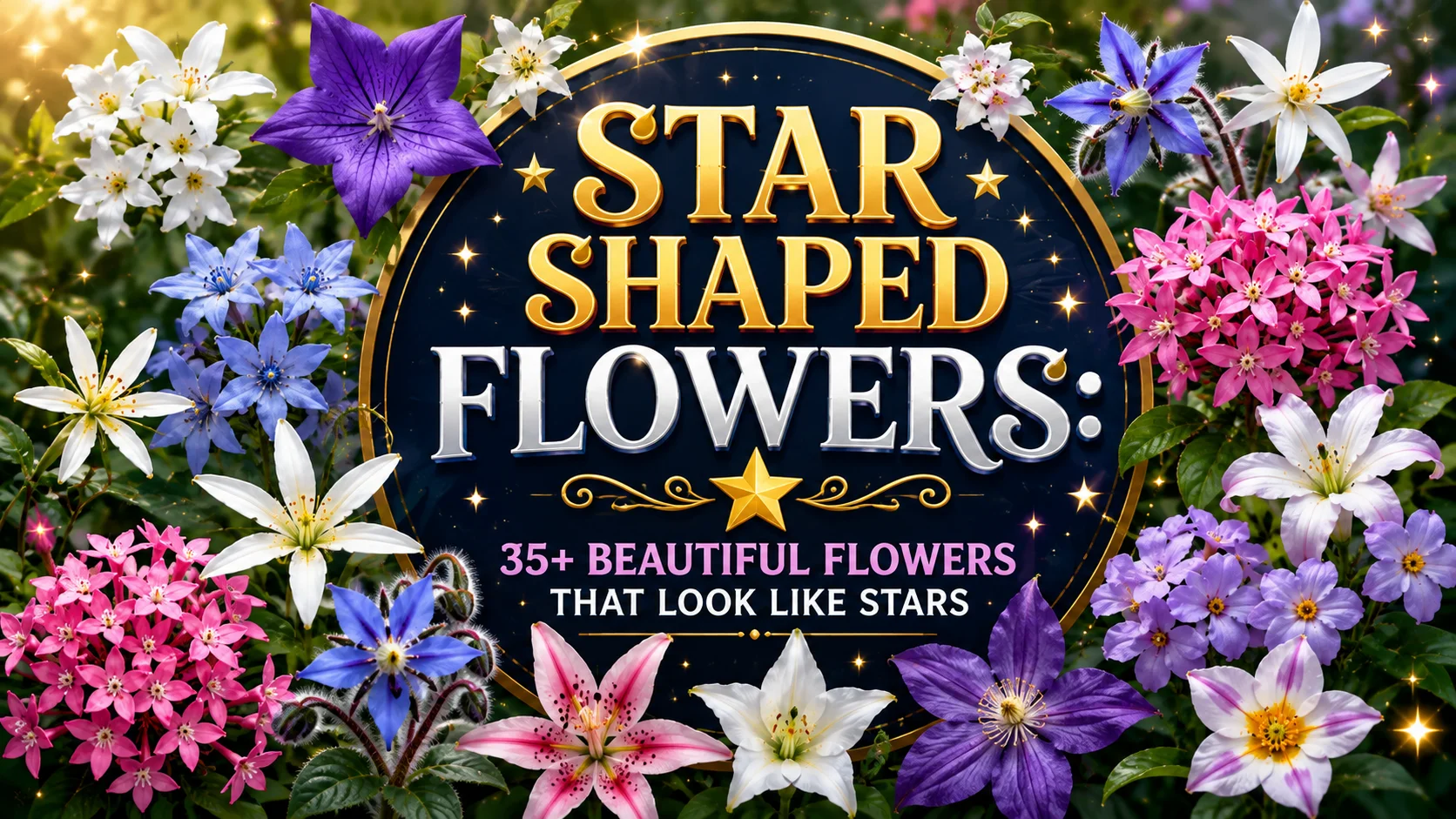
Star shaped flowers are among the most eye-catching blooms in gardens, bouquets, wildflower displays, and indoor plant collections. Their petals naturally spread outward in a pointed or symmetrical pattern, creating the appearance of a tiny star.
If you’re searching for star-shaped flowers, flowers that look like stars, flowers with star-shaped petals, star flowers, white star flowers, pink star flowers, blue star flowers, yellow star flowers, or unusual star-shaped blooms, you’ll find plenty of beautiful choices. Some are small and delicate, while others produce clusters of star-like flowers that make a dramatic display.
Popular examples include Star Jasmine, Star of Bethlehem, Starflower, Pentas, Tweedia, Trachelospermum, and Isotoma. Depending on the species, these flowers can grow as vines, perennials, annuals, bulbs, shrubs, or ground covers.
Let’s explore some of the most beautiful flowers shaped like stars, along with their colors, growing habits, meanings, and care requirements.
🌟 What Are Star Shaped Flowers?
Star shaped flowers have petals or flower lobes that radiate outward from the center, creating a shape that resembles a five-pointed or multi-pointed star. The exact form varies from one plant to another.
Some flowers have sharply pointed petals, while others have rounded tips that still create a star-like outline. You can find this shape in many different plant families, so star-shaped flowers are not limited to one botanical group.
They can appear in several colors, including:
- White star flowers
- Pink star flowers
- Blue star flowers
- Purple star flowers
- Yellow star flowers
- Red star flowers
- Greenish star flowers
- Cream-colored star flowers
Many species also attract bees, butterflies, hummingbirds, and other pollinators, making them useful additions to wildlife-friendly gardens.
🌼 Star Jasmine
Star Jasmine (Trachelospermum jasminoides) is one of the most recognizable plants with star-shaped white flowers. Despite its common name, it isn’t a true jasmine.
The plant grows as a vigorous evergreen vine and produces clusters of small, fragrant white flowers. Its flowers have narrow petals that create a distinct star-like appearance.
Key features:
- Flower color: White
- Shape: Five-pointed star
- Growth habit: Climbing vine
- Fragrance: Sweet and noticeable
- Blooming: Usually spring to summer, depending on climate
- Best use: Trellises, fences, walls, containers
Star Jasmine is particularly attractive when allowed to climb over a structure, where its dark green foliage contrasts beautifully with the white blooms.
⭐ Star of Bethlehem Flower
The Star of Bethlehem (Ornithogalum species) gets its common name from its bright, star-like flowers.
The flowers typically have six pointed petals and often appear white with a green stripe on the underside. They emerge from bulbs and can form attractive clusters.
Growing characteristics include:
- White star-shaped flowers
- Bulb-forming growth
- Narrow green leaves
- Spring flowering in many climates
- Excellent for naturalized planting
- Suitable for garden beds and borders
The name also gives this flower a strong religious and symbolic association, particularly with the biblical Star of Bethlehem.
💙 Starflower
Starflower is a common name used for several plants, but Borago officinalis, commonly known as borage, is one of the best-known examples.
Borage produces beautiful blue flowers with five pointed petals. The flowers have a distinctive star-like shape and often attract bees.
Starflower characteristics:
- Blue or blue-purple flowers
- Five pointed petals
- Herbaceous annual or short-lived perennial
- Attractive to pollinators
- Edible flowers are traditionally used as a garnish
- Easy to grow in suitable conditions
Its brilliant blue color makes it particularly popular among gardeners looking for blue star-shaped flowers.
🌸 Pentas
Pentas produce clusters of small, five-petaled flowers that can look like tiny stars.
They are available in several colors, including:
- Pink
- Red
- White
- Lavender
- Purple
Because individual flowers appear in dense clusters, pentas can create a colorful starry effect across the plant.
Pentas are also valued as pollinator-friendly flowers, attracting butterflies and other beneficial garden visitors.
💜 Tweedia
Tweedia (Oxypetalum caeruleum) is a beautiful plant known for its unusual sky-blue, star-shaped flowers.
Its soft blue blooms make it one of the most attractive choices for people searching specifically for blue star flowers.
The flowers generally have five petals and appear against silvery-green foliage.
Tweedia is popular for:
- Cottage gardens
- Containers
- Cut flower arrangements
- Blue-themed gardens
- Floral photography
- Pollinator gardens
Its unusual color makes Tweedia especially appealing to gardeners who want something different from traditional white or pink flowers.
🌿 Isotoma
Isotoma plants produce delicate, star-shaped flowers in shades of blue, purple, lavender, pink, or white, depending on the species and cultivar.
The flowers usually have five narrow, pointed lobes that give them a distinctly star-like appearance.
Isotoma can work well in:
- Rock gardens
- Containers
- Hanging baskets
- Garden borders
- Cottage-style landscapes
Its airy appearance makes it a good choice when you want small star-shaped flowers rather than large, dramatic blooms.
🌺 Star-Shaped Flowers by Color
One of the easiest ways to choose a star-shaped flower is to start with your favorite color.
White Star Shaped Flowers
- Star Jasmine
- Star of Bethlehem
- Starflower varieties
- White Pentas
- White Isotoma
- White Trachelospermum
- Star-shaped jasmine relatives
- White Ornithogalum
White star flowers can create a clean, elegant appearance and work particularly well in moon gardens.
Blue Star Shaped Flowers
- Borage
- Tweedia
- Blue Isotoma
- Blue Pentas
- Amsonia
- Blue starflower varieties
- Blue woodland star
- Some gentian species
Blue blooms are especially striking because naturally blue flowers are relatively uncommon.
Pink Star Shaped Flowers
- Pink Pentas
- Pink Isotoma
- Pink starflower varieties
- Pink Dianthus relatives
- Some flowering succulents
- Pink ornamental milkweed varieties
Pink star-shaped blooms work well in romantic and cottage gardens.
Purple Star Shaped Flowers
- Purple Isotoma
- Purple Pentas
- Some starflower species
- Certain gentians
- Purple ornamental flowering plants
Purple gives star-shaped flowers a more dramatic and mysterious appearance.
Yellow Star Shaped Flowers
Several yellow flowers have pointed petals or star-like arrangements, including certain Sedum, Hypoxis, and other small flowering plants.
Yellow star-shaped blooms can brighten rock gardens, borders, and naturalized planting areas.
🌱 Small Star Shaped Flowers
If you’re searching for small flowers that look like stars, consider these options:
- Star Jasmine
- Starflower
- Borage
- Pentas
- Isotoma
- Star of Bethlehem
- Amsonia
- Sedum varieties
- Hypoxis
- Gentian varieties
- Ornithogalum
- Trientalis
Small star flowers work especially well when planted in groups. Instead of relying on one large bloom, many of these plants create a starry carpet or cluster of tiny flowers.
🌿 Star Shaped Flowers for Gardens
Some star-shaped flowers are particularly useful in landscape gardening.
Good choices include:
- Star Jasmine — excellent for walls and trellises
- Pentas — useful for colorful borders and containers
- Borage — attractive to bees
- Tweedia — excellent for blue-themed gardens
- Isotoma — useful in containers and borders
- Star of Bethlehem — suitable for bulb gardens
- Amsonia — attractive foliage and star-like flowers
- Sedum — useful for rock gardens and drought-tolerant landscapes
Before planting, check whether a particular species suits your local climate, soil, sunlight, and moisture conditions.
🪴 Star Shaped Flowers for Containers
If you don’t have a large garden, several star-shaped flowering plants can grow successfully in containers under suitable conditions.
Good possibilities include:
- Pentas
- Isotoma
- Tweedia
- Star Jasmine
- Borage
- Certain Sedum species
- Compact starflower varieties
Use a container with good drainage and choose a potting mix appropriate for the plant. Place the container where the species receives its preferred amount of sunlight.
🦋 Star Shaped Flowers That Attract Pollinators
Many star-shaped flowers can support pollinators by providing nectar or pollen.
Popular choices include:
- Borage
- Pentas
- Tweedia
- Amsonia
- Star Jasmine
- Isotoma
- Gentian
- Sedum
Borage and Pentas are particularly well known for attracting pollinating insects.
When creating a pollinator garden, combine several flower shapes and blooming periods rather than relying on a single species.
🌸 Star Shaped Flowers and Their Meanings
Flowers that resemble stars often create symbolic associations with hope, guidance, dreams, wonder, purity, and inspiration.
| Flower | Common Symbolic Association |
|---|---|
| Star Jasmine | Love, attachment, elegance |
| Star of Bethlehem | Hope, faith, guidance |
| Borage | Courage and confidence |
| Tweedia | Love, tranquility, uniqueness |
| Pentas | Warmth, affection, harmony |
| Amsonia | Calmness and beauty |
| Isotoma | Delicacy and charm |
Flower meanings can vary across cultures and traditions, so these associations are best viewed as symbolic interpretations rather than fixed definitions.
🌟 Flowers That Look Like Stars
If you’re searching specifically for flowers that look like stars, these are excellent examples to explore:
- Star Jasmine
- Star of Bethlehem
- Borage
- Tweedia
- Pentas
- Isotoma
- Amsonia
- Sedum
- Hypoxis
- Gentian
- Trientalis
- Ornithogalum
- Starflower
- Blue starflower
- Shooting star flower
- Star magnolia
- Star-shaped clematis varieties
- Star-shaped succulent flowers
- Star-shaped milkweed flowers
- Star-shaped wildflowers
Some have a literal five- or six-pointed appearance, while others create a star-like outline when viewed from above.
🌺 Unusual Star Shaped Flowers
If you want something less common than roses, lilies, or daisies, consider these unusual options:
- Tweedia
- Isotoma
- Amsonia
- Trientalis
- Hypoxis
- Ornithogalum
- Borage
- Gentian
- Star of Bethlehem
- Star Jasmine
- Star magnolia
- Shooting star
- Certain Stapelia species
- Star-shaped succulent flowers
- Starflower varieties
These plants can add something distinctive to a collection, especially when you want unusual botanical flowers with recognizable shapes.
🌿 How to Grow Star Shaped Flowers
The best growing conditions depend on the species, but these general steps can help.
1. Choose the Right Flower
Start by considering your USDA hardiness zone, sunlight, soil type, and available space.
2. Provide Suitable Light
Many flowering plants prefer several hours of sunlight, while some woodland species prefer partial shade.
3. Prepare Well-Drained Soil
Most flowering plants perform better when the soil drains well. Heavy, constantly wet soil can create problems for many species.
4. Water According to the Plant
Don’t assume every star-shaped flower needs the same amount of water. Check the specific plant’s requirements.
5. Feed When Appropriate
Some flowering plants benefit from fertilizer during active growth. Avoid excessive feeding, especially when a plant naturally prefers poorer soil.
6. Remove Spent Flowers
Deadheading can improve the appearance of many ornamental plants and may encourage additional flowering.
7. Watch for Pests
Check leaves and flowers regularly for common garden pests such as aphids, spider mites, or caterpillars.
8. Give Vining Plants Support
Plants such as Star Jasmine grow vertically and benefit from a trellis, fence, arbor, or other support structure.
❓ FAQs About Star Shaped Flowers
What is the most popular star-shaped flower?
Star Jasmine is one of the best-known plants with distinctly star-shaped flowers. Star of Bethlehem and borage are also popular examples.
What flower looks like a five-pointed star?
Several flowers have five pointed petals or lobes, including borage, Tweedia, Pentas, Isotoma, and Star Jasmine.
What are white star-shaped flowers?
Star Jasmine and Star of Bethlehem are two well-known examples. Both produce white blooms with a recognizable star-like appearance.
What are blue star-shaped flowers?
Borage, Tweedia, and blue Isotoma are excellent examples of blue flowers with star-like forms.
What is a flower called Starflower?
Starflower is a common name used for multiple plants. Borage (Borago officinalis) is one of the best-known plants associated with the name.
What is the Star of Bethlehem flower?
Star of Bethlehem commonly refers to plants in the genus Ornithogalum. They produce star-shaped flowers, often white, and grow from bulbs.
Are star-shaped flowers good for pollinators?
Many are. Borage, Pentas, Tweedia, Amsonia, and other flowering species can provide resources for bees, butterflies, and other pollinators.
Can star-shaped flowers grow in pots?
Yes. Pentas, Isotoma, Tweedia, Borage, and some Sedum varieties can be grown in containers when their light, soil, drainage, and watering needs are met.
What are the easiest star-shaped flowers to grow?
The answer depends on your climate, but Pentas, Borage, Star Jasmine, and some Sedum varieties can be relatively approachable choices when grown under suitable conditions.
What do star-shaped flowers symbolize?
Because of their appearance, star-shaped blooms are often associated with hope, guidance, dreams, inspiration, wonder, and beauty. Specific meanings vary by flower and culture.
Conclusion
Star shaped flowers bring a unique geometric beauty to gardens, bouquets, containers, and natural landscapes. From fragrant Star Jasmine and symbolic Star of Bethlehem to vivid blue Tweedia and pollinator-friendly Borage, there are many varieties to explore.
When choosing one, consider more than appearance. Think about the flower’s color, mature size, sunlight requirements, soil preferences, climate, fragrance, bloom season, and pollinator value. A plant that looks beautiful but doesn’t suit your growing conditions may struggle.
Whether you’re searching for white star flowers, blue star-shaped blooms, small star flowers, unusual flowers that look like stars, or star-shaped flowers for your garden, these plants offer plenty of possibilities.
With the right selection and care, a collection of star-like blooms can turn an ordinary garden into something that feels almost magical. 🌟🌸

Ethan Carter is a nature enthusiast and content writer with a passion for flowers and botanical knowledge. He is the author behind FlowerNamez, where he shares simple and informative content about flower names, types, and meanings.
With a focus on clarity and accuracy, Ethan aims to help readers explore the beauty of flowers and understand their significance in everyday life.