
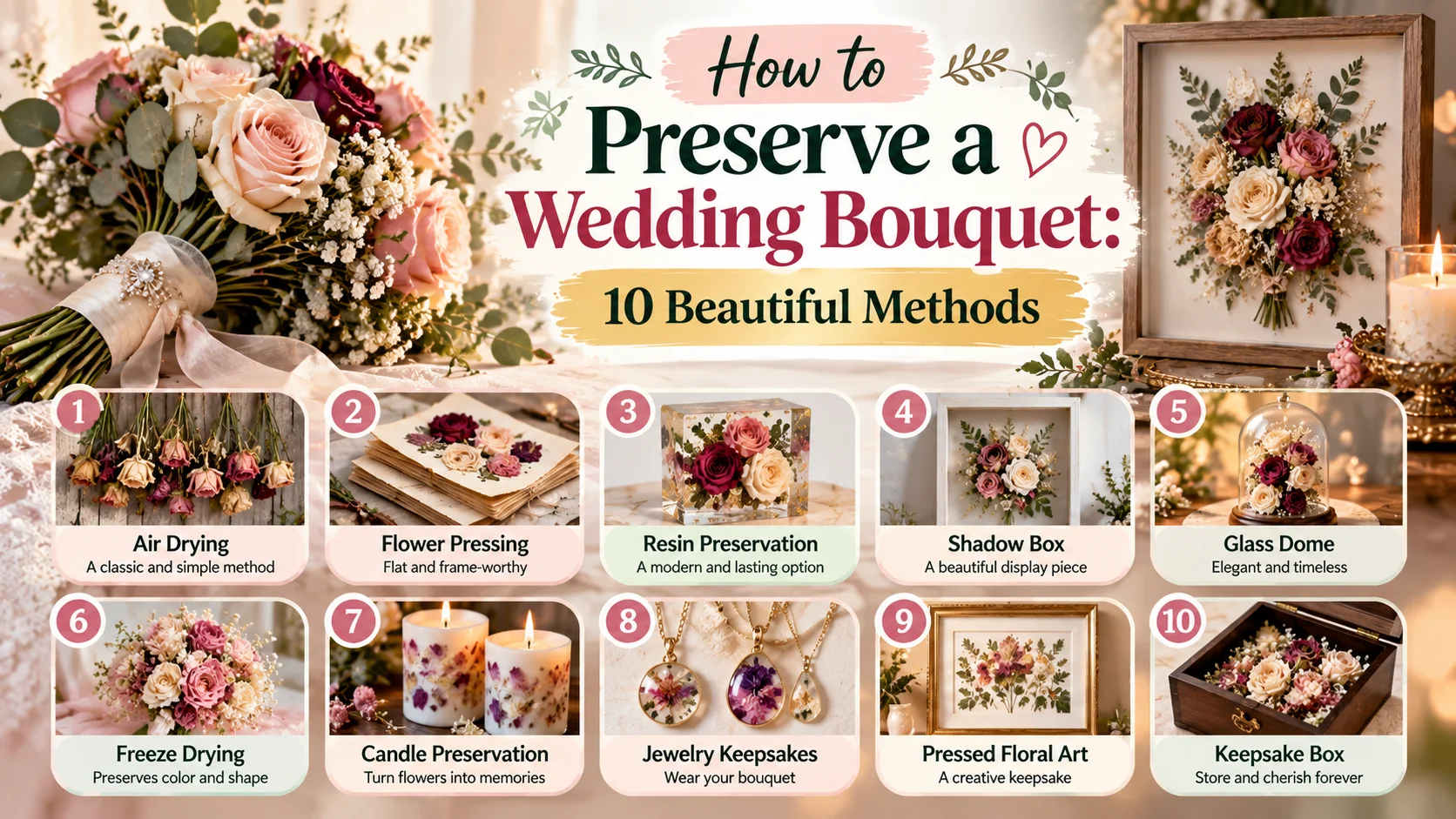
Learning how to preserve a wedding bouquet can turn a meaningful collection of flowers into a lasting keepsake. Wedding flowers often carry memories of the ceremony, the people who shared the day, and the emotions surrounding one of life’s biggest celebrations. Fortunately, there are several ways to preserve a bridal bouquet, from simple air-drying and pressing to silica gel drying, resin preservation, shadow boxes, and professional flower preservation. The best method depends on the flower types, desired appearance, available time, and whether the goal is to keep the bouquet looking natural or create a decorative keepsake.
🌸 Why Preserve a Wedding Bouquet?
A wedding bouquet can hold sentimental value long after the celebration ends. Preserving wedding flowers allows couples to keep part of their wedding day in a physical form rather than letting the flowers naturally deteriorate.
A preserved bridal bouquet can become wall art, a framed display, a shadow box, or a small keepsake. Preserving flowers quickly after the wedding can also improve the chances of maintaining their shape, color, and texture.
⏰ When Should You Preserve a Wedding Bouquet?
The best time to begin wedding bouquet preservation is as soon as reasonably possible after the wedding. Fresh flowers continue losing moisture after being cut, and delays can lead to wilting, browning, or petal damage.
Ideally, prepare the bouquet for preservation within the first few days. Keep it somewhere cool and dry while deciding which preservation technique to use, and avoid leaving it in a warm car, direct sunlight, or a humid room.
🌿 How to Prepare a Wedding Bouquet for Preservation
Before choosing a preservation technique, carefully inspect the flowers and remove damaged leaves or petals. Preparation is an important part of preserving a bridal bouquet at home because dirt, excess moisture, and damaged plant material can affect the final result.
Gently remove decorative elements that could interfere with drying, such as ribbons or water tubes, while keeping sentimental accessories separately if they are important to the final display.
Basic preparation steps:
- Remove the bouquet from water.
- Gently dry excess surface moisture.
- Remove damaged petals.
- Check stems for broken areas.
- Separate especially delicate flowers if necessary.
- Keep flowers away from direct sunlight.
- Decide whether the whole bouquet or individual flowers will be preserved.
- Photograph the original bouquet before taking it apart.
🌾 Method 1: Air-Dry the Wedding Bouquet
Air-drying is one of the simplest and most affordable ways to preserve a wedding bouquet naturally. It requires minimal equipment and works particularly well with flowers that naturally retain their shape after drying.
The finished flowers will have a dried, rustic appearance rather than looking exactly like fresh blooms. This method is especially attractive for vintage, farmhouse, boho, and natural wedding décor.
How to air-dry a bouquet:
- Remove excess foliage and damaged petals.
- Divide the bouquet into smaller sections if it is very large.
- Tie the stems together securely.
- Hang the flowers upside down.
- Choose a dark, dry, well-ventilated location.
- Keep the bouquet away from direct sunlight.
- Allow the flowers to dry completely.
- Handle the dried petals carefully because they can become fragile.
Drying time varies according to flower type, humidity, and bouquet size, but many flowers require several weeks to dry thoroughly.
📖 Method 2: Press Wedding Flowers
Pressing is a beautiful option for couples who want pressed wedding flowers rather than a three-dimensional bouquet. Flat flowers can be displayed in frames, wedding albums, journals, cards, or botanical artwork.
This method works particularly well for individual petals and flatter flowers. Large, dense blooms may not retain their natural three-dimensional form when pressed.
Simple flower-pressing process:
- Select flowers that are relatively fresh.
- Separate individual blooms if necessary.
- Place flowers between absorbent paper.
- Put the paper inside a heavy book or flower press.
- Add weight evenly.
- Leave the flowers undisturbed while they dry.
- Replace damp paper when necessary.
- Handle the finished flowers carefully.
Pressed wedding flowers can be arranged into a custom frame with the wedding date, names, invitation details, or a short message.
🧪 Method 3: Preserve Wedding Flowers With Silica Gel
Silica gel flower preservation is one of the popular home methods for maintaining the shape of individual flowers. Instead of simply hanging flowers and allowing them to shrink naturally, silica gel surrounds the blooms and draws out moisture.
This technique can work especially well for flowers where retaining the original three-dimensional shape is important. It is often used for roses, daisies, carnations, and other flowers that can tolerate careful handling.
How to preserve flowers with silica gel:
- Choose a clean, airtight container.
- Add a layer of flower-drying silica gel.
- Place the flowers carefully inside.
- Gently cover the blooms with more silica gel.
- Make sure the petals are supported.
- Seal the container.
- Allow the flowers to dry according to the product instructions.
- Remove the flowers carefully.
- Brush away remaining crystals gently.
- Display or store the dried flowers in a dry environment.
Silica gel can be reused depending on the product and its condition, making it useful for multiple flower-preservation projects.
🌹 Method 4: Dry Individual Wedding Flowers
Sometimes preserving the entire bouquet is unnecessary. Drying individual wedding flowers can make the process easier and provide more flexibility when creating a final keepsake.
A bride or couple can select the most meaningful flowers, such as the central rose, a favorite bloom, or flowers representing members of the wedding party. Individual dried flowers can later be arranged in a frame, shadow box, ornament, or small display.
This approach is particularly useful when the original bouquet is too large or delicate to preserve as one piece.
🖼️ Method 5: Create a Wedding Bouquet Shadow Box
A wedding bouquet shadow box combines dried flowers with other wedding-day keepsakes. Instead of preserving only the flowers, the display can tell a larger story about the celebration.
Possible items include:
- Dried bouquet flowers
- Wedding invitation
- Wedding date
- Couple’s names
- Ribbon from the bouquet
- Boutonniere
- Ceremony program
- Small photographs
- Table card
- Lace
- Jewelry
- Handwritten notes
- Fabric from wedding attire
Arrange the items carefully before permanently securing them. A shadow box can become a beautiful piece of wall décor that preserves multiple wedding memories in one place.
🧴 Method 6: Preserve Wedding Flowers in Resin
Resin preservation can turn dried flowers into decorative objects such as paperweights, trays, coasters, ornaments, jewelry, or display blocks. Wedding bouquet resin preservation is particularly popular when a couple wants a modern keepsake rather than a traditional framed bouquet.
Flowers must generally be thoroughly dried before being placed in resin. Moisture trapped inside a flower can affect the finished piece, so proper drying is an important preparation step.
Because resin involves chemical products and requires careful handling, follow the manufacturer’s safety instructions, use suitable protective equipment, and work in an appropriately ventilated area.
🕯️ Method 7: Turn Wedding Flowers Into Decorative Keepsakes
Preserved flowers can become more than a bouquet displayed in a vase. Dried wedding blooms can be incorporated into creative keepsakes that fit the couple’s home décor.
Ideas include:
- Framed botanical art
- Resin coasters
- Decorative ornaments
- Paperweights
- Jewelry
- Greeting cards
- Bookmarks
- Christmas ornaments
- Small glass displays
- Memory boxes
- Dried-flower wreaths
- Decorative trays
- Botanical wall art
These options allow the original flowers to become part of everyday décor rather than remaining stored away.
🌺 Method 8: Preserve Wedding Flowers With Glycerin
Glycerin preservation is another technique sometimes used with plant material. The process replaces some of the moisture within plant tissues and can help certain foliage maintain a flexible appearance.
This method is generally more suitable for particular leaves and foliage than for every type of flower. Results vary depending on the plant material, so testing a small piece first can be useful.
For a bridal bouquet preservation project, glycerin may be more appropriate for greenery than delicate petals.
❄️ Method 9: Freeze-Dry a Wedding Bouquet
Freeze-drying is a specialized preservation method designed to remove moisture while helping flowers retain their original shape and appearance. It can produce a result that looks much closer to the original bouquet than conventional air-drying.
Because freeze-drying requires specialized equipment and controlled conditions, it is usually handled by professional flower-preservation companies rather than performed at home.
For couples who want to preserve a wedding bouquet professionally, freeze-drying can be worth considering when maintaining the original appearance is a high priority.
👩🎨 Method 10: Hire a Professional Wedding Flower Preserver
Professional preservation is an option when the bouquet is highly sentimental, expensive, unusually delicate, or difficult to preserve at home. Specialists may offer techniques such as freeze-drying, resin work, pressing, framing, or custom shadow-box designs.
Before choosing a service, ask how the flowers will be treated, what final appearance can realistically be expected, how long the process takes, and what happens if individual flowers do not survive the preservation process.
Professional preservation can also be useful when the bouquet includes several different flower varieties that require different handling.
🌹 Which Wedding Bouquet Preservation Method Is Best?
There is no single method that works perfectly for every bouquet. The best wedding bouquet preservation method depends on the flower type, desired appearance, budget, available equipment, and importance of maintaining the original shape.
| Preservation Method | Best For | Typical Appearance |
|---|---|---|
| Air drying | Rustic bouquets | Dried and natural |
| Pressing | Flat flowers | Two-dimensional |
| Silica gel | Individual blooms | More three-dimensional |
| Resin | Decorative keepsakes | Encased |
| Shadow box | Complete displays | Framed |
| Glycerin | Foliage | Flexible |
| Freeze-drying | High-value bouquets | Closest to fresh |
| Professional preservation | Complex bouquets | Custom |
🌸 How to Preserve Roses From a Wedding Bouquet
Roses are among the most commonly preserved wedding flowers, but their dense petals can make drying technique important. Preserving wedding roses can involve air-drying, silica gel, pressing individual petals, or professional freeze-drying.
For a traditional dried appearance, hanging roses upside down can work well. For better shape retention, silica gel or professional preservation may be preferable.
🌿 How to Preserve Greenery From a Bridal Bouquet
Greenery can be just as meaningful as flowers, especially when a bouquet includes eucalyptus, ferns, ivy, olive branches, or other foliage. Some greenery dries beautifully and can add texture to a preserved bouquet.
Preserving bridal bouquet greenery can involve air-drying or other plant-preservation techniques depending on the specific foliage. Keep dried greenery away from excessive humidity and direct sunlight to help reduce deterioration.
🎨 How to Keep Preserved Wedding Flowers Looking Beautiful
Once flowers have been preserved, their environment can influence how long they remain attractive. Direct sunlight can cause fading, while humidity can encourage deterioration in improperly dried plant material.
For long-term preserved wedding flower care, display the flowers somewhere relatively dry and away from strong sunlight. A glass frame or enclosed display can provide additional protection from dust and accidental damage.
⚠️ Common Wedding Bouquet Preservation Mistakes
Preserving flowers requires patience because rushing the drying process can damage petals or trap moisture. Some of the most common mistakes happen before preservation even begins.
Avoid:
- Waiting too long after the wedding
- Leaving flowers in direct sunlight
- Storing wet flowers in sealed containers
- Handling fragile dried petals roughly
- Using incompletely dried flowers in resin
- Ignoring humidity
- Overpacking dried flowers
- Spraying unsuitable products directly onto petals
- Mixing wet and dry flowers together
- Expecting every flower variety to preserve identically
💐 How to Preserve a Wedding Bouquet Before the Big Day
Bouquet preservation is easier when planned before the wedding. Talk with the florist about which flowers are being used and whether particular blooms are known to preserve well.
It can also help to have a preservation plan ready before the ceremony. Decide whether the goal is a complete bouquet, selected flowers, pressed petals, a shadow box, or professional preservation. Having a plan reduces the chance of flowers sitting unattended for too long after the celebration.
🥀 Can You Preserve a Wilted Wedding Bouquet?
A slightly wilted bouquet may still be salvageable, but the sooner preservation begins, the better. Flowers that are heavily browned, moldy, or structurally damaged may not preserve successfully.
If the bouquet has sentimental importance and its condition has already declined, a professional preservation specialist may be able to recommend the most appropriate approach.
🎀 Wedding Bouquet Preservation Ideas Without Resin
Not everyone wants a resin keepsake. There are many attractive ways to preserve wedding flowers without resin, including pressing, air-drying, shadow boxes, glass frames, dried-flower arrangements, and professional freeze-drying.
A framed arrangement can preserve the original flowers while keeping the display lightweight and easy to hang. Pressed flowers can create an especially elegant minimalist piece.
💍 What to Do With a Preserved Wedding Bouquet
Once the bouquet has been dried or professionally preserved, there are many ways to display it. A preserved arrangement can become part of a home’s décor or remain a private keepsake.
Consider:
- Framing the flowers
- Displaying them in a glass case
- Creating a shadow box
- Adding the wedding invitation
- Incorporating the flowers into artwork
- Making a resin keepsake
- Creating a dried-flower wreath
- Preserving individual petals
- Placing flowers in a memory box
- Giving a small preserved flower to a family member
❓ FAQs About Preserving a Wedding Bouquet
How soon should a wedding bouquet be preserved?
It is best to begin preparing the bouquet as soon as possible after the wedding. Fresh flowers gradually lose moisture and may wilt, brown, or become damaged, so early preparation generally gives better preservation results.
What is the easiest way to preserve a wedding bouquet?
Air-drying is one of the simplest home methods because it requires minimal equipment. The bouquet can be hung upside down in a dry, dark, well-ventilated area until completely dry.
What is the best way to preserve a wedding bouquet?
The best method depends on the flowers and desired result. Air-drying is simple, pressing works for flat displays, silica gel can preserve individual flower shapes, and professional freeze-drying can provide a more lifelike result.
Can I preserve my wedding bouquet myself?
Yes. Air-drying, pressing, and silica gel drying are commonly used DIY approaches. More specialized techniques, such as freeze-drying, generally require professional equipment.
How long does a preserved wedding bouquet last?
A properly dried and carefully stored bouquet can last for years. However, preserved flowers remain delicate and can gradually fade or deteriorate when exposed to sunlight, humidity, dust, or frequent handling.
Can roses be preserved in a wedding bouquet?
Yes. Roses can be air-dried, dried with silica gel, pressed as individual petals, or professionally preserved. The method chosen will affect the final shape and appearance.
Can a wedding bouquet be preserved in resin?
Yes, but flowers should be thoroughly dried before being placed in resin. Resin preservation can create attractive decorative keepsakes, but it requires careful preparation and appropriate safety precautions.
How do I preserve a wedding bouquet without drying it?
Professional freeze-drying is one option for maintaining a more lifelike appearance. A specialist can assess the flowers and determine whether freeze-drying or another professional technique is appropriate.
Is it better to preserve the whole bouquet or individual flowers?
Either option can work. Preserving individual flowers gives more flexibility for framing and keepsakes, while preserving the entire bouquet maintains the original arrangement and overall appearance.
💐 Conclusion
Learning how to preserve a wedding bouquet gives couples a way to keep part of their wedding day long after the fresh flowers have faded. Air-drying is simple and affordable, pressing creates elegant two-dimensional artwork, silica gel can help maintain individual flower shapes, and resin can transform dried blooms into decorative keepsakes. For bouquets that are especially valuable or delicate, professional preservation and freeze-drying offer additional possibilities. The most important step is to begin caring for the bouquet soon after the wedding and choose a method suited to its flowers. With thoughtful handling and proper storage, a bridal bouquet can become a beautiful reminder of a meaningful celebration for years to come. 💍🌸

Ethan Carter is a nature enthusiast and content writer with a passion for flowers and botanical knowledge. He is the author behind FlowerNamez, where he shares simple and informative content about flower names, types, and meanings.
With a focus on clarity and accuracy, Ethan aims to help readers explore the beauty of flowers and understand their significance in everyday life.